This article was automatically translated from the original Turkish version.
+2 More
Location | Çankırı Street Türkiye Ankara Ulus | ||||||||
|---|---|---|---|---|---|---|---|---|---|
Period(s) | Rome AD 212–217 (Caracalla) | ||||||||
Excavations | 1937–1943, 2007–2011 | ||||||||
Exhibited Works | Grave Steles, Inscriptions, Architectural Elements | ||||||||
Area(s) | 65 000 m² | ||||||||
Visit | Open 7 Days a Week | ||||||||
The Roman Baths Archaeological Site is an important archaeological area located on Çankırı Street in the Ulus district of Ankara, Türkiye. Situated on a plateau approximately 2.5 meters high, the site holds historical and archaeological significance as a large bath complex built by the Roman Emperor Caracalla (212–217 CE) in honor of the god of health, Asclepius. Layers of settlement from the Phrygian, Roman, Byzantine, Seljuk, and Ottoman periods have been identified beneath the structure.

Roman Baths Archaeological Site (Türkiye Culture Portal)
The baths were constructed in the third century CE and measure approximately 80 by 130 meters. The structure, built of stone and brick, consists of two main sections: the palaestra, a space for sports and physical training, and the enclosed bath section. Surrounding the palaestra is a colonnaded portico with numerous inscribed columns. Water was supplied to the baths via stone blocks transported from Elmadağ, about 40 kilometers away. During the Roman Empire, the complex served as one of Ankara’s largest bathhouses.
The first excavations were carried out in 1937 by Professor Dr. Remzi Oğuz Arık. Between 1939 and 1943, further excavations fully uncovered the bath structure. Excavations conducted between 2007 and 2011 revealed the architectural layout of a colonnaded street and associated shops located in the northeast of the palaestra. Large-scale statues of a Roman emperor were also discovered during these excavations.

Roman Baths Archaeological Site (Anadolu Agency)
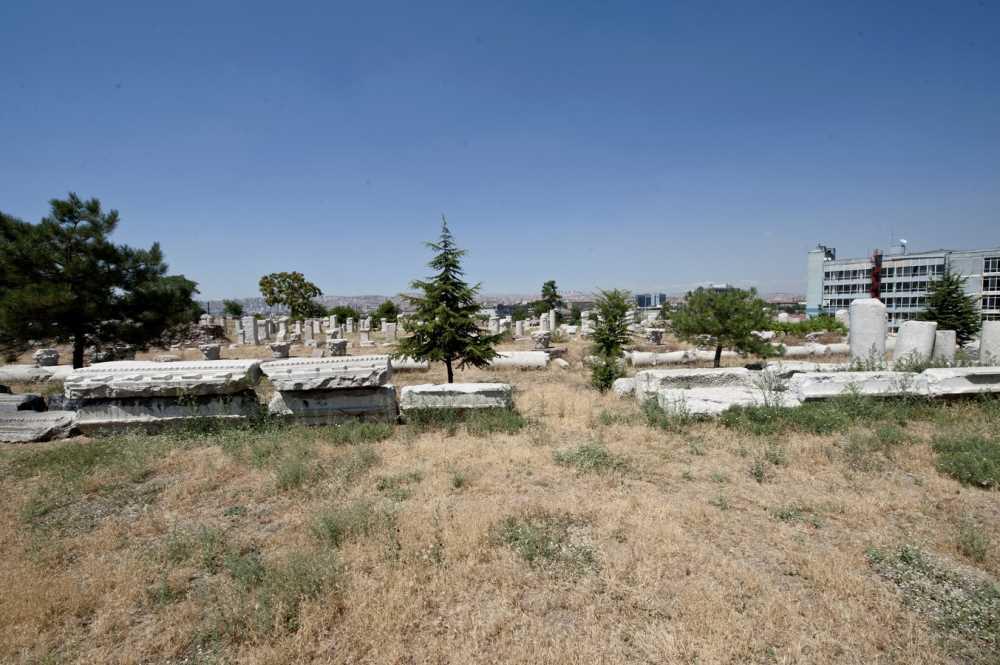
The Roman Baths Archaeological Site was developed into an open-air museum through restoration work carried out between 1997 and 2001. On an area of approximately 65,000 square meters, around one thousand funerary stelae, inscriptions, and architectural fragments dating primarily to the Roman and Byzantine periods are displayed. Funerary stelae are located along the south and west wings of the sports area; inscribed blocks, pedestals, and water spouts are found in the north wing; altars and architectural pieces are displayed in the east wing; and sarcophagi and lion statues occupy the central area. The inscribed epitaphs provide information on the social and cultural activities of retired soldiers in Roman-era Ankara.

Roman Baths Archaeological Site (Anadolu Agency)
The Roman Baths Archaeological Site is protected under the auspices of the Museum of Anatolian Civilizations. The site is open to visitors seven days a week, and ongoing restoration and landscape improvement works are conducted. Various conservation measures are implemented to safeguard the structure and its exhibited artifacts.
Anadolu Ajansı. “Başkent’in Açık Hava Müzesi: Roma Hamamı.” Accessed June 25, 2025. https://www.aa.com.tr/tr/kultur-sanat/baskentin-acik-hava-muzesi-roma-hamami/1238800.
Türkiye Cumhuriyeti Kültür ve Turizm Bakanlığı. “Roma Hamamı.” Accessed June 25, 2025. https://muze.gov.tr/muze-detay?SectionId=ROM01&DistId=MRK.
Türkiye Kültür Portalı. “Roma Hamamı Açık Hava Müzesi ve Ören Yeri.” T.C. Kültür ve Turizm Bakanlığı. Accessed June 25, 2025. https://www.kulturportali.gov.tr/turkiye/ankara/gezilecekyer/roma-hamami-acik-hava-muzes-ve-oren-yer.

Location | Çankırı Street Türkiye Ankara Ulus | ||||||||
|---|---|---|---|---|---|---|---|---|---|
Period(s) | Rome AD 212–217 (Caracalla) | ||||||||
Excavations | 1937–1943, 2007–2011 | ||||||||
Exhibited Works | Grave Steles, Inscriptions, Architectural Elements | ||||||||
Area(s) | 65 000 m² | ||||||||
Visit | Open 7 Days a Week | ||||||||
History and Architecture
Excavations and Archaeological Finds
The Site and Exhibited Artifacts
Conservation and Visitation