

This article was automatically translated from the original Turkish version.
+1 More
Year of Discovery(ies) | 1864 | ||||||||
|---|---|---|---|---|---|---|---|---|---|
Origin(s) | Easter Island (Rapa Nui) | ||||||||
Material(s) | Wooden tablets and ceremonial objects. staffs | ||||||||
Content | Creation deities, astronomical records, sacrifice lists, and genealogies. | ||||||||
Writing Technique | Reverse boustrophedon. The tablet is rotated 180 degrees at the end of each line. | ||||||||
Rongorongo (Kohau Rongorongo) is a writing system originating from Rapa Nui (Easter Island) that has not yet been fully deciphered. It is the only known writing system in Oceania that predates European contact. Contrary to assumptions that the system emerged after European contact in 1770, the absence of any depictions of European objects such as ships or hats in the glyphs supports the view that the script was invented prior to contact.【1】It was discovered in 1864 by the missionary Eyraud. The corpus surviving to the present day, consisting of approximately two dozen objects, includes wooden tablets, a staff, two reimiro (chest ornaments), a bird-man figure, and a fish box. The known texts contain a total of approximately 12,000 to 14,000 glyphs.【2】
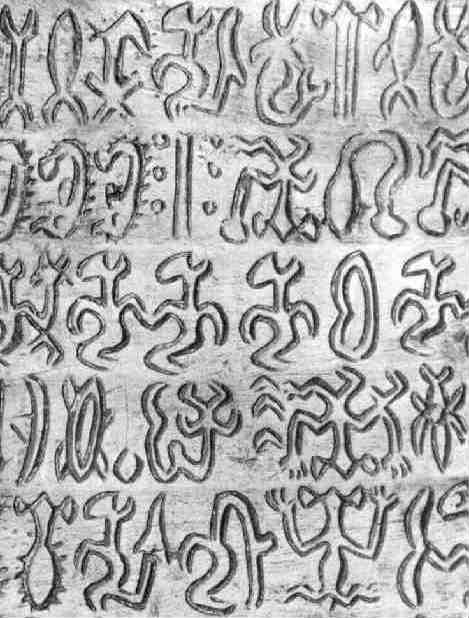
The signs of the writing system were incised into wooden surfaces using obsidian flakes or shark teeth. The texts were written using an original method known as "reverse boustrophedon," in which successive lines run in opposite directions. During reading, the reader must rotate the tablet at the end of each line. Due to the scarcity of wood on the island, scribes filled every centimeter of the material with signs without leaving spaces between words. Some artifacts, such as the Mamari tablet, have an oval and sloping shape, while other tablets are more rectangular.【3】

Rongorongo Script (picryl)
The total number of signs in the system varies according to analytical standards. Thomas Barthel created a catalog of 603 filled positions, Boris Kudrjavtzev identified 427 signs across two tablets, and Igor and Konstantin Pozdniakov determined that only 52 distinct signs constitute 99.7 percent of the entire corpus. Rongorongo has a logosyllabic structure, incorporating logographic signs (word signs), syllabic signs, and phonetic complements. Signs can be used independently or combined and modified to form complex ligatures. The use of "allographs" — visually distinct signs with identical readings — is widespread in the system. In addition, various graphic variants of individual signs, preserving their core outlines, are freely distributed throughout the texts.【4】
The content of Rongorongo texts has been examined through various disciplinary lenses. Cosmogonic readings suggest that the texts contain creation myths structured in triadic patterns of the form "X Y Zn," with each initial glyph accompanied by a phallic suffix. Another analytical framework proposes that the system is not a phonetic record of language but rather a specialized graphic notation system used by Polynesian peoples to store knowledge of the night sky, stars, constellations, and navigational information.【5】
The texts also contain records of sacrificial rituals and lists of victims (kohau îka). In these lists, individuals who were killed or sacrificed are represented by the "ika" (fish) glyph (/700/), which exhibits polysemic properties. Genealogical records and dynastic texts include references to the gods Tangaroa and Rongo, ancestors of Hotu-Matua, the island’s local chief, and the leaders of the western tribes (Hanau Momoko).
Astronomical events are recorded with specific notations in the texts. The appearance of Halley’s Comet in the skies over Easter Island in 1682 was recorded using the term "Paupau" combined with a staff-like glyph. Similarly, the total solar eclipse that occurred on the island on 16 September 1773 during the morning hours is reflected in the texts through the expression "Mata mi" (Dead Face).【6】
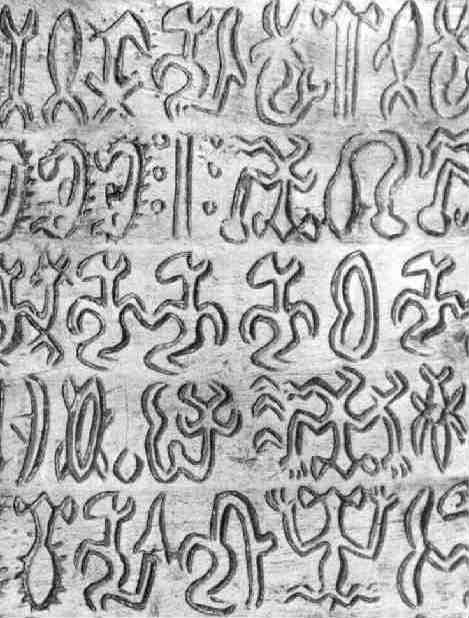
Rongorongo Script (getarchive.net)
The rules of the Rongorongo system were transmitted in specialized schools such as Te Hare-titaha located at Ahu Akapu and Anakena. Strict discipline was enforced; students knelt with arms folded and memorized ancient texts. During the initial stages of writing instruction, students copied glyphs onto banana leaves using bird bones or sharpened sticks. Once they attained sufficient expertise, students progressed to carving on wooden tablets made of toromiro wood. The teaching assistants in these schools held the title "te pahu" (scribe). Specific texts such as "He timo te akoako" were memorized as foundational educational material and used for writing practice. The goal of instruction was to ensure the accurate sequential carving of signs and the transmission across generations of the technique of rotating the tablet at each line turn.【7】
Davletshin, Albert. "Allographs, Graphic Variants and Iconic Formulae in the Kohau Rongorongo Script of Rapa Nui (Easter Island)." *The Journal of the Polynesian Society* 126, no. 1 (2017): 61–92. Accessed April 13, 2026. https://www.jstor.org/stable/26451651?seq=2
Esen-Baur, Heide-Margaret. "Towards an Understanding of Rongorongo." *Anthropos* 106, no. 2 (2011): 439-461. Accessed April 13, 2026. https://www.jstor.org/stable/23031624?searchText=Rongorongo+script
Harris, Martyn, and Tomi S. Melka. "The Rongorongo Script: On a Listed Sequence in the Recto of Tablet 'Mamari'." *Journal of Quantitative Linguistics* 18, no. 2 (2011): 122–173. Accessed April 13, 2026. https://www.tandfonline.com/doi/full/10.1080/09296174.2011.556003?scroll=top&needAccess=true#abstract
Horley, Paul. "Allographic Variations and Statistical Analysis of the Rongorongo Script." *Rapa Nui Journal* 19, no. 2 (2005). Accessed April 13, 2026. https://evols.library.manoa.hawaii.edu/items/af73d1dc-60df-4143-ab68-770a56d81d82
Rjabchikov, Sergei V. "The rongorongo Schools on Easter Island." *Anthropos* 107, no. 2 (2012): 564-570. Accessed April 13, 2026. https://www.jstor.org/stable/23510060?if_data=e30%3D&seq=1
Rjabchikov, Sergei V. *The Rongorongo Script: Ten Papers*. Krasnodar: The Sergei Rjabchikov Foundation - Research Centre for Studies of Ancient Civilisations and Cultures, 2019. Accessed April 13, 2026. https://www.researchgate.net/profile/Sergei-Rjabchikov/publication/359342057_The_Rongorongo_Script_Ten_Papers/links/6235f9efbe72d414daccc768/The-Rongorongo-Script-Ten-Papers.pdf
“Rongo-Rongo Script.” Garystockbridge617. GetArchive. Accessed April 14, 2026. https://garystockbridge617.getarchive.net/amp/media/rongo-rongo-script-4d5e77
“Rongorongo-Gr2-6.” Drussano35. GetArchive. Accessed April 14, 2026. https://drussano35.getarchive.net/media/rongorongo-gr2-6-88ac09
“Rongorongo-I-Santiago-Staff-Color.” Picryl. Accessed April 14, 2026. https://picryl.com/media/rongorongo-i-santiago-staff-color-61c4d1
[1]
Albert Davletshin, "Allographs, Graphic Variants and Iconic Formulae in the Kohau Rongorongo Script of Rapa Nui (Easter Island)," The Journal of the Polynesian Society 126, no. 1 (2017): 2, Access 13 April 2026.https://www.jstor.org/stable/26451651?seq=2
[2]
Heide-Margaret Esen-Baur, "Towards an Understanding of Rongorongo," Anthropos 106, no. 2 (2011): 2, Access 13 April 2026.https://www.jstor.org/stable/23031624?searchText=Rongorongo+script
Paul Horley, "Allographic Variations and Statistical Analysis of the Rongorongo Script," Rapa Nui Journal 19, no. 2 (2005), 1. Access 13 April 2026.https://evols.library.manoa.hawaii.edu/items/af73d1dc-60df-4143-ab68-770a56d81d82
Martyn Harris ve Tomi S. Melka, "The Rongorongo Script: On a Listed Sequence in the Recto of Tablet 'Mamari'," Journal of Quantitative Linguistics 18, no. 2 (2011): 4, Access 13 April 2026.https://www.tandfonline.com/doi/full/10.1080/09296174.2011.556003?scroll=top&needAccess=true#abstract
[3]
Paul Horley, "Allographic Variations and Statistical Analysis of the Rongorongo Script," Rapa Nui Journal 19, no. 2 (2005), 1. Access 13 April 2026.https://evols.library.manoa.hawaii.edu/items/af73d1dc-60df-4143-ab68-770a56d81d82
Sergei V. Rjabchikov, "The rongorongo Schools on Easter Island," Anthropos 107, no. 2 (2012): 2, Access 13 April 2026.https://www.jstor.org/stable/23510060?if_data=e30%3D&seq=1
Martyn Harris ve Tomi S. Melka, "The Rongorongo Script: On a Listed Sequence in the Recto of Tablet 'Mamari'," Journal of Quantitative Linguistics 18, no. 2 (2011): 6,7. Access 13 April 2026.https://www.tandfonline.com/doi/full/10.1080/09296174.2011.556003?scroll=top&needAccess=true#abstract
[4]
Albert Davletshin, "Allographs, Graphic Variants and Iconic Formulae in the Kohau Rongorongo Script of Rapa Nui (Easter Island)," The Journal of the Polynesian Society 126, no. 1 (2017): 1,2,7,28. Access 13 April 2026.https://www.jstor.org/stable/26451651?seq=2
Paul Horley, "Allographic Variations and Statistical Analysis of the Rongorongo Script," Rapa Nui Journal 19, no. 2 (2005), 1,5. Access 13 April 2026.https://evols.library.manoa.hawaii.edu/items/af73d1dc-60df-4143-ab68-770a56d81d82
Heide-Margaret Esen-Baur, "Towards an Understanding of Rongorongo," Anthropos 106, no. 2 (2011): 3, Access 13 April 2026.https://www.jstor.org/stable/23031624?searchText=Rongorongo+script
[5]
Albert Davletshin, "Allographs, Graphic Variants and Iconic Formulae in the Kohau Rongorongo Script of Rapa Nui (Easter Island)," The Journal of the Polynesian Society 126, no. 1 (2017): 26, Access 13 April 2026.https://www.jstor.org/stable/26451651?seq=2
Heide-Margaret Esen-Baur, "Towards an Understanding of Rongorongo," Anthropos 106, no. 2 (2011): 2, Access 13 April 2026.https://www.jstor.org/stable/23031624?searchText=Rongorongo+script
[6]
Sergei V. Rjabchikov, "The rongorongo Schools on Easter Island," Anthropos 107, no. 2 (2012): 2, Access 13 April 2026.https://www.jstor.org/stable/23510060?if_data=e30%3D&seq=1
Paul Horley, "Allographic Variations and Statistical Analysis of the Rongorongo Script," Rapa Nui Journal 19, no. 2 (2005), 5. Access 13 April 2026.https://evols.library.manoa.hawaii.edu/items/af73d1dc-60df-4143-ab68-770a56d81d82
Sergei V. Rjabchikov, The Rongorongo Script: Ten Papers (Krasnodar: The Sergei Rjabchikov Foundation - Research Centre for Studies of Ancient Civilisations and Cultures, 2019), 3,8,9,21. Access 13 April 2026.https://www.researchgate.net/profile/Sergei-Rjabchikov/publication/359342057_The_Rongorongo_Script_Ten_Papers/links/6235f9efbe72d414daccc768/The-Rongorongo-Script-Ten-Papers.pdf
[7]
Sergei V. Rjabchikov, "The rongorongo Schools on Easter Island," Anthropos 107, no. 2 (2012): 2,3. Access 13 April 2026.https://www.jstor.org/stable/23510060?if_data=e30%3D&seq=1


Year of Discovery(ies) | 1864 | ||||||||
|---|---|---|---|---|---|---|---|---|---|
Origin(s) | Easter Island (Rapa Nui) | ||||||||
Material(s) | Wooden tablets and ceremonial objects. staffs | ||||||||
Content | Creation deities, astronomical records, sacrifice lists, and genealogies. | ||||||||
Writing Technique | Reverse boustrophedon. The tablet is rotated 180 degrees at the end of each line. | ||||||||
Physical Characteristics and Writing Techniques
Sign Inventory and Graphic Structure
Content of the Texts and Interpretive Theories
Educational Institutions and Transmission Process