


This article was automatically translated from the original Turkish version.
RSS (Really Simple Syndication) is a web feed technology that enables the automated delivery of updated content published on the internet to users through standardized data structures. RSS is an acronym derived from Real Simple Syndication, RDF Site Summary, or Rich Site Summary.
It is used to distribute newly published content from news websites, blogs, online magazines, podcast broadcasts, and other digital content platforms. RSS allows users to access updated content without needing to visit individual websites continuously. The system uses XML (Extensible Markup Language) as its data format for structuring and transmitting information.
RSS has played a significant role in the content distribution infrastructure of the internet. Its adoption expanded notably during the Web 2.0 era with the rise of user-generated content. The proliferation of blogging systems, decentralized distribution of news feeds, and the aggregation of information from multiple sources into a single interface have broadened the applications of RSS technology.
Podcast publishing relies on RSS as its fundamental data transmission mechanism. The publication, updating, and automatic delivery of podcast episodes to various platforms are all accomplished through RSS feeds.
The RSS system operates via “feeds” — files created by content providers and updated at regular intervals. These feed files contain various metadata such as content titles, URLs, publication dates, descriptions, author information, and media links. RSS readers or feed aggregators periodically check these files and present new content to users.
The first version of RSS, RSS 0.90, was developed by Ramanathan V. Guha at Netscape. The system was designed to allow users to access content streams via the “My Netscape” portal. The initial version used a data structure based on RDF (Resource Description Framework), which enabled semantic relationships between data elements. However, the structural complexity made implementation difficult.
As a result, the subsequent RSS 0.91 version removed the RDF structure in favor of a simpler XML-based format. This change simplified the application development process.
During the evolution of RSS, the RSS-DEV working group developed version 1.0. Aaron Swartz was among the contributors to this group. RSS 1.0 reintroduced the RDF-based approach. This version was not only an content summarization system but also became a component of Semantic Web technologies.
RSS 1.0 aimed to establish more advanced data relationships between content items. However, due to its relatively complex technical structure, its adoption remained limited.
The next phase of RSS development was led by Dave Winer. Version 2.0 was released in 2002. This version adopted the phrase “Really Simple Syndication” and introduced a simpler data structure.
The “Enclosure” tag was introduced in RSS 2.0, enabling audio, video, and other media files to be attached to RSS feeds. The Enclosure tag became one of the key technical components in the emergence of podcast technology. Podcast clients use RSS feeds to automatically download and deliver new media files to users.
Due to structural inconsistencies and standardization issues among RSS versions, an alternative web feed standard called Atom was developed. Atom uses an XML-based structure and aims to reduce incompatibilities among various RSS versions. The Atom standard offers more detailed data definition features and has been supported by a wide range of web services.
RSS operates on the principle of embedding metadata about published content into XML-based feed files.
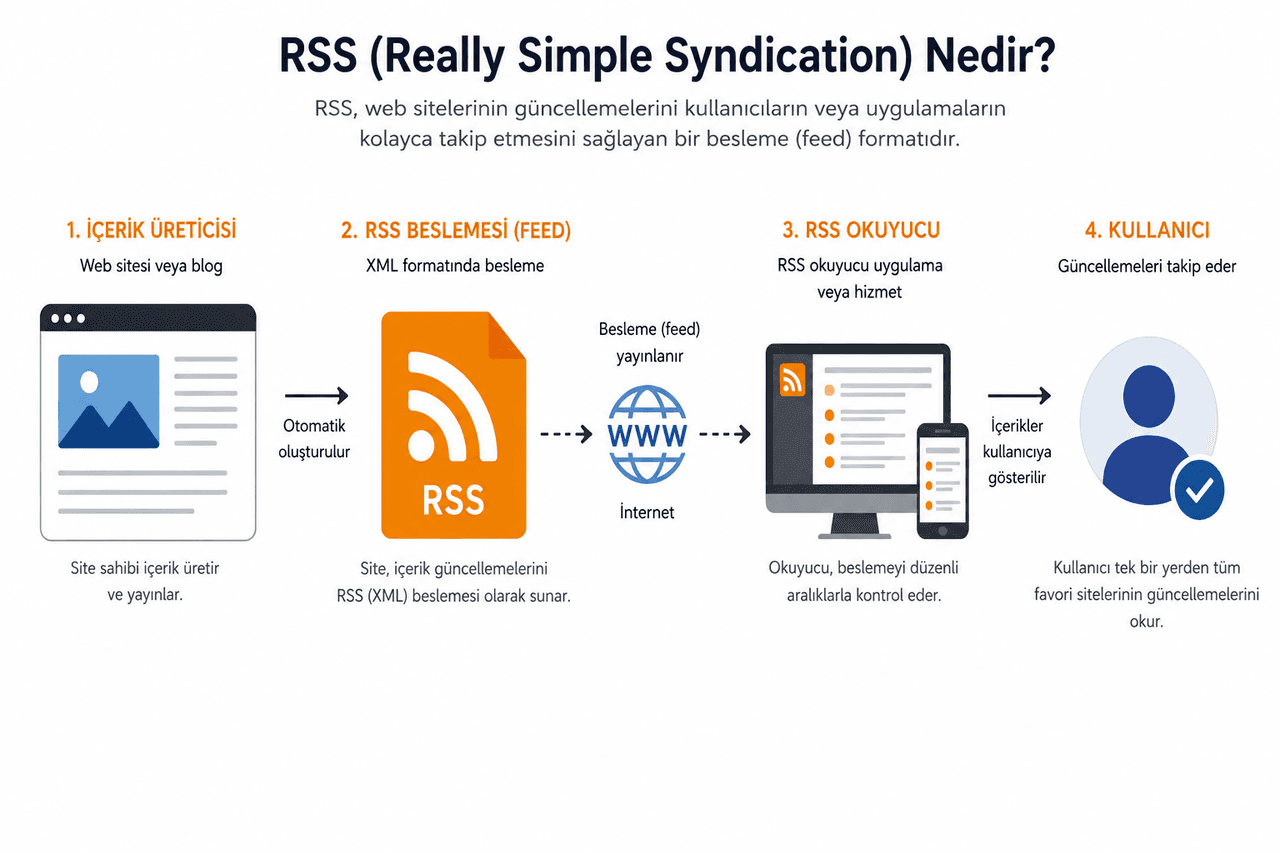
RSS (Generated by AI)
When a web server publishes new content, it creates or updates an XML file containing metadata such as the title, URL, publication date, description, and other relevant information. This file constitutes the RSS feed.
The user adds the relevant RSS link to an RSS reader or feed aggregation software. This establishes a connection between the client software and the content source.
The RSS reader periodically checks the XML file on the server. It identifies new content by examining publication dates, GUID (Globally Unique Identifier), or update information.
When new content is detected, the XML data is parsed and converted into a format suitable for the user interface. Titles, descriptions, links, and media elements are presented to the user in a readable form.
The rise of social media platforms, algorithmic content systems, and mobile applications has relatively reduced the usage of RSS. Nevertheless, RSS technology continues to be used. News tracking systems, podcast applications, academic publication trackers, content management systems, software development platforms, and personal information collection systems still rely on RSS technology.

No Discussion Added Yet
Start discussion for "RSS (Really Simple Syndication)" article
The Development and History of RSS
Netscape Era (RSS 0.90) – 1999
RSS-DEV Working Group and RSS 1.0
Dave Winer and RSS 2.0
The Emergence of the Atom Standard
How RSS Works
1. Creation of the XML Feed File
2. Subscription Process
3. Polling Process
4. Data Parsing and Presentation
Current Use of RSS