


This article was automatically translated from the original Turkish version.
+1 More
Rubber
Name(s) | Rubber | ||||||||
|---|---|---|---|---|---|---|---|---|---|
Definition(s) | An elastomeric material obtained from the milky sap (latex) of tropical plants or through synthetic methods. | ||||||||
Type(s) | Natural Rubber (NR) etc.) IIR EPDM NBR BR Synthetic Rubber (SBR | ||||||||
Chemical Formula | Basic formula for natural rubber: (C₅H₈)ₙ (composed of isoprene units) | ||||||||
Source | Natural: Hevea brasiliensis tree; Synthetic: Petroleum and alcohol derivatives | ||||||||
Historical Origin | Aztec and Inca civilizations; introduced to Europe at the end of the 15th century | ||||||||
Applications | Automotive, Healthcare, Construction, White goods, Sports equipment, Insulation systems | ||||||||
Advantage(s) | Elasticity Impact resistance Electrical insulation Impermeability | ||||||||
Disadvantages | UV and oxidation sensitivity, Chemical degradation, Heat sensitivity | ||||||||
Production Process | Collection → Coagulation → Rolling → Drying → Pressing | ||||||||
Recycling Methods | Granulation, Devulcanization, Energy recovery | ||||||||
Environmental Impacts | Deforestation, Chemical waste, Microplastic hazard | ||||||||
Top Producing Countries | Thailand, Indonesia, Malaysia, India, China | ||||||||
Economic Lifespan (Wood) | ~30 years (7 years maturation + 23 years production) | ||||||||
Rubber is a type of elastomer obtained naturally from the milky sap (latex) of certain tropical plants or synthetically through the polymerization of petroleum- and alcohol-derived compounds. Elastomers are materials with high elasticity that return to their original shape when applied forces are removed. Due to this property, rubber is widely used in applications where flexibility is critical.

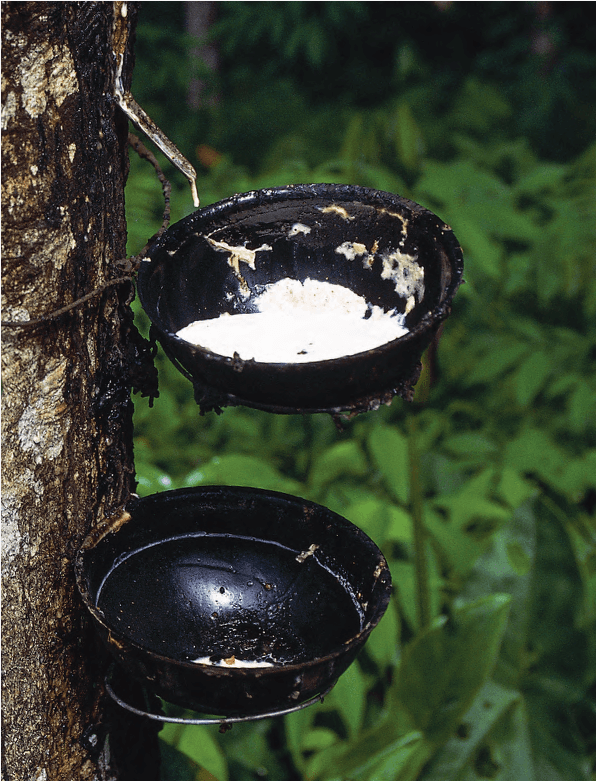
Image of Natural Rubber Latex (scienceandtechnology)
Rubber-based materials offer various physical, chemical and mechanical advantages:
Natural rubber (NR) is typically produced by processing latex obtained from the Hevea brasiliensis tree. Synthetic rubbers are manufactured through the chemical polymerization of various monomers, primarily ethylene, propylene, butadiene and styrene.
Despite their versatile properties, rubber materials have certain limitations. These disadvantages are key factors that determine their applications and processing conditions:
Therefore, selecting the appropriate type of rubber for a given application and developing specialized formulations based on usage conditions is essential.
The earliest known uses of rubber date back to Mesoamerican and South American civilizations. The Aztecs and Maya used rubber in shoe soles and objects employed in religious ceremonies. In 1493, during Christopher Columbus’s second voyage to the Americas, it was observed that indigenous people played games with objects made from a tree they called “cau-uchu.” The word “caoutchouc” derives from the Quechua language and means “weeping tree.”
In the 18th century, Charles Marie de la Condamine and François Fresneau were among the pioneers who introduced rubber to Europe. Fresneau’s 1751 article is considered one of the first scientific texts written on rubber.
In 1839, Charles Goodyear’s development of vulcanization—the process of treating rubber with sulfur—marked a turning point in the industrial adoption of rubber. Vulcanization enhanced rubber’s mechanical strength and heat resistance while preserving its elasticity. By the end of the 19th century, European powers, particularly Britain, established rubber plantations in their colonies to expand natural rubber production.
Natural rubber is derived from the latex sap of the Hevea brasiliensis tree, which grows in tropical climates. Latex is collected by making V-shaped incisions in the tree bark and allowing the sap to flow into containers. The collected liquid is coagulated using formic acid, then processed through rolling to remove excess water and dried into shape. These steps are as follows:
On average, 35 percent of the collected latex is rubber. When latex is treated with sulfur, it produces products known as rubber. Adding 12–20 percent sulfur results in elastic rubber, while sulfur content approaching 30 percent produces hard insulating materials.

Image of Latex Collection Process (scienceandtechnology)
Synthetic rubber was developed to reduce dependence on natural resources and to enhance environmental durability. In the early 20th century, particularly during wartime periods, countries such as Germany and the United States began producing synthetic rubber due to the unavailability of natural rubber. Common types of synthetic rubber include:
Synthetic rubbers are produced using specialized polymerization techniques and are formulated to have more stable physical and chemical properties than natural rubber.
Rubber serves a wide variety of functions across different sectors. This material is particularly favored in applications requiring flexibility, sealing and durability. Major application areas include:
This versatility stems from the ability to tailor rubber’s physical properties to suit specific processing requirements.

Use of Rubber Material in Tire and Glove Production (scienceandtechnology)
Rubber production, particularly through plantation activities in tropical regions, creates significant environmental pressures. Deforestation, loss of biodiversity and soil erosion are the primary environmental issues associated with natural rubber production. Synthetic rubber production, being based on fossil fuels, has a higher carbon footprint.
Therefore, recycling rubber waste is of great importance. Recycling methods include:
Recycling offers economic and environmental benefits by reducing raw material demand.
Rubber, with a history spanning thousands of years, has become one of the fundamental building blocks of modern industry through technological advancements. Used in numerous sectors in both natural and synthetic forms, it stands out as an indispensable engineering material due to its high elasticity, durability and chemical resistance. However, considering the environmental impact of its production process, developing and promoting rubber recycling technologies is essential for sustainable industrial policies.
Dal, Şerife Mine. "Kauçuk, Türleri, Özellikleri, Üretim Potansiyelleri, Kullanım Alanları, Atık Kauçuk Geri Kazanımı ve İşlenme Sistemlerinin Araştırması." Master's thesis,Mersin Üniversitesi, 2015. Accessed May 30, 2025.
Vahapoğlu, Vahap. "Kauçuk Türü Malzemeler I. Doğal Kauçuk." C.B.Ü. Fen Bilimleri Dergisi 3, no. 1 (2007): 57–70. Accessed May 30, 2025.
Vahapoğlu, Vahap. "Kauçuk Türü Malzemeler: Sınıflandırma." Mehmet Akif Ersoy Üniversitesi Fen Bilimleri Enstitüsü Dergisi 4, no. 1 (2013): 25–34. Accessed May 30, 2025.
İdin, Şahin. "Yaşamımızın Bir Parçası: Kauçuk." Bilim ve Teknik, February 2020, 76–81. TÜBİTAK. Accessed May 30, 2025.

Rubber
Name(s) | Rubber | ||||||||
|---|---|---|---|---|---|---|---|---|---|
Definition(s) | An elastomeric material obtained from the milky sap (latex) of tropical plants or through synthetic methods. | ||||||||
Type(s) | Natural Rubber (NR) etc.) IIR EPDM NBR BR Synthetic Rubber (SBR | ||||||||
Chemical Formula | Basic formula for natural rubber: (C₅H₈)ₙ (composed of isoprene units) | ||||||||
Source | Natural: Hevea brasiliensis tree; Synthetic: Petroleum and alcohol derivatives | ||||||||
Historical Origin | Aztec and Inca civilizations; introduced to Europe at the end of the 15th century | ||||||||
Applications | Automotive, Healthcare, Construction, White goods, Sports equipment, Insulation systems | ||||||||
Advantage(s) | Elasticity Impact resistance Electrical insulation Impermeability | ||||||||
Disadvantages | UV and oxidation sensitivity, Chemical degradation, Heat sensitivity | ||||||||
Production Process | Collection → Coagulation → Rolling → Drying → Pressing | ||||||||
Recycling Methods | Granulation, Devulcanization, Energy recovery | ||||||||
Environmental Impacts | Deforestation, Chemical waste, Microplastic hazard | ||||||||
Top Producing Countries | Thailand, Indonesia, Malaysia, India, China | ||||||||
Economic Lifespan (Wood) | ~30 years (7 years maturation + 23 years production) | ||||||||
Advantages
Disadvantages
Historical Development
Natural Rubber Production
Synthetic Rubber
Applications
Environmental Impact and Recycling