

This article was automatically translated from the original Turkish version.
+1 More
The Saab 35 Draken is a single-engine supersonic interceptor aircraft developed by Sweden. The aircraft was designed by the Swedish aerospace and defense company Saab AB for the Swedish Air Force’s air defense missions. Development work began in the early 1950s and the first prototype flight was conducted on 25 October 1955【1】.

Saab 35 Draken (Ian Abbott)
The Saab 35 Draken project was initiated in the early 1950s in response to the Swedish Air Force’s need for a new fighter aircraft capable of high-speed interception missions. Sweden’s air defense planning identified a requirement for an interception platform able to respond rapidly to high-altitude and high-speed bomber aircraft. Accordingly, the aircraft was designed to achieve supersonic speeds and to carry out radar-guided interception missions.
The task of developing the aircraft was assigned to the Swedish aerospace manufacturer Saab AB. During the design phase, various wing configurations were evaluated to meet supersonic flight requirements. Following aerodynamic research, it was decided to adopt a double-delta wing arrangement for the fuselage. This design aimed to provide the necessary aerodynamic characteristics for high-speed flight while simultaneously enhancing low-speed maneuverability.
The first prototype developed under the program, the Saab 210 research aircraft, was used to test the aerodynamic properties of the planned wing configuration. This experimental aircraft enabled flight testing of the double-delta wing design developed for the Draken program. The Saab 210 prototype made its first flight in 1952【2】.
The first Saab 35 aircraft, the main prototype of the Draken program, made its first flight on 25 October 1955. During the test program, improvements were made to the flight control systems, aerodynamic structure and avionics equipment. Following the completion of testing, production aircraft were developed and the Draken entered service with the Swedish Air Force in 1960.
The Saab 35 Draken was designed using an original aerodynamic configuration developed to meet supersonic flight requirements. The aircraft’s most distinctive design feature is its double-delta wing planform. In this design, the inner portion of the wing has a high sweep angle while the outer portion is configured with a lower sweep angle. This arrangement ensures aerodynamic efficiency at high speeds while improving controllability at low speeds.

Saab 35 Draken Technical drawing (generated by AI)
The fuselage structure was designed to withstand the aerodynamic forces generated during supersonic flight. Air intakes located within the fuselage were positioned to supply the necessary airflow to the engine. These intakes are situated on both sides of the fuselage and are configured to support engine performance at high speeds. This design represents one of the engineering solutions implemented to ensure stable airflow at supersonic velocities.
The Draken’s powerplant is the Volvo RM6 turbojet engine 【3】. This engine is a licensed Swedish-produced version of the British Rolls-Royce Avon. With an afterburner system, the engine provided sufficient thrust to enable the aircraft to reach supersonic speeds.
The cockpit was designed for a single pilot. The aircraft is equipped with a radar system, navigation equipment and avionics systems necessary for air defense missions. These systems were used to detect airborne targets and carry out interception tasks.
The landing gear consists of a three-wheel arrangement with a nose gear and two main gears designed to retract into the fuselage. The wing structure and landing gear configuration were developed to balance high-speed performance with operational requirements.

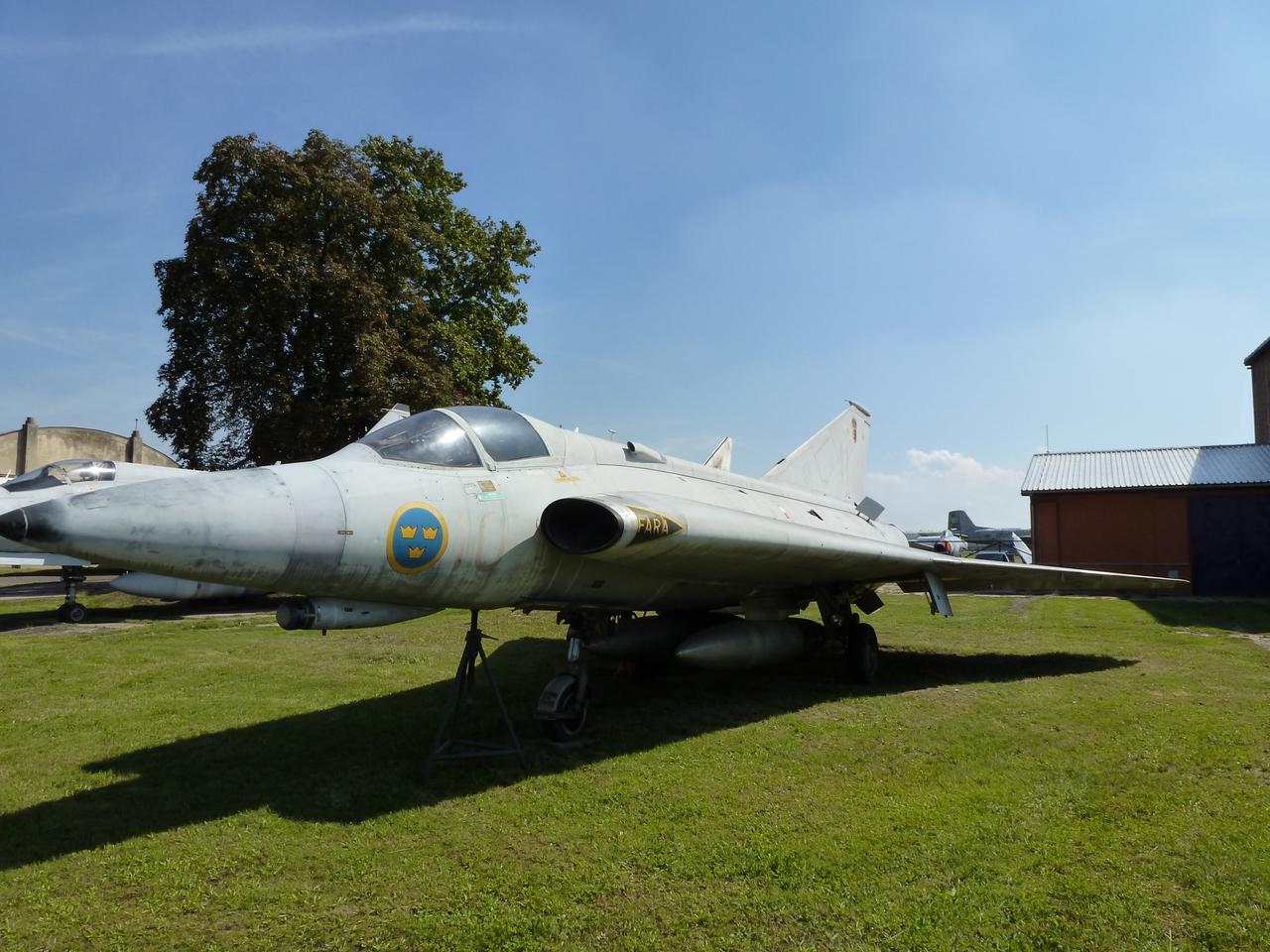
Saab 35 Draken (Miroslav Juhos)
Following the commencement of production aircraft deliveries, the Saab 35 Draken entered service with the Swedish Air Force in 1960. It was commissioned for interception and air defense missions; later variants were adapted for reconnaissance, training and, in certain export markets, attack roles.
In Sweden, the Draken family remained in service for many years across various squadrons. According to Saab’s 2005 corporate statement, different versions of the Draken were operated by the Swedish Air Force between 1960 and 1998.
Export variants expanded the Draken’s operational use beyond Sweden. The aircraft was also operated by Denmark, Finland and Austria. According to the Finnish Air Force Museum’s official information, series production Draken aircraft were delivered to the Swedish Air Force in early 1960 and subsequently entered the inventories of other users including Finland. In Denmark, the F-35, RF-35 and TF-35 variants were delivered beginning in 1970 and underwent modernization programs in subsequent years【4】.
The Draken’s service life varied by country. Saab’s corporate statement notes that as of 2005, the aircraft remained in active service in Austria. The same statement confirms that military service in Sweden ended in 1998. After withdrawal from Swedish service, some Draken aircraft were transferred to museum collections, while others were preserved for historical flight operations.
Operationally, the Draken was evaluated for different mission profiles according to the needs of its user nations. In Sweden, its primary role was air defense and interception, while in Denmark, variants adapted for reconnaissance and attack missions were also employed. This demonstrates that the Draken platform was operated in various subtypes to meet diverse mission requirements.
Saab 35 Draken (PaddyPatrone)
The Saab 35 Draken is a single-engine, single-pilot supersonic fighter aircraft. Its fuselage structure is based on a double-delta wing planform. This aerodynamic configuration was developed to ensure stable flight at high speeds and to manage aerodynamic effects encountered during supersonic flight. Production models of the Draken family were developed using similar basic dimensions and system architecture.
The aircraft’s length is approximately 15.35 meters, wingspan 9.42 meters and height approximately 3.89 meters.[2] The wing area is approximately 49.2 square meters. The Draken’s empty weight is approximately 7,800 kilograms, and its maximum takeoff weight reaches approximately 16,000 kilograms.
The aircraft’s powerplant is the Volvo RM6C turbojet engine, a licensed Swedish-produced version of the British Rolls-Royce Avon. With an afterburner system, this engine generates approximately 78 kN of thrust. The engine configuration is one of the key elements enabling the aircraft to achieve supersonic speeds【5】.
The Saab 35 Draken’s maximum speed is approximately Mach 2.0 (about 2,100 km/h). The aircraft’s operational ceiling is approximately 20,000 meters. Its range varies depending on mission load and fuel quantity but can reach approximately 3,000 kilometers.

Saab 35 Draken (Rob Schleiffert)
In terms of armament, the Draken was designed for air defense missions and is configured to carry air-to-air missile systems. The aircraft is also equipped with an internal 30 mm automatic cannon and can carry various types of ordnance on external hardpoints under the fuselage【6】.
The Saab 35 Draken was developed to meet the Swedish Air Force’s air defense requirements and was produced in various variants adapted for different mission types during the program’s duration. These variants shared the same basic airframe and engine structure but differed in avionics systems, radar equipment, armament and mission systems.
The first production model of the Draken family is the J 35A variant. This model was developed for interception missions and entered service with the Swedish Air Force in 1960. The J 35A was equipped with a radar system and air-to-air missile capability and served as one of Sweden’s early supersonic interceptor aircraft.
Later variants developed during the program, the J 35B and J 35D, emerged from improvements to radar and avionics systems. The J 35D model was produced as an upgraded version featuring a more powerful engine configuration and increased fuel capacity compared to earlier variants【7】.
The S 35E variant, developed for reconnaissance missions, was equipped with photographic reconnaissance cameras mounted internally within the fuselage. This variant was used by the Swedish Air Force for aerial photography and reconnaissance tasks.
The two-seat training variant, the SK 35C, was developed for training Draken pilots. This variant features front and rear cockpits and was used exclusively for flight instruction.
The final upgraded Swedish variant of the Draken platform is the J 35F model. This variant featured improved radar systems and enhanced air-to-air missile integration, incorporating modernized systems specifically for air defense missions.
Export variants were also developed. The F-35, RF-35 and TF-35 models produced for Denmark are attack and reconnaissance-adapted versions. Finland and Austria also adopted different Draken variants into their inventories.

Saab J 35B Draken (Johnny Comstedt)
The Saab 35 Draken program was one of the major military aircraft projects undertaken during the development of Sweden’s aerospace industry. During the aircraft’s design and production, extensive engineering work was conducted in areas such as aerodynamic research, radar and avionics system integration, and licensed engine manufacturing. These efforts contributed significantly to the advancement of Sweden’s military aviation research and production capabilities.
The double-delta wing planform applied during the Draken’s development was designed to meet supersonic flight requirements. This aerodynamic structure emerged as a result of engineering studies aimed at achieving stable flight at high speeds and analyzing control characteristics across different flight regimes.
The technical experience gained during the Draken program was later applied to the design processes of subsequent Swedish fighter aircraft. In this context, aerodynamic design, avionics integration and aircraft manufacturing knowledge derived from the Draken were utilized in the development of the Saab 37 Viggen and later the Saab JAS 39 Gripen programs.
After retiring from operational service, some Draken aircraft were preserved in aviation museums. Several of these aircraft are now on display in museum collections in Sweden and other user nations.
Abbott, Ian. “TF-35 Draken at MHV.” 28 April 2016. Flickr. Photo. Accessed March 6, 2026. https://www.flickr.com/photos/ian_e_abbott/27026789356/
Aéroplans. “Saab 35 Draken.” September 3, 2011. Flickr. Photo. Accessed March 6, 2026. https://www.flickr.com/photos/aeroplans/6350852511/.
Comstedt, Johnny. “Saab 1250 J 35B Draken 35248 in Kareby.” July 17, 2021. Flickr. Photo. Accessed March 6, 2026. https://www.flickr.com/photos/johnnyflight/51321323642/.
Estrella Warbird Museum. “SAAB RF-35 Draken.” Estrella Warbirds. Accessed March 6, 2026. https://www.ewarbirds.org/aircraft/rf35draken.shtml.
Global Aircraft Organization. “Saab 35 Draken.” Global Aircraft. Accessed March 6, 2026. http://globalaircraft.org/planes/saab_35_draken.pl.
GlobalSecurity.org. "Saab 35 Draken Specifications." GlobalSecurity.org. Accessed March 6, 2026. https://www.globalsecurity.org/military/world/europe/draken-specs.htm.
Juhos, Miroslav. “Saab 35 Draken.” 04 Ekim 2008. Flickr. Photo. Accessed March 6, 2026. https://www.flickr.com/photos/31177986@N02/3159628477/.
PaddyPatrone. “Saab 35 Draken.” YouTube. Accessed March 6, 2026. https://www.youtube.com/watch?si=WHviO5RIRupY0xz-&v=JaZtt0pf8FU&feature=youtu.be.
Pima Air & Space Museum. "SAAB RF-35." Pima Air & Space Museum. Accessed March 6, 2026. https://pimaair.org/museum-aircraft/saab-35-draken/.
Saab AB. “Draken – 50 Years in the Air.” Saab Newsroom. October 25, 2005. Accessed March 6, 2026. https://www.saab.com/newsroom/press-releases/2005/draken--50-years-in-the-air
Schleiffert, Rob. “Draken Denmark.” August 13, 2022. Flickr. Photo. Accessed March 6, 2026. https://www.flickr.com/photos/109661044@N07/52296191009/.
Schleiffert, Rob. “Draken.” 08 Eylül 2019. Flickr. Photo. Accessed March 6, 2026. https://www.flickr.com/photos/109661044@N07/48723361836/.
Swedish Air Force Historic Flight. “J35 & SK35 Draken.” SwAFHF. Accessed March 6, 2026. https://swafhf.com/startsida/j35-sk35-draken/.
[1]
Global Aircraft Organization. “Saab 35 Draken.” Global Aircraft. Access date: 6 March 2026. http://globalaircraft.org/planes/saab_35_draken.pl.
[2]
Global Aircraft Organization. “Saab 35 Draken.” Global Aircraft. Access date: 6 March 2026. http://globalaircraft.org/planes/saab_35_draken.pl.
[3]
GlobalSecurity.org, “Saab 35 Draken Specifications,” GlobalSecurity.org, access date: 6 March 2026, https://www.globalsecurity.org/military/world/europe/draken-specs.htm.
[4]
Saab AB. “Draken – 50 Years in the Air.” Saab Newsroom. 25 October 2005. Access date: 6 March 2026. https://www.saab.com/newsroom/press-releases/2005/draken--50-years-in-the-air.
[5]
Global Aircraft Organization. “Saab 35 Draken.” Global Aircraft. Access date: 6 March 2026. http://globalaircraft.org/planes/saab_35_draken.pl.
[6]
GlobalSecurity.org, “Saab 35 Draken Specifications,” GlobalSecurity.org, access date: 6 March 2026, https://www.globalsecurity.org/military/world/europe/draken-specs.htm.
[7]
Swedish Air Force Historic Flight. “J35 & SK35 Draken.” SwAFHF. Access date: 6 March 2026. https://swafhf.com/startsida/j35-sk35-draken/

Development Process
Design and Technical Structure
Operational Use
Technical Specifications
Variants
Industrial Legacy