


This article was automatically translated from the original Turkish version.
+2 More
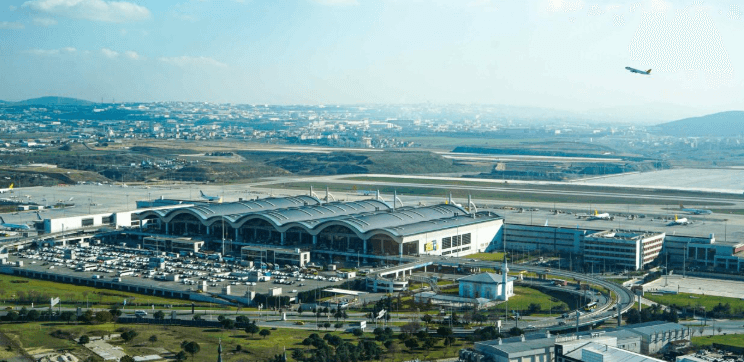
Sabiha Gökçen Airport
Location | Istanbul Türkiye | ||||||||
|---|---|---|---|---|---|---|---|---|---|
Opening Date(s) | 8 January 2001 | ||||||||
ICAO Code | LTFJ | ||||||||
IATA Code | SAW | ||||||||
Apron Capacity | Medium apron with capacity for 62 aircraft, cargo apron with capacity for 40 aircraft | ||||||||
Passenger Capacity | Annual 85 million passengers (targeted) | ||||||||
Geographic Coordinates | 40°53′42″N, 29°18′33″E | ||||||||
Sabiha Gökçen International Airport is one of the largest airports in Türkiye and Europe. The airport, which began operations on 8 January 2001, was constructed under the Advanced Technology Industry Park and Airfield Project (İTEP) managed by the Undersecretariat for Defense Industries (SSM).
In 2008, the operating rights of the airport were acquired by Malaysia Airports Holdings Berhad (MAHB). On 31 October 2009, a new international terminal building was commissioned, significantly increasing the airport’s annual passenger capacity.
Sabiha Gökçen Airport is located in the Pendik district of Istanbul, place and has geographic coordinates of 40°53′42″N 29°18′33″E. Situated on Istanbul’s Anatolian Side, the airport is approximately 45 km from the city center. Its direct connections to the TEM Motorway and D-100 Highway make access very convenient. Transport options include metro, bus, HAVAŞ services, and taxis. Direct access to the airport is provided by the M4 Kadıköy-Sabiha Gökçen metro line.
The airport offers passengers a comprehensive and comfortable service with 128 check-in counters, 74 passport control points, a 4,500 m² duty-free area, 9,594 m² of restaurant and café space, CIP and lounge services, a 400 m² conference hall, and a parking facility with capacity for 4,718 vehicles.
In addition, the airport features a multi-aircraft parking system capable of serving eight wide-body or sixteen medium-body aircraft simultaneously.
Sabiha Gökçen Airport has become one of Türkiye’s fastest-growing airports by continuously increasing its passenger capacity. The airport, which handled 47,000 passengers in 2001, has reached an annual capacity of 41.4 million passengers as of 2024.
There has been significant growth in both domestic and international passenger numbers, with the airport reaching a capacity of 37 million passengers in 2023 and expected to exceed 41 million in 2024.
To better manage increasing passenger traffic, Sabiha Gökçen Airport has constructed a 3,540-meter-long second runway. This runway, inaugurated on 25 December 2023 by President Recep Tayyip Erdoğan, is designed to raise the airport’s annual passenger capacity to 85 million.
The new runway’s key features include:
Sabiha Gökçen International Airport serves as a hub for Pegasus Airlines, Turkish Airlines (AnadoluJet), SunExpress, Emirates, Qatar Airways, Flydubai, like and many other major airlines. Regular flights operate to Europe, the Middle East, Asia, and Africa.
The airport is positioned as Türkiye’s third busiest airport by passenger traffic, after Istanbul Airport and Antalya Airport.
The New International Terminal was constructed under the Build-Operate-Transfer model and opened to service on 31 October 2009. The project included the following modernizations:
Sabiha Gökçen International Airport provides numerous services to enhance comfort and safety:
The airport is named after Sabiha Gökçen, who was born in Bursa in 1913. Adopted by Atatürk in 1925, Gökçen completed her education at Çankaya Primary School and Istanbul Üsküdar Girls’ College. In 1935, she joined the Turkish Aeronautical Association’s Turkish Bird Civil Aviation School and later completed advanced glider training in Crimea. In 1936, she entered the Eskişehir Military Aviation School, where she received flight training on fighter and bombardment aircraft, and earned her military flight badge in 1937. In 1938, she gained international recognition by participating in a Balkan tour. She served as “Chief Instructor” at the Turkish Aeronautical Association’s Türkkuşu until 1955. In 1996, she was selected as one of the “20 Aviators Who Made Their Mark in World History” and completed her final flight that same year.

Sabiha Gökçen, Pioneering Women of the Republic.
Based on this information, the airport derives its name from the world’s first female war pilot and Türkiye’s first female pilot, Sabiha Gökçen.
Sabiha Gökçen International Airport is one of the most important transportation hubs for both Istanbul and Türkiye. With its continuously expanding infrastructure, growing passenger capacity, and modern services, it holds a position of significant importance. With the commissioning of the new runway and future expansion projects, the airport aims to reach an annual capacity of 85 million passengers.
As one of Türkiye’s largest investments in aviation, Sabiha Gökçen International Airport is poised to become one of Europe’s largest airports due to its strategic location and technological infrastructure.
About Us. Accessed March 19, 2025. https://www.sabihagokcen.aero/kurumsal-bilgiler/sabiha-gokcen-havalimani/hakkimizda.
Havalimanı Trafik Raporu. Accessed March 19, 2025. https://www.sabihagokcen.aero/kurumsal-bilgiler/sabiha-gokcen-havalimani/havalimani-trafik-raporu.
New External Routes Terminal Project. Accessed March 19, 2025. https://www.sabihagokcen.aero/kurumsal-bilgiler/sabiha-gokcen-havalimani/yeni-dis-hatlar-terminali-projesi.
Sabiha Gökçen Airport Runway 2 Opened. Accessed March 19, 2025. https://www.uab.gov.tr/haberler/sabiha-gokcen-havalimani-2-pisti-yarin-hizmete-giriyor.
Who is Sabiha Gökçen? Accessed March 19, 2025. https://www.sabihagokcen.aero/sabiha-gokcen-kimdir.html.

Sabiha Gökçen Airport
Location | Istanbul Türkiye | ||||||||
|---|---|---|---|---|---|---|---|---|---|
Opening Date(s) | 8 January 2001 | ||||||||
ICAO Code | LTFJ | ||||||||
IATA Code | SAW | ||||||||
Apron Capacity | Medium apron with capacity for 62 aircraft, cargo apron with capacity for 40 aircraft | ||||||||
Passenger Capacity | Annual 85 million passengers (targeted) | ||||||||
Geographic Coordinates | 40°53′42″N, 29°18′33″E | ||||||||
No Discussion Added Yet
Start discussion for "Sabiha Gökçen Airport" article
Location and Transport
Terminals and Capacity
Passenger Traffic and Airport Development
Second Runway and Capacity Expansion
Airlines and Destinations
New International Terminal Project
Services Offered at the Airport
About Sabiha Gökçen