


This article was automatically translated from the original Turkish version.
Shaqif Castle (Qal'at al-Shaqif) is a medieval fortress situated on a hill overlooking the Litani River, approximately 700 meters above sea level, within the Nabatiyye Governorate of Southern Lebanon. Built by the Crusaders in the 12th century, the castle has been controlled by numerous military and political powers over successive periods. On 31 May 2026, the Israeli military captured the castle as part of its ongoing military campaign against Hezbollah. The castle is also known in Arabic as Qal'at al-Shaqif or Shaqif Ernun, and during the Crusader period it was referred to as Beaufort (French: Belfort, meaning "beautiful castle").
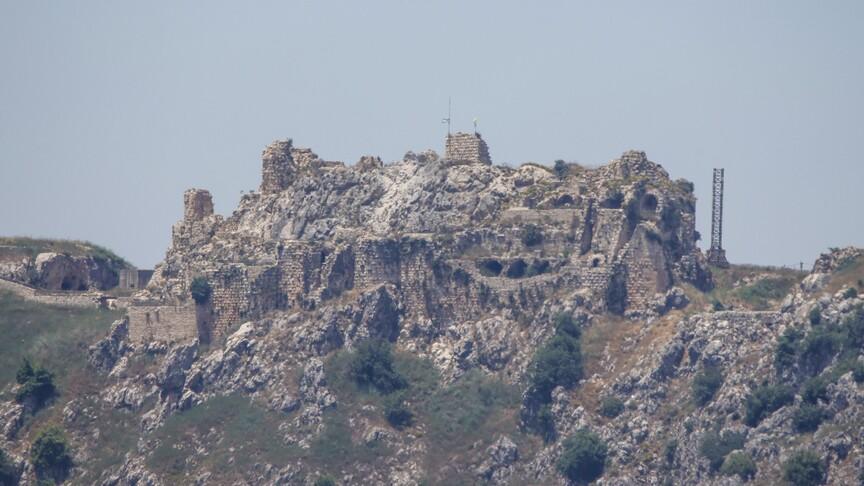
Shaqif Castle - (Anadolu Ajansı)
Shaqif Castle was constructed in the 12th century by the Crusaders atop earlier fortifications. Its Arabic name, Qal'at al-Shaqif, derives from an ancient Syriac word meaning "castle on the high cliff".
In 1139, King Fulk of Jerusalem seized control of the region and ordered the castle's construction. In 1190, Saladin captured the castle; it returned to Crusader hands approximately 60 years later. In 1268, Sultan Baybars took control of the fortress.
The 1837 Galilee Earthquake caused significant damage to the structure, leading to its abandonment. The ruins were subsequently used by local communities as animal shelters and stone quarries. The castle changed hands under the control of the Crusaders, Ayyubids, Mamluks, Ottomans, and French Mandate administration.
Following the outbreak of the Lebanese Civil War in 1975, fighters from the Palestine Liberation Organization (PLO) used the castle as a military base. In 1982, the Israeli military seized the castle from the PLO and began using it as a garrison within its security zone in southern Lebanon. Israeli forces retained control of the castle until their withdrawal in 2000.
The castle walls suffered damage during Israeli attacks targeting PLO positions in the 1970s and during Hezbollah attacks against the Israeli garrison in the 1980s and 1990s. After the Israeli military withdrawal in 2000, the castle was partially restored and opened to visitors.
Shaqif Castle occupies a strategic hilltop commanding views of the Litani River, the town center of Nabatiyye, and surrounding villages. From the castle, visibility extends approximately 10 kilometers east to the Golan Heights and approximately 25 kilometers west to the Mediterranean Sea. The castle's position allows observation of the towns and villages around Nabatiyye, the western Bekaa Valley, the Golan Heights, and the northern Galilee region.
The castle is recognized by UNESCO as one of the best-preserved medieval castles in the Middle East. During the 2024 Israel-Hezbollah war, UNESCO granted enhanced protection status to 34 cultural sites in Lebanon, including Shaqif Castle, to safeguard them under conflict conditions. In 2026, the castle was added to a special list of cultural heritage sites in conflict zones. Israel is not a member of UNESCO.
Conflict between Israel and Hezbollah began on 2 March 2026. The Israeli military launched intensive aerial attacks across Lebanon, targeting numerous towns in the south. The Lebanese government announced that over 1 million people had been displaced within the country during this period.
U.S. President Donald Trump announced on 24 April that the 10-day temporary ceasefire, which had entered into force on 17 April, had been extended by three additional weeks. Following the third round of negotiations mediated by the United States on 14–15 May, it was agreed that the ceasefire would be extended by an additional 45 days as of 17 May, with a fourth round of talks scheduled for early June.
Israeli Prime Minister Benjamin Netanyahu announced on 25 May that he had ordered the military to intensify its attacks on Lebanon.
On 26 May 2026, Netanyahu ordered Israeli forces to advance beyond the 12-kilometer zone they had previously controlled inside Lebanon's border. According to an anonymous Lebanese military source on 30 May, the Israeli military expanded its occupation by advancing through the village of Yahmur to occupy the villages of Eastern Zavtar and Shaqif Ernun north of the Litani River.
The Israeli military announced that in the final days of May 2026, its ground forces conducted large-scale operations across the Wadi Seluki and Shaqif ridges in southern Lebanon. Israeli Defense Forces Spokesperson Ella Waweya stated that before the ground assault, the area had been subjected to intense aerial bombardment and artillery fire, and that the operation's objective was to destroy Hezbollah command centers and infrastructure.
On the morning of 31 May 2026, Israeli ground forces captured Shaqif Castle following months of aerial bombardment and clashes with surrounding villages. Netanyahu announced that Israel's occupation in southern Lebanon had now extended beyond the Litani River.
The Israeli military's Arabic-language spokesperson, Avichay Adraee, published photographs on social media showing Israeli soldiers outside the castle. Defense Minister Israel Katz confirmed that the Israeli flag had been raised over the castle and shared a photograph displaying the banner of the Golani Brigade.
Netanyahu stated in an address: "We have returned to Beaufort today in a different way. We have returned united, resolute, and stronger than ever."
On the day the castle was captured, U.S. Secretary of State Marco Rubio held telephone conversations with Lebanese President Joseph Aoun and Israeli Prime Minister Netanyahu, proposing continued negotiations. According to an anonymous U.S. official, the proposal called for Hezbollah to halt all attacks against Israel, while Israel would refrain from expanding its military operations in Beirut.
Lebanese Parliament Speaker Nabih Berri stated in a televised address that Hezbollah could guarantee its "full, comprehensive, and immediate commitment" to the ceasefire, and asked: "Who will force Israel to stop its attacks?"
French Foreign Minister Jean-Noël Barrot condemned Israel's military operations in Lebanon as "unacceptable" and called for an emergency meeting of the UN Security Council. In an interview with French television channel BFM TV, Barrot stated: "Nothing can justify Israel's continued military campaign in Lebanon and its deepening occupation of Lebanese territory."
Al Jazeera. "What Is Lebanon’s Beaufort Castle, and Why Has Israel Captured It?" Al Jazeera, June 1, 2026. Accessed June 3, 2026. https://www.aljazeera.com/news/2026/6/1/what-is-lebanons-beaufort-castle-and-why-has-israel-captured-it.
Anadolu Agency. "Beyond Beaufort Castle: What’s Next in Israel’s Lebanon Offensive?" Anadolu Agency, June 2, 2026. Accessed June 3, 2026. https://www.aa.com.tr/en/middle-east/beyond-beaufort-castle-what-s-next-in-israel-s-lebanon-offensive/3952575
Associated Press. "Israeli Army Captures Strategic Castle in Lebanon in Deepest Incursion Into the Country in 26 Years." Associated Press, June 1, 2026. Accessed June 3, 2026. https://apnews.com/article/lebanon-israel-capture-castle-beaufort-206c3d6c4dc9a139007f043556a0019b
Museum With No Frontiers. "Beaufort Castle." Sharing History Database. Accessed June 3, 2026. https://sharinghistory.museumwnf.org/database_item.php?id=monument;AWE;lb;52;en.
Reuters. "Lebanon Crusader Castle Seized by Israel a Symbol of Bloody History." Reuters, June 1, 2026. Accessed June 3, 2026. https://www.reuters.com/world/middle-east/lebanon-crusader-castle-seized-by-israel-symbol-bloody-history-2026-06-01/
TRT Haber. "İsrail Ordusu, Lübnan’da Litani Nehri’nin Kuzeyinde Yer Alan Stratejik Tepedeki Kaleyi İşgal Etti." TRT Haber, June 2, 2026. Accessed June 3, 2026. https://www.trthaber.com/haber/dunya/katil-israil-ordusu-lubnanda-litani-nehrinin-kuzeyinde-yer-alan-stratejik-tepedeki-kaleyi-isgal-etti-946672.html

Historical Background
20th Century
Strategic Location
UNESCO Status and Cultural Heritage
2026 Israeli Military Operation
Diplomatic Developments