


This article was automatically translated from the original Turkish version.
+1 More
Sampling
Definition(s) | Sampling is the examination of a smaller group (sample) selected from a population according to specific rules with the expectation that it represents the population. | ||||||||
|---|---|---|---|---|---|---|---|---|---|
Purpose(s) | To obtain generalizable information when examining the entire population is costly or impossible. time-consuming | ||||||||
Basic Terms | Population: The group consisting of all individuals related to the research topic. Sample: A subgroup selected from the population with the aim of representing it. Representativeness: The extent to which the sample reflects the population. | ||||||||
Application Area(s) | Qualitative and quantitative research Psychology Sociology Education Health | ||||||||
Sampling is one of the fundamental building blocks of the research process. In scientific studies, it is often impractical, costly, or time-consuming to examine the entire population. Therefore, researchers prefer to work with a smaller group called a "sample" that represents the population. The methods and techniques used in this process are referred to as "sampling."
The research population is the collective group of individuals related to a specific problem. A smaller group selected from this population and structured to reflect its characteristics is defined as the sample. An ideal sample must have a representative structure that mirrors the population’s features and allows findings from the sample to be generalized to the entire population. To enhance the representativeness of the sample, various sampling techniques are employed.
Sampling methods are broadly divided into two main categories: probability-based (random) and non-probability-based (purposive or judgmental) methods.
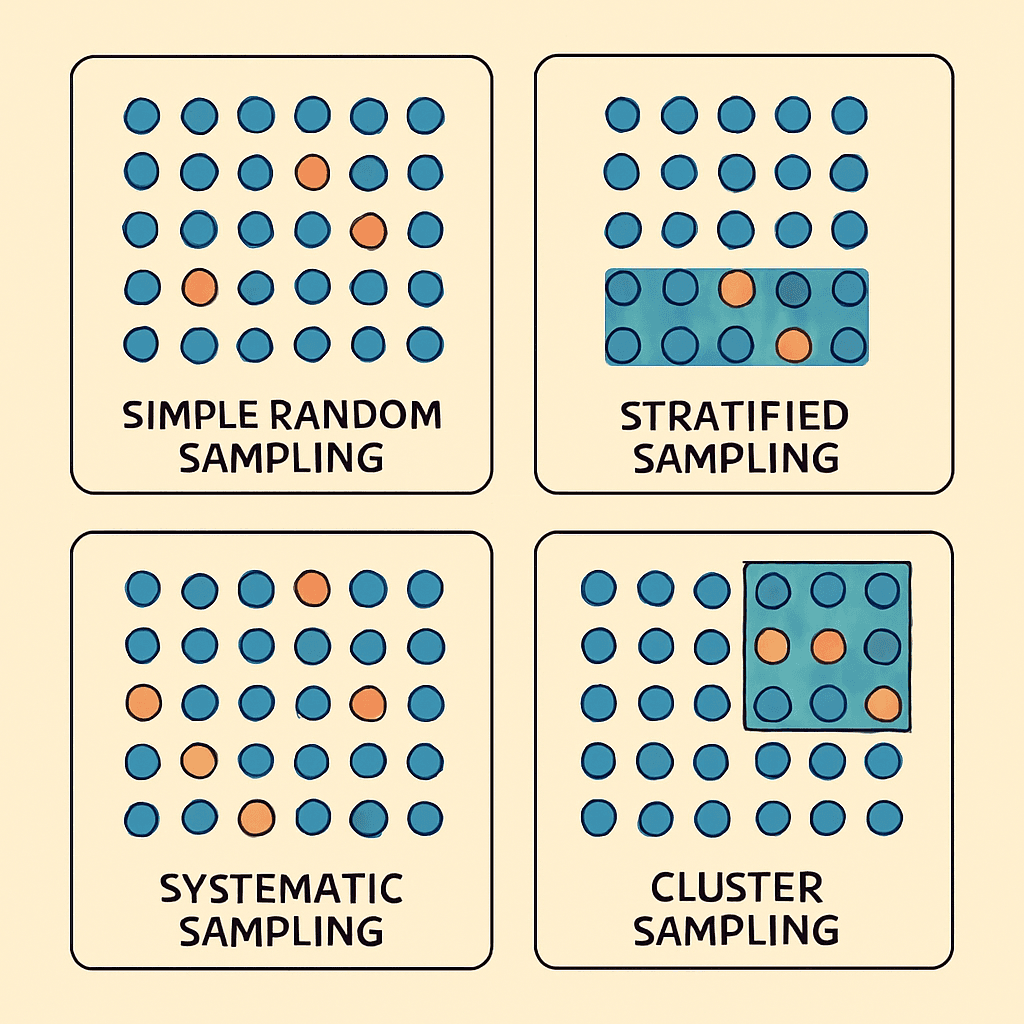
In this type, every individual in the population has an equal chance of being selected for the sample. It produces highly representative results with strong generalizability. The main types include:

Probability-Based (Random) Sampling Methods (Generated by Artificial Intelligence)
In this type of sampling, individuals do not have an equal chance of selection. Participants are chosen based on the research objective, favoring those who can provide rich informational value. It is especially common in qualitative research. The main types include:
In qualitative research, sample size is determined based on data saturation, which refers to the point at which no new information is obtained and the study can be concluded. This approach is applicable when calculating sample size using classical statistical formulas is not feasible. At the same time, validity (the accuracy of measurement) and reliability (the consistency of measurement) are key criteria to consider when selecting a sample.
Non-representative samples can compromise the ability to generalize research findings to the broader population. For example, data collected through home visits during working hours may exclude individuals who are not at home, introducing systematic bias into the sample. If such biases are not corrected through appropriate statistical adjustments, they can negatively affect the validity of the analysis.
Bingöl Üniversitesi. Research Population, Sample Selection, and Measurement. Accessed [Date]. https://www.bingol.edu.tr/media/210799/sayt-bolum12-Arastirma-Evreni-Orneklem-Secimi-ve-Olcum.pdf
Kılıç, S. (2013). Örnekleme yöntemleri. Duygudurum Bozuklukları Dergisi, 3(1), 44-6. https://doi.org/10.5455/jmood.20130325011730
Yağar, F., & Dökme, S. (2018). NİTELİKSEL ARAŞTIRMALARIN PLANLANMASI: ARAŞTIRMA SORULARI, ÖRNEKLEM SEÇİMİ, GEÇERLİK VE GÜVENİRLİK. Gazi Sağlık Bilimleri Dergisi, 3(3), 1-9. https://dergipark.org.tr/tr/pub/gsbdergi/issue/39953/474327

Sampling
Definition(s) | Sampling is the examination of a smaller group (sample) selected from a population according to specific rules with the expectation that it represents the population. | ||||||||
|---|---|---|---|---|---|---|---|---|---|
Purpose(s) | To obtain generalizable information when examining the entire population is costly or impossible. time-consuming | ||||||||
Basic Terms | Population: The group consisting of all individuals related to the research topic. Sample: A subgroup selected from the population with the aim of representing it. Representativeness: The extent to which the sample reflects the population. | ||||||||
Application Area(s) | Qualitative and quantitative research Psychology Sociology Education Health | ||||||||
Sampling and Representativeness
Types of Sampling
Probability-Based (Random) Sampling
Non-Probability-Based (Purposive) Sampling
Saturation and Validity
Sampling Errors and Biases