


This article was automatically translated from the original Turkish version.
+2 More
Şaphane cherry is a unique cherry variety belonging to the species Prunus cerasus L. and native to the Kütahya province of Türkiye. This cherry variety is protected under a Geographical Indication Certification Document and is cultivated at elevations of 900–1100 meters above sea level in the central district of Kütahya, as well as in the districts of Şaphane, Pazarlar, and Simav.
The distinctive characteristics of the product arise from the ecological conditions of its growing region. Cultivation at elevations of 900–1100 meters enhances fruit size, flavor, and aroma. The fruit is broadly heart-shaped with a blunt apex and has a glossy, firm, dark red skin. The flesh is dark red, low in fiber, and partially attached to the stone. It is sweet and aromatic. The high temperature difference between night (12–15 °C) and day (29–32 °C) during harvest season hardens the fruit skin, providing an advantage for long-distance transportation. Şaphane cherry is primarily used in the fruit juice industry.
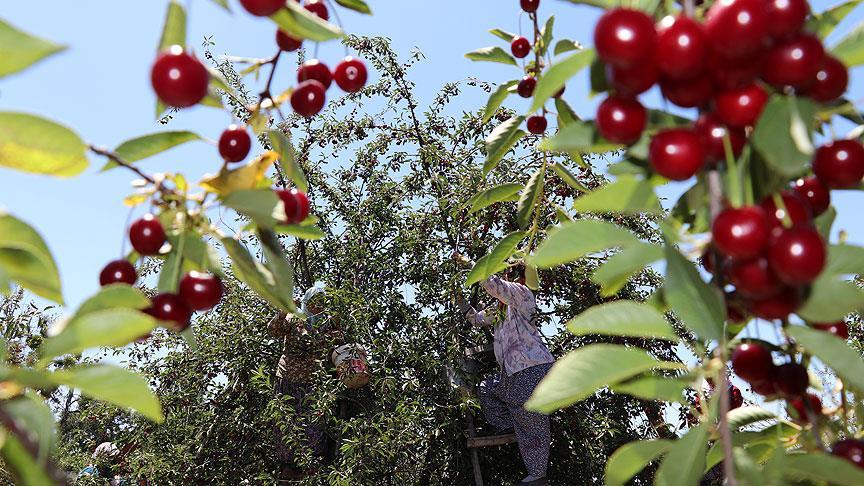
Harvesting Process of Şaphane Cherry (Anadolu Agency)
Distinctive physical and chemical parameters of Şaphane cherry have been determined. Fruit weight ranges from 4.2 to 5.7 g, width from 18.5 to 23 mm, length from 17.5 to 22 mm, and height from 17 to 21 mm. The stalk length is 5.5–7 cm with a stalk weight of 0.1–0.2 g, while the stone weight is 0.3–0.4 g. Chemically, the fruit has a pH of 3.1–3.2, titratable acidity expressed as malic acid of 1.20–1.55%, and soluble solids (Brix) content of 16–19%. Fruit flesh firmness measures 0.44–0.48 kg, and juice content varies between 42% and 52%. The average yield per tree is 25–30 kg.【1】
The production of Şaphane cherry is carried out according to specific methods and control procedures.

Appearance of Şaphane Cherry (Anadolu Agency)
Specific information regarding storage and preservation conditions for Şaphane cherry is not available. However, it is noted that the firm skin structure developed due to the high temperature differential provides an advantage for long-distance transportation. The product is transported to fruit juice factories on the same day following harvest.harvest
Compliance of Şaphane cherry with geographical indication standards is monitored by a control authority coordinated by the Kütahya Chamber of Commerce. This authority consists of four representatives: one from the Kütahya Chamber of Commerce, two from the Kütahya Provincial Directorate of Agriculture and Forestry, and one from the Şaphane District Directorate of Agriculture and Forestry. Inspections are conducted once annually during the harvest season; additional inspections are carried out within 15 days if a complaint is filed.
Inspection criteria include fruit weight, soluble solids content (Brix), titratable acidity expressed as malic acid, stalk length, and correct use of the geographical indication logo. Additionally, for new orchard owners, production methods such as site selection, planting distance, and fertilization are also subject to inspection. Inspection records are archived by the Kütahya Chamber of Commerce and reported to the Turkish Patent and Trademark Office.
[1]
Kütahya Ticaret Borsası, "Şaphane Vişnesi Coğrafi İşaret Belgesi," Kütahya Ticaret Borsası, erişim 14 Eylül 2025,

Distinctive Characteristics
Physical and Chemical Parameters
Production Method
Storage and Preservation Conditions
Control
