This article was automatically translated from the original Turkish version.
Vehicle type | Unmanned Surface Vehicle (USV) | ||||||||
|---|---|---|---|---|---|---|---|---|---|
Manufacturer | Saronic Technologies (USA) | ||||||||
Length | 24 feet (approximately 7.3 meters) | ||||||||
Propulsion system | Diesel engine | ||||||||
Range | 1,000 nautical miles (≈1,852 km) | ||||||||
Maximum speed | 35+ knots (≈65+ km/h) | ||||||||
Payload capacity | 1,000 pounds (≈453 kg) | ||||||||
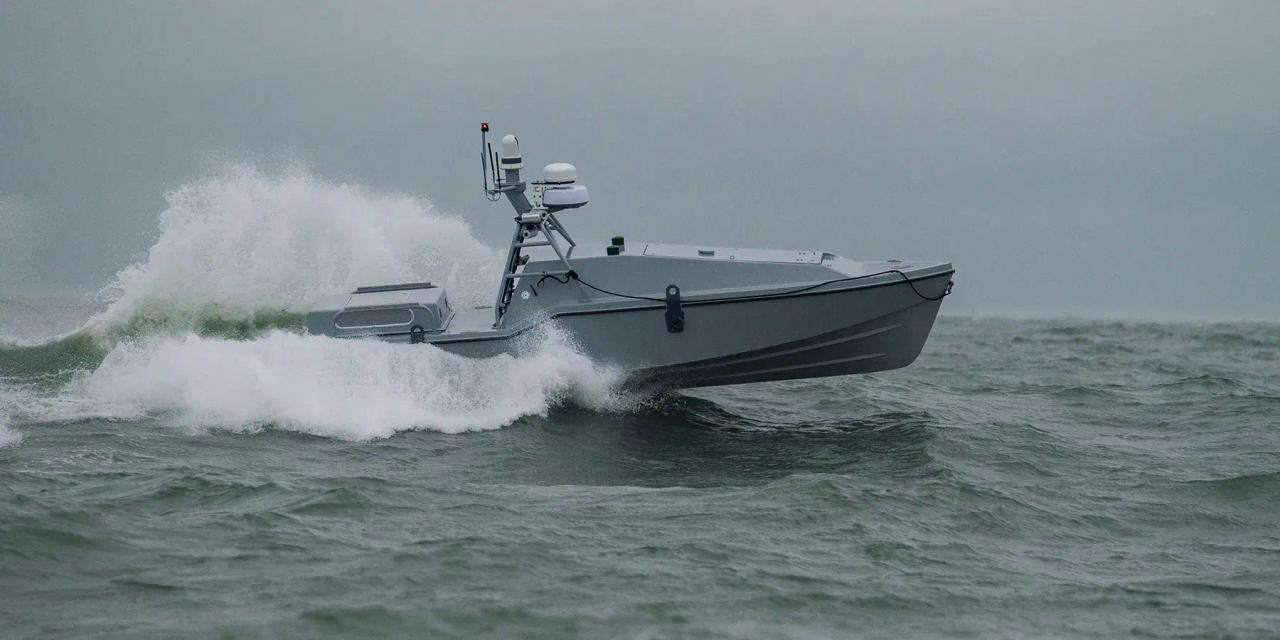
Saronic Corsair is a diesel-powered, unmanned surface vessel (USV) developed by the United States-based company Saronic Technologies. The vessel is approximately 24 feet (7.3 meters) in length. It has a range of over 1,000 nautical miles, a maximum speed in excess of 35 knots, and a payload capacity of 1,000 pounds (approximately 453 kilograms).【1】The Corsair was designed by Saronic under the U.S. Department of Defense’s Replicator program with the objective of deploying thousands of expendable unmanned platforms to deter a potential Chinese invasion of Taiwan. It was developed for missions including maritime domain awareness, intelligence-surveillance-reconnaissance (ISR), logistics, and kinetic and non-kinetic effects.【2】
Saronic Corsair - (Saronic Technologies)
On 8 June 2026, the Corsair was deployed in a rescue operation following the downing of a U.S. Army AH-64 Apache helicopter off the coast of Oman. It gained prominence during the attack on Iran’s Bandar Abbas Naval Base on 12–13 July 2026, marking the first time the U.S. directly employed its maritime drones in combat operations.
The Corsair’s technical specifications are as follows:
The Corsair’s design philosophy differs from that of traditional warships. The absence of a crew eliminates the need for life support systems, safety margins, and habitable space, allowing the saved volume and weight to be allocated to fuel, sensors, and payload capacity. This approach enables long range and high mission endurance on a small, low-cost platform.【4】
The key feature distinguishing the Corsair from a remotely operated vessel is its autonomy software architecture. The vessel’s sensing and navigation functions are executed via edge processing technology on onboard computers, enabling it to continue its mission even if communication or GPS signals are lost or degraded.【5】
The autonomy software stack used across all Saronic vessels is managed by the company’s Echelon command and control platform. Echelon enables a single operator to create a mission using a “click-to-plan” method, test it in a simulation environment, and then simultaneously control multiple vessels using a one-to-many operational model.【6】
The software architecture consists of three core components:
In October 2025, as part of a collaboration announced that month, NVIDIA’s computing hardware began being used in Saronic vessels for real-time sensing and decision-making. Additionally, NVIDIA Omniverse simulation tools are used to generate high-resolution digital twins for training and validating autonomy systems.
The Corsair’s sensing system employs a passive sensing approach instead of active radar. The system monitors its environment using electro-optical cameras, infrared cameras, and electronic support measures (ESM), aiming to avoid emitting electromagnetic signals that could reveal its position.
Detailed technical information regarding the Corsair’s hull structure, propulsion system, sensor suite, navigation equipment, communication waveforms, encryption methods, and anti-jamming and anti-spoofing measures has not been publicly disclosed by Saronic.
According to Saronic’s published data, the company conducted an extensive, week-long continuous test campaign with eight Corsair vessels operating more than 70 nautical miles offshore. During this campaign, the vessels covered over 4,500 nautical miles, completed a five-day continuous autonomous loiter mission, and achieved over 92 hours of uninterrupted navigation. The tests also evaluated scenarios involving loss of communication, passive sensing conditions, and launch and recovery operations from a larger vessel at sea.
Saronic also reported that during Corsair tests conducted throughout 2025, the fleet accumulated over 79,000 nautical miles of transit and more than 15,000 hours of operational time. According to Saronic, the Corsair’s autonomy architecture supports autonomous loiter durations exceeding 50 days. The tests were conducted under sea state conditions ranging from 2 to 5 and wave heights exceeding 5 feet.【8】
Saronic Technologies is a defense technology company founded in March 2022 in Austin, Texas. The company’s co-founder and Chief Executive Officer (CEO) is Dino Mavrookas, a former member of the U.S. Navy’s SEAL Team 2 and Naval Special Warfare Development Group (DEVGRU). After serving 11 years in the Navy, Mavrookas earned a Master of Business Administration (MBA) from the Wharton School and then worked for approximately five years as a software investor at Vista Equity Partners.【9】
Saronic designs, manufactures, and deploys AI-enabled unmanned surface vessels ranging from 6 to 150 feet in length. The company’s platforms are being developed for use by the U.S. Navy, allied defense forces, and selected commercial and government agencies for missions including maritime security, maritime domain awareness, reconnaissance, logistics, and cargo transport.【10】
Saronic’s unmanned maritime platforms are in use by the U.S. Navy and the U.S. Department of Defense.
Saronic’s production facility in Austin, Texas is reported to have the capacity to produce 400 to 500 Corsairs annually. The company has stated its goal to increase this capacity to 2,000 vessels per year with the commissioning of a new production line.
The U.S. Navy signed an Other Transaction Agreement (OTA) worth over $392 million with Saronic in May 2025. In July 2025, the Naval Sea Systems Command (NAVSEA) awarded a production contract under this agreement valued at approximately $197 million, nearly half the agreement’s ceiling.【11】
In December 2025, then-U.S. Secretary of the Navy John C. Phelan announced at the Reagan National Defense Forum that Saronic had transitioned its Corsair from prototype to serial production in less than 12 months. Phelan stated that the approximately $200 million portion of the contract would be paid upfront as an advance, with production expected to be completed in less than 12 months.
Phelan also noted that the contract with Saronic exemplified an open competitive procurement process and the adoption of a manned-unmanned fleet approach. The contract is reported to be valid through 2031.【12】
On the night of 8 June 2026, a U.S. Army AH-64 Apache attack helicopter on patrol near the Strait of Hormuz was shot down by Iran off the coast of Oman. U.S. Central Command (CENTCOM) announced that both crew members were rescued within approximately two hours, their health was stable, and an investigation into the incident was ongoing.
Instead of sending a second manned helicopter into the crash zone, unmanned systems under the command of Task Force 59, part of the U.S. Fifth Fleet, were deployed. A Saronic Corsair unmanned surface vessel reached the two downed aviators; after the crew boarded the vessel under their own power, the Corsair transported them to a secure location where a manned helicopter later conducted their extraction.
U.S. Navy Lieutenant Tim Hawkins, CENTCOM Spokesperson, confirmed to Reuters that the platform used in the rescue was the Saronic Corsair. While CENTCOM’s official statement did not specify the model, the platform’s identity was later confirmed by both the CENTCOM spokesperson and Saronic.【13】
Reuters characterized the incident as the first known instance of the U.S. military employing an unmanned maritime vessel for personnel recovery. Hawkins also told Navy Times that Task Force 59 had begun deploying these unmanned maritime vessels in the region since late March 2026.
Bryan Clark, an analyst at the Hudson Institute, stated that the Corsair’s use in the rescue operation was not pre-planned and that the vessel had been in the region for surveillance duties.
U.S. Central Command (CENTCOM) conducted an attack on Iran’s Bandar Abbas Naval Base on 12–13 July 2026 using three Saronic Corsair unmanned surface vessels targeting the submarine and ship maintenance facility. One of the targets was a Gadir-class mini-submarine moored at the pier.【14】
Corsair strikes Bandar Abbas Naval Base harbor, 13 July 2026 - (Associated Press)
In a social media statement following the operation, CENTCOM announced the use of multiple one-way attack unmanned surface vessels and confirmed that three Corsairs had struck the harbor facility at Bandar Abbas. The statement emphasized that the operation marked the first time the U.S. military directly employed its maritime drones in combat operations.
Twenty-five-second footage released by CENTCOM shows Corsair vessels approaching the pier at Bandar Abbas and striking a target identified as the Gadir-class mini-submarine mounted on a crane. Satellite imagery has corroborated that the facility targeted was indeed the Bandar Abbas Naval Base.
A U.S. defense official speaking to USNI News clarified that the operation was not conducted by the U.S. Fifth Fleet or the U.S. Navy directly, but was executed as a CENTCOM operation.
The attack has been assessed as the first operational use of lethal unmanned surface vessels (USVs) by the U.S. military. The operation is described as part of a broader campaign aimed at degrading Iran’s capacity to threaten maritime traffic in the Strait of Hormuz, which also involved strikes against coastal radars, air defense systems, and other military targets using one-way attack unmanned aerial vehicles.
Following the attack, Saronic confirmed on its social media account that multiple Corsair unmanned surface vessels had been used in operations targeting Iran’s capacity to threaten commercial maritime traffic. In its statement, the company expressed pride that “our technology supported this mission and contributed to the safety of the brave men and women of the U.S. Armed Forces.” 【15】
Associated Press. “US Military Uses Drone Boats to Hit an Iran Facility in First-of-Its-Kind Attack.” YouTube. Accessed July 14, 2026.https://www.youtube.com/watch?v=IKAaTNbgaww
Business Insider. “The US Navy's New Sea Drones Have Gone From Rescuing Downed Airmen to Blowing Up Iranian Targets.” Accessed July 14, 2026.https://www.businessinsider.com/us-navy-sea-drones-rescuing-airmen-attacking-iran-2026-7
DefenseScoop. "U.S. Military Uses Corsair Maritime Drones to Attack Iran." DefenseScoop. Accessed July 14, 2026.https://defensescoop.com/2026/07/13/corsair-maritime-drones-attack-iran/
Drone Warfare. "Saronic Corsair: The Navy's Autonomous Drone Boat, in Depth." Accessed July 14, 2026.https://drone-warfare.com/research/saronic-corsair/
Military Times. “Sea Drones Strike Iranian Port in Combat First for US.” Military Times. Accessed July 14, 2026.https://www.militarytimes.com/news/your-military/2026/07/13/sea-drones-strike-iranian-port-in-combat-first-for-us-navy/
Naval News. “CENTCOM Deploys Saronic Corsair USV Against Iranian Submarine At Bandar Abbas.” Naval News. Accessed July 14, 2026.https://www.navalnews.com/naval-news/2026/07/centcom-saronic-corsair-usv-strike-iran-submarine-bandar-abbas/
Saronic Technologies. “Saronic Unveils Corsair: An Autonomous Surface Vessel for a Future Hybrid Fleet.” YouTube. Accessed July 14, 2026.https://www.youtube.com/watch?v=JzXV9X1G4jo
Saronic. “Vessels.” Saronic. Accessed July 14, 2026.https://www.saronic.com/vessels
Startup Intros. "SARONIC." Accessed July 14, 2026.https://startupintros.com/orgs/saronic
Summit Ventures. "Saronic." Summit Ventures. Accessed July 14, 2026.https://www.summit-ventures.net/company/saronic/
The Defense Post. "US Navy Taps Saronic to Rapidly Produce Corsair Autonomous Surface Vessels." Accessed July 14, 2026.https://thedefensepost.com/2025/12/15/saronic-autonomous-vessels/
The Hill. "US Military’s Sea Drones Helped Strike Iranian Targets." Accessed July 14, 2026.https://thehill.com/policy/defense/5966167-us-military-sea-drones-iran/
USNI News. “VIDEO: 3 Lethal U.S. Drones Attack Iranian Sub, Port Facility.” USNI News. Accessed July 14, 2026.https://news.usni.org/2026/07/13/video-3-lethal-u-s-drones-attack-iranian-sub-port-facility
gCaptain. “Billion-Dollar USV Builder Saronic Scores Military Rescue Milestone Near Hormuz.” gCaptain. Accessed July 14, 2026.https://gcaptain.com/billion-dollar-usv-builder-saronic-scores-operational-milestone-in-oman-rescue/
[1]
Saronic Technologies, “Vessels,” Erişim 14 Temmuz 2026, https://www.saronic.com/vessels
[2]
The Defense Post, “US Navy Taps Saronic to Rapidly Produce Corsair Autonomous Surface Vessels,” erişim 14 Temmuz 2026, https://thedefensepost.com/2025/12/15/saronic-autonomous-vessels/
[3]
Drone Warfare Research, “Saronic Corsair: The Navy's Autonomous Drone Boat, in Depth,” Accessed July 14, 2026.https://drone-warfare.com/research/saronic-corsair/
[4]
Drone Warfare Research, “Saronic Corsair: The Navy's Autonomous Drone Boat, in Depth,”
[5]
Drone Warfare Research, “Saronic Corsair: The Navy's Autonomous Drone Boat, in Depth,”
[6]
Drone Warfare Research, “Saronic Corsair: The Navy's Autonomous Drone Boat, in Depth,”
[7]
Drone Warfare Research, “Saronic Corsair: The Navy's Autonomous Drone Boat, in Depth,”
[8]
Drone Warfare Research, “Saronic Corsair: The Navy's Autonomous Drone Boat, in Depth,”
[9]
Startup Intros, “Saronic,” erişim 14 Temmuz 2026, https://startupintros.com/orgs/saronic
[10]
Summit Ventures Partners, “Saronic,” erişim 14 Temmuz 2026, https://www.summit-ventures.net/company/saronic/
[11]
Summit Ventures Partners, “Saronic,”
[12]
Summit Ventures Partners, “Saronic,”
[13]
Drone Warfare Research, “Saronic Corsair: The Navy's Autonomous Drone Boat, in Depth,”
[14]
Naval News, “CENTCOM Deploys Saronic Corsair USV Against Iranian Submarine At Bandar Abbas,” erişim 14 Temmuz 2026, https://www.navalnews.com/naval-news/2026/07/centcom-saronic-corsair-usv-strike-iran-submarine-bandar-abbas/
[15]
The Hill, “In a First, US Military Used Seaborne Drones in Attack on Iran Port,” erişim 14 Temmuz 2026, https://thehill.com/policy/defense/5966167-us-military-sea-drones-iran/


Vehicle type | Unmanned Surface Vehicle (USV) | ||||||||
|---|---|---|---|---|---|---|---|---|---|
Manufacturer | Saronic Technologies (USA) | ||||||||
Length | 24 feet (approximately 7.3 meters) | ||||||||
Propulsion system | Diesel engine | ||||||||
Range | 1,000 nautical miles (≈1,852 km) | ||||||||
Maximum speed | 35+ knots (≈65+ km/h) | ||||||||
Payload capacity | 1,000 pounds (≈453 kg) | ||||||||
Technical Specifications
Design and Autonomy System
Testing and Validation Trials
Manufacturer: Saronic Technologies
U.S. Navy Procurement Contract
Operational Use
Hormuz Strait Rescue Operation (8 June 2026)
Bandar Abbas Naval Base Attack (12–13 July 2026)