


This article was automatically translated from the original Turkish version.
+3 More
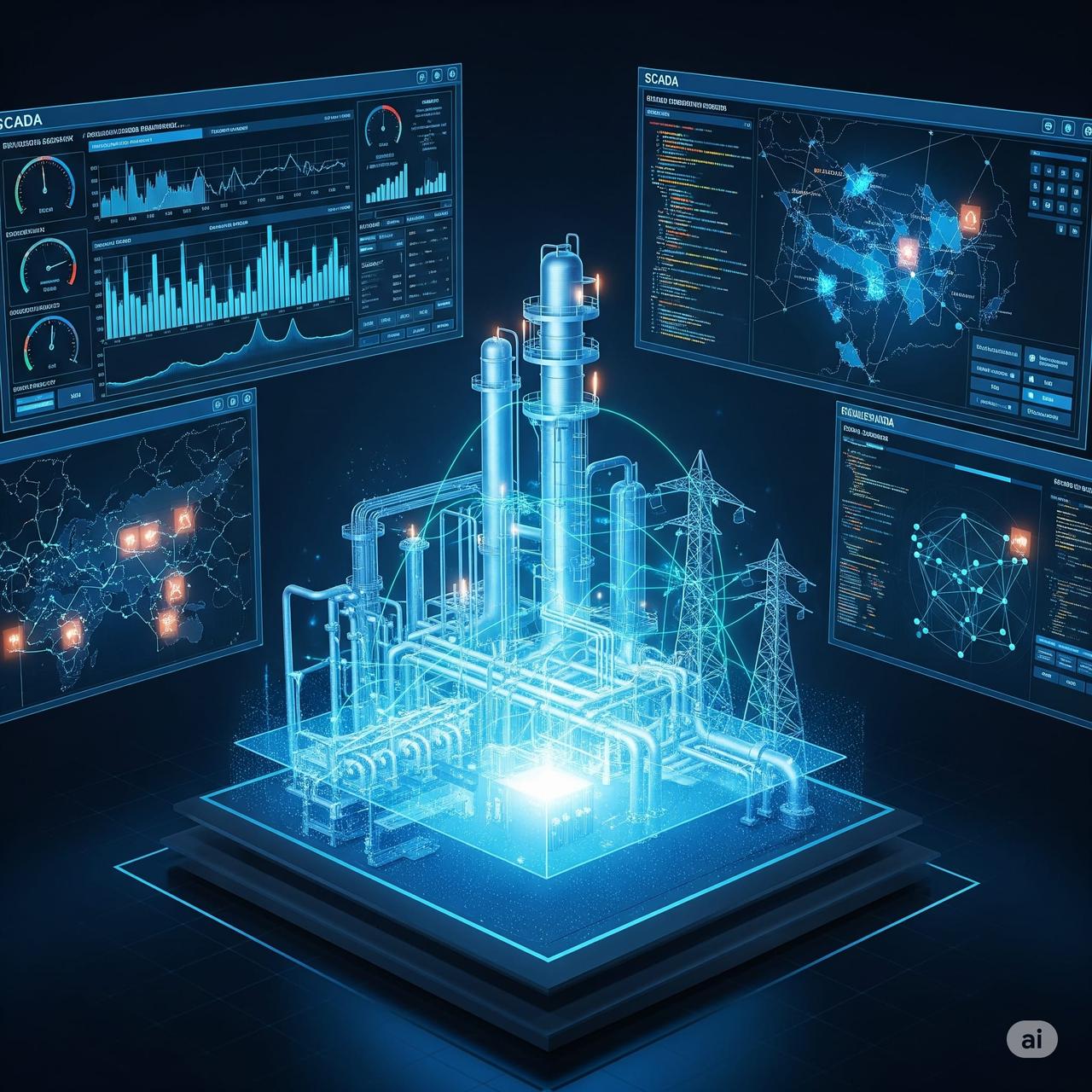
SCADA Systems (generated with artificial intelligence)
Definition(s) | Supervisory Control and Data Acquisition | ||||||||
|---|---|---|---|---|---|---|---|---|---|
Turkish Equivalent | Central Monitoring and Data Collection | ||||||||
Basic Components | MTU, RTU/PLC, HMI, Communication Network | ||||||||
Main Functions | Monitoring, Control, Data Collection, Reporting | ||||||||
Application Area(s) | Energy Transportation Production Water Management | ||||||||
SCADA (Supervisory Control and Data Acquisition), known in Turkish as Centralized Monitoring and Data Collection, is a system composed of software and hardware components designed to monitor, control, and manage industrial and infrastructure processes from a central location. These systems collect real-time data from various devices spread across wide geographic areas or complex industrial operations, process this data, present it to operators in a meaningful format, and enable remote control of processes. Their primary objective is to increase operational efficiency, reduce costs, ensure system security, and minimize human error. SCADA has become an indispensable part of modern industry and critical infrastructure, from power plants and water treatment facilities to production lines and transportation networks.

(This Image Was Generated by Artificial Intelligence)
A SCADA system consists of several core components that work in integration to ensure seamless flow of information and commands between physical processes in the field and the central control room.
SCADA systems perform a set of fundamental functions to enable the efficient and secure management of industrial processes.

(This Image Was Generated by Artificial Intelligence)
Due to their scalable and flexible architecture, SCADA systems are widely used across diverse industries and critical infrastructure facilities.
The implementation of SCADA systems provides businesses with significant operational, financial, and security benefits.

(This Image Was Generated by Artificial Intelligence)
Because SCADA systems control critical infrastructure, they represent a major target for cyber attackers. Past incidents such as cyberattacks on Ukraine’s power grids, the Stuxnet virus targeting Iran’s nuclear facilities, and cyberattacks against large corporations like Saudi Aramco have demonstrated how vital SCADA security is. Traditionally, these systems were considered secure because they were isolated from external networks (air-gapped). However, with the advent of Industry 4.0, the integration of SCADA systems with corporate information technology (IT) networks and the internet has significantly increased cybersecurity risks.
Therefore, a multilayered approach must be adopted to secure SCADA systems. This approach includes installing firewalls and network segmentation structures such as DMZ (Demilitarized Zone) between operational technology (OT) and information technology (IT) networks, deploying intrusion detection systems (IDS), conducting regular security audits, applying software updates, and providing personnel training. Additionally, international standards such as NIST and IEC 62443, along with reference architectures like the Purdue Model, provide guiding principles for designing and implementing secure SCADA systems. Analyzing cyber threats to SCADA systems and implementing risk mitigation strategies is critical for operational continuity and national security.
AB Market Otomasyon A.Ş. "SCADA Sisteminizi Seçerken Dikkat Etmeniz Gerekenler." ABMarketOtomasyon.com. Accessed July 17, 2025. https://abmarketotomasyon.com/scada-sistemenizi-secerken-dikkat-etmeniz-gerekenler/.
Adatech. "SCADA Nedir? Ne İşe Yarar? Sistemi Nasıl Çalışır?" Adatech.com.tr. Accessed July 17, 2025. https://www.adatech.com.tr/scada-nedir-scada-sistemi-nasil-calisir/.
Armin Elektrik. "SCADA Nedir? Ne İşe Yarar?" Armin.com.tr. Accessed July 17, 2025. https://www.armin.com.tr/scada-nedir-ne-ise-yarar/.
Beyaz.Net. "SCADA Güvenliğinin Önemi." Accessed July 17, 2025. https://www.beyaz.net/tr/guvenlik/makaleler/scada_guvenliginin_onemi.html.
Birci Enerji. "Scada Otomasyon Sistemleri." BirciEnerji.com. Accessed July 17, 2025. https://www.bircienerji.com/scada-otomasyon.asp.
Kesir Mühendislik. "Scada." Kesir.com.tr. Accessed July 17, 2025. https://www.kesir.com.tr/teknik-dep-scada-otomasyon-departmani-scada.
Mikrodev. "SCADA Nedir ve SCADA Sistemleri Nasıl Kullanılır?" Mikrodev.com. Accessed July 17, 2025. https://www.mikrodev.com/tr/scada-nedir-scada-sistemleri-nasil-kullanilir/.
Mikrodev. "SCADA Nedir, Kimler Kullanır ve Nasıl Çalışır?" Mikrodev.com. Accessed July 17, 2025. https://www.mikrodev.com/tr/scada-nedir/.
Power Otomasyon ve Makine. "Scada Sistemleri." PowerOtomasyon.com.tr. Accessed July 17, 2025. https://www.powerotomasyon.com.tr/scada-sistemleri.
Teksuas. "SCADA Sistemleri." Teksuas.com. Accessed July 17, 2025. https://teksuas.com/scada-sistemleri/.
Tepe Otomasyon. "Endüstriyel SCADA." Tepeotomasyon.com. Accessed July 17, 2025. https://tepeotomasyon.com/category/scada-uygulamalari/.
Tesla Kontrol. "SCADA Nedir? Endüstri 4.0'ın Altın Çağı." Teslakontrol.com. Accessed July 17, 2025. https://www.teslakontrol.com/tr/scada-nedir.

SCADA Systems (generated with artificial intelligence)
Definition(s) | Supervisory Control and Data Acquisition | ||||||||
|---|---|---|---|---|---|---|---|---|---|
Turkish Equivalent | Central Monitoring and Data Collection | ||||||||
Basic Components | MTU, RTU/PLC, HMI, Communication Network | ||||||||
Main Functions | Monitoring, Control, Data Collection, Reporting | ||||||||
Application Area(s) | Energy Transportation Production Water Management | ||||||||
Structure and Components of a SCADA System
Functions of SCADA Systems
Application Areas
Advantages
SCADA Security