

This article was automatically translated from the original Turkish version.
+2 More
Definition | Taking pleasure in another's misfortune | ||||||||
|---|---|---|---|---|---|---|---|---|---|
Type | Concept of Psychology | ||||||||
Origin | German | ||||||||
Proto-Language | German | ||||||||
Social Context | Group relationships | ||||||||
Word Structure | Schaden "harm" + Freude "joy" | ||||||||
Moral Condition | Discussions | ||||||||
Turkish Equivalent | Feeling pleasure in another's misfortune | ||||||||
Nature | Social emotion | ||||||||
Ancient Equivalent | Epichairekakia | ||||||||
Determinants | Jealousy, entitlement | ||||||||
Fields of Study | Psychology Sociology Philosophy | ||||||||
Schadenfreude (Malicious Joy), is an emotional phenomenon that describes the experience of pleasure in response to the misfortunes of others. The term originates from the German words “Schaden” (harm) and “Freude” (joy) and has historically appeared in various cultures and languages through expressions with similar meanings.【1】 The ancient Greek concept of “epichairekakia” is regarded as one of its early historical equivalents. Although similar expressions have emerged in various languages over time, the term entered English in the 19th century and became established in academic literature.【2】
Schadenfreude arises from a cognitive evaluation process in which an individual interprets another person’s misfortune through the lens of their own goals and expectations. In this process, the individual’s subjective perception is more decisive than the objective nature of the event. Moral evaluations of this emotion have varied across different societies; some approaches view it as ethically problematic while others consider it a comprehensible response under certain conditions.
Today, schadenfreude is studied in psychology and the social sciences as a multidimensional emotion. Its conceptual scope has expanded to include the influence of social structures alongside individual experiences. As a result, schadenfreude is understood as a phenomenon operating at both individual and collective levels.
The concept of schadenfreude is etymologically a German compound word, literally meaning “pleasure from another’s harm.” However, this emotion is not confined to the German language; similar conceptual equivalents exist in other languages. The ancient Greek term “epichairekakia” points to its historical roots. Similar expressions carrying comparable meanings are found in French, Hebrew, and many other languages. The term entered English in the 19th century and was incorporated into dictionaries.【3】
This process also reveals that schadenfreude involves not only linguistic but also cultural transmission. The existence of comparable terms for this emotion across different societies suggests that it represents a universal human experience. Linguistic diversity demonstrates how the emotion is expressed differently in various cultures. However, the absence of a specific term in a language does not imply the absence of the emotion itself. This highlights the complex relationship between the universality of emotions and the limitations of language. The term’s widespread adoption has been accelerated by academic and cultural exchanges, establishing schadenfreude as a well-established term in modern psychological literature.
Schadenfreude is an emotion that emerges as a result of a psychological evaluation process. In this process, the individual interprets another’s misfortune in alignment with their own goals and expectations. The individual’s subjective assessment, rather than the objective features of the event, plays the decisive role in triggering the emotion. Consequently, the same event can elicit different emotional responses in different individuals. Schadenfreude is generally regarded as the opposite of empathy.【4】
While empathy involves sharing another’s pain, schadenfreude entails deriving pleasure from it. In this sense, the emotion is considered a counter-empathic response. Its emergence is closely linked to social comparison processes.【5】 Differences perceived between oneself and others can trigger this emotion. Furthermore, it is connected to the individual’s self-perception and social standing.
Several factors contribute to the emergence of schadenfreude. One is the perception of “deservedness.” When an individual’s misfortune is seen as deserved, the emotion arises more readily.【6】 Particularly when the person is perceived to have previously engaged in negative behavior, their failures or losses may elicit a more positive emotional response. This is closely tied to individuals’ perceptions of justice.【7】
The second important factor is “envy.”【8】 The misfortune of someone who is envied increases the likelihood of schadenfreude.【9】 Third, the individual’s self-evaluation is significant. The failure of another can shift the individual’s negative self-perception, leading them to feel better about themselves.
Group membership is also an important factor. Individuals are more likely to experience this emotion toward those outside their own group. This is related to social identity and group dynamics. Thus, schadenfreude is a multifaceted phenomenon not attributable to a single cause.【10】
Schadenfreude is not only an individual phenomenon but also one observed in intergroup relations. It becomes particularly pronounced in contexts of intense competition. Groups perceived as high-status and competitive are more likely to be targets of schadenfreude. This is linked to stereotypes and social perceptions. Intergroup comparisons shape individuals’ emotional responses.【11】
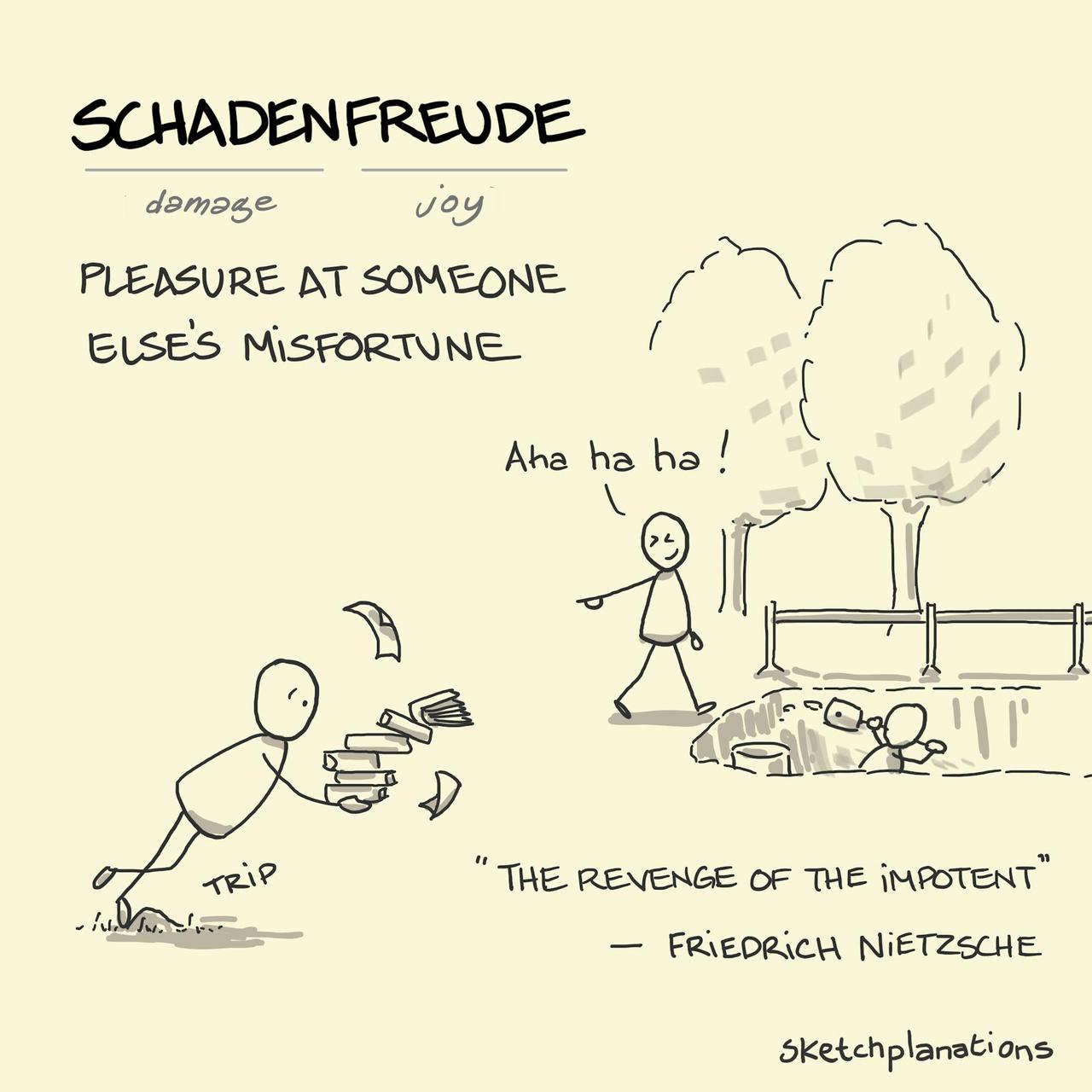
Depiction of Relative Satisfaction Derived from Others’ Downfalls (Sketchplanations)
The failure of rival groups is often met with positive emotional reactions. This process is explained by social identity theory. Individuals tend to evaluate their own groups positively, so the misfortunes of other groups can reinforce the perceived superiority of their own. Research indicates that this emotion may also be associated with harmful behaviors in certain contexts. Thus, schadenfreude has the potential to produce significant consequences for social relationships.【12】
The emotion of schadenfreude can be observed concretely in various contexts of daily life. For example, in sports, the defeat of a rival team in a crucial match can generate positive emotional reactions among fans. This is especially evident in highly competitive encounters. Similarly, in academic settings, the failure of a high-achieving student may trigger schadenfreude in some individuals. On social media, the widespread attention and occasional positive reactions to misfortunes experienced by prominent or high-status individuals represent another manifestation of this emotion. These examples demonstrate that schadenfreude is not merely a theoretical concept but a tangible phenomenon observable in everyday life.【13】
Schadenfreude has long been a subject of moral and philosophical debate. Some thinkers have regarded it as an ethically negative trait, arguing that deriving pleasure from another’s suffering is morally problematic. In contrast, other perspectives suggest that this emotion can be understandable under certain conditions. The perception of “deservedness” plays a central role in these debates.【14】
Some views interpret the emergence of this emotion differently when justice is perceived to have been served. However, there is no consensus on its moral value. Different thinkers have interpreted schadenfreude in varied ways, reflecting its complex nature. Moreover, the diversity of underlying motivations further influences these debates. Thus, schadenfreude presents a multidimensional subject for both psychological and ethical inquiry.
Schadenfreude has various consequences at both individual and societal levels. This emotion can play a critical role in an individual’s self-evaluation process.【15】 The misfortunes of others can enhance an individual’s positive self-assessment, which is directly linked to self-esteem. However, when experienced persistently and intensely, this emotion can negatively affect social relationships. In cases associated with a lack of empathy, interpersonal bonds may be damaged. Additionally, schadenfreude can contribute to increased tensions between groups.
Research indicates that schadenfreude may be linked to harmful tendencies in certain contexts.【16】 Nevertheless, this emotion does not always lead to negative outcomes. In specific contexts, it may help individuals restore emotional balance. Therefore, schadenfreude is an emotion with both functional and problematic dimensions.
Studies show that schadenfreude occurs more frequently under specific social and psychological conditions. It is particularly intensified when misfortunes befall individuals or groups that are envied. Furthermore, groups perceived as high-status and competitive are identified as more frequent targets of this emotion. Experimental research reveals that individuals exhibit stronger positive emotional responses to the misfortunes of such groups and, in some cases, display increased tendencies toward harmful behavior.【17】
Atak, Hasan, Martin Jencius, Aybala Albay, Seda Karatekin, and Fatma Kurnaz Tuzcuoğlu. "Schadenfreude: A Conceptual Review / Schadenfreude: Kavramsal Bir Derleme." *Uluslararası Hakemli Sosyal Bilimler E-Dergisi*, no. 52 (2024): 598–622. Accessed April 27, 2026. https://dergipark.org.tr/en/download/article-file/4198967
Cikara, Mina, and Susan T. Fiske. "Their Pain, Our Pleasure: Stereotype Content and Schadenfreude." *Annals of the New York Academy of Sciences* 1299, no. 1 (2013): 52–59. Accessed April 27, 2026. https://pmc.ncbi.nlm.nih.gov/articles/PMC4472308/pdf/nihms699020.pdf
Hey, Jono. "Fading Affect Bias." Sketchplanations. Accessed April 27, 2026. https://sketchplanations.com/fading-affect-bias
Hey, Jono. "Schadenfreude." *Sketchplanations*. Accessed April 27, 2026. https://sketchplanations.com/schadenfreude.
Kurtuluş, Elif. "Schadenfreude: Başkasının Talihsizliğinden Duyulan Keyif, Tiffany Watt Smith (Çev. Nüvit Bingöl, Kolektif Kitap, 2021)." Kitap incelemesi. *Üsküdar Üniversitesi Sosyal Bilimler Dergisi*, no. 14 (2022): 151–155. Accessed April 27, 2026. http://doi.org/10.32739/uskudarsbd.8.14.106
Schindler, Rose, André Körner, Sylvia Bauer, Sarina Hadji, and Udo Rudolph. "Causes and Consequences of Schadenfreude and Sympathy: A Developmental Analysis." PLOS ONE 10, no. 8 (2015): e0137669. Accessed April 27, 2026. https://journals.plos.org/plosone/article?id=10.1371/journal.pone.0137669
Van Dijk, Wilco W., and Jaap W. Ouwerkerk. "Introduction to Schadenfreude." In *Schadenfreude: Understanding Pleasure at the Misfortune of Others*, 1–10. Cambridge: Cambridge University Press, 2014. Accessed April 27, 2026. https://assets.cambridge.org/97811070/17504/excerpt/9781107017504_excerpt.pdf
Van de Ven, Niels, Charles E. Hoogland, Richard H. Smith, Wilco W. van Dijk, Seger M. Breugelmans, and Marcel Zeelenberg. "When Envy Leads to Schadenfreude." *Cognition and Emotion* 29, no. 6 (2015): 1007–1025. Accessed April 27, 2026. https://repository.tilburguniversity.edu/server/api/core/bitstreams/2faa59fa-4421-453a-872e-3974559c29f0/content
[1]
Wilco W. van Dijk and Jaap W. Ouwerkerk. “Introduction to Schadenfreude.” Schadenfreude: Understanding Pleasure at the Misfortune of Others (2011): 1. Accessed 27 April 2026. https://assets.cambridge.org/97811070/17504/excerpt/9781107017504_excerpt.pdf
[2]
A.e., p 1,
[3]
Elif Kurtuluş. “Schadenfreude: Başkasının Talihsizliğinden Duyulan Keyif, Tiffany Watt Smith (Çev. Nüvit Bingöl, Kolektif Kitap, 2021).” Üsküdar Üniversitesi Sosyal Bilimler Dergisi 14, no. 1 (2022): 153. Accessed 27 April 2026. https://dergipark.org.tr/en/download/article-file/2377338
[4]
Mina Cikara and Susan T. Fiske. “Their Pain, Our Pleasure: Stereotype Content and Schadenfreude.” Annals of the New York Academy of Sciences 1299 (2013): 2. Accessed 27 April 2026. https://pmc.ncbi.nlm.nih.gov/articles/PMC4472308/pdf/nihms699020.pdf
[5]
A.e., p 2,
[6]
A.e., p 2,
[7]
van de Ven, N., C. E. Hoogland, R. H. Smith, W. W. van Dijk, S. M. Breugelmans ve M. Zeelenberg. “When envy leads to schadenfreude.” Cognition & Emotion 29, 6 (2015): 6. Accessed 28 April 2026. https://repository.tilburguniversity.edu/server/api/core/bitstreams/2faa59fa-4421-453a-872e-3974559c29f0/content
[8]
A.e., p 3,
[9]
Wilco W. van Dijk and Jaap W. Ouwerkerk. “Introduction to Schadenfreude.” Schadenfreude: Understanding Pleasure at the Misfortune of Others (2011): 8.
[10]
Mina Cikara and Susan T. Fiske. “Their Pain, Our Pleasure: Stereotype Content and Schadenfreude.” Annals of the New York Academy of Sciences 1299 (2013): 2.
[11]
Mina Cikara and Susan T. Fiske. “Their Pain, Our Pleasure: Stereotype Content and Schadenfreude.” Annals of the New York Academy of Sciences 1299 (2013): 3.
[12]
A.e., p 3,
[13]
A.e., p 6,
[14]
Wilco W. van Dijk and Jaap W. Ouwerkerk. “Introduction to Schadenfreude.” Schadenfreude: Understanding Pleasure at the Misfortune of Others (2011): 4-5.
[15]
Hasan Atak, Martin Jencius, Aybala Albay, Seda Karatekin ve Fatma Kurnaz Tuzcuoğlu. “Schadenfreude: A Conceptual Review / Schadenfreude: Kavramsal Bir Derleme.” Psikiyatride Güncel Yaklaşımlar 17, no. 3 (2025): 607. Accessed 27 April 2026. https://dergipark.org.tr/en/download/article-file/4198967
[16]
Mina Cikara and Susan T. Fiske. “Their Pain, Our Pleasure: Stereotype Content and Schadenfreude.” Annals of the New York Academy of Sciences 1299 (2013): 2.
[17]
A.e., p 3,


Definition | Taking pleasure in another's misfortune | ||||||||
|---|---|---|---|---|---|---|---|---|---|
Type | Concept of Psychology | ||||||||
Origin | German | ||||||||
Proto-Language | German | ||||||||
Social Context | Group relationships | ||||||||
Word Structure | Schaden "harm" + Freude "joy" | ||||||||
Moral Condition | Discussions | ||||||||
Turkish Equivalent | Feeling pleasure in another's misfortune | ||||||||
Nature | Social emotion | ||||||||
Ancient Equivalent | Epichairekakia | ||||||||
Determinants | Jealousy, entitlement | ||||||||
Fields of Study | Psychology Sociology Philosophy | ||||||||
No Discussion Added Yet
Start discussion for "Schadenfreude (Malicious Joy)" article
Conceptual and Linguistic Origins
Psychological Definition and Structure
Key Determinants
Social and Intergroup Dimensions
Moral and Philosophical Debates
Functional and Social Consequences