


This article was automatically translated from the original Turkish version.
Search for Extraterrestrial Intelligence (SETI, Search for ExtraTerrestrial Intelligence) is a scientific field that investigates traces of extraterrestrial intelligent life through electromagnetic signals. This approach is based on the assumption that if advanced technologies exist in the universe, they would leave measurable signatures in their environment. The research is connected to disciplines such as astronomy, engineering, computer science, sociology, and communication theory. SETI constitutes a broad research framework that not only searches for potential signals but also examines the possible behavioral patterns, communication strategies, and signal processing limitations of technological civilizations.
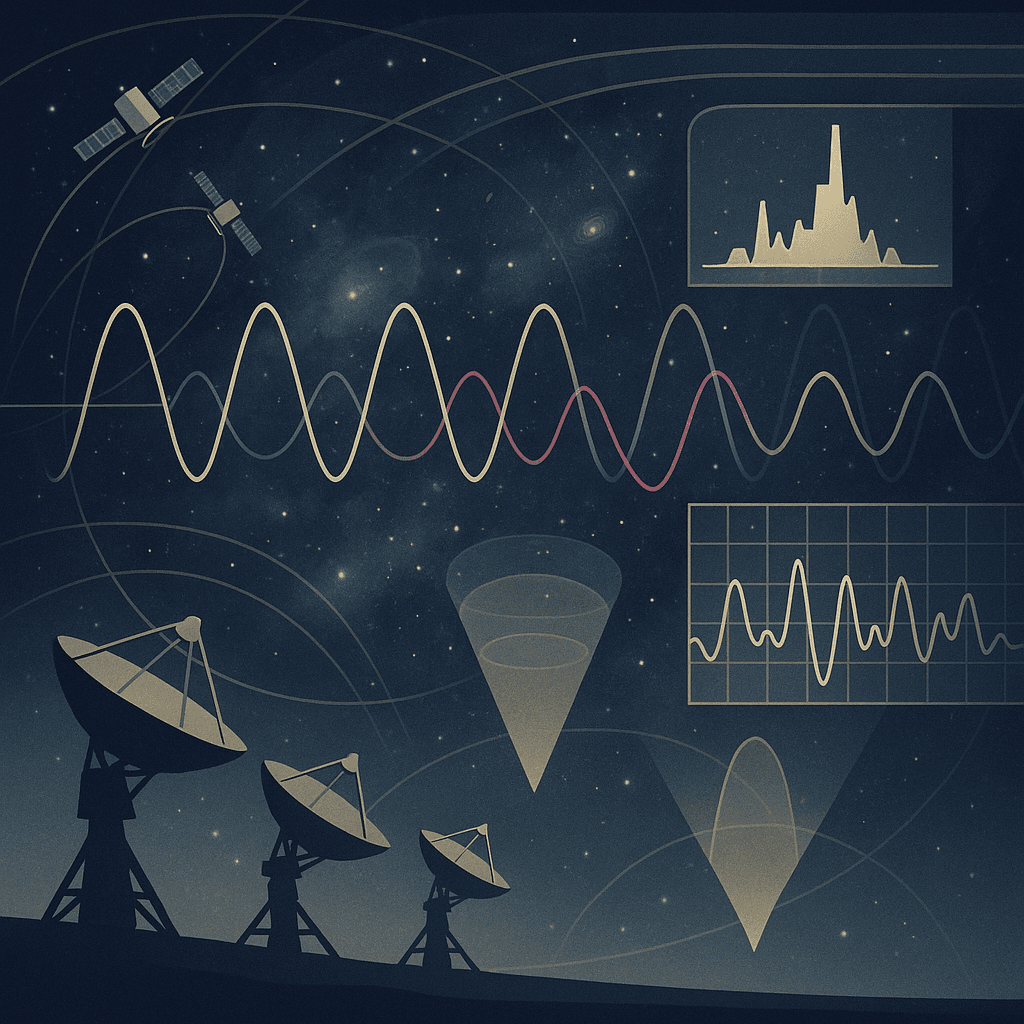
A Visual Representing the Search for Extraterrestrial Intelligence (Generated by Artificial Intelligence.)
The modern origins of SETI begin with a 1959 study by Cocconi and Morrison, who discussed the suitability of radio waves for interstellar communication. This was followed by Frank Drake’s 1960 Project Ozma, which listened for narrowband radio signals from nearby stars and is recognized as the first experimental application of modern SETI. NASA supported various SETI programs during the 1970s and 1980s, but federal funding ended in 1993, after which research was carried out primarily by private organizations and universities. The cultural and sociological dimensions of SETI have also become increasingly prominent over time. Messaging initiatives have gradually shifted from state institutions to individual and commercial efforts, resulting in a diverse communication practice in terms of representation, purpose, and content.
SETI research is based on the assumption that technological civilizations can generate artificial signals distinguishable from natural processes in the electromagnetic spectrum. Radio waves are considered the primary communication medium due to their relatively low attenuation through the interstellar medium and low energy requirements. Narrowband structures are rarely observed in natural astrophysical sources and thus may indicate technological origin. Early SETI literature focused primarily on narrowband signals; later periods expanded the research scope to include broadband signals, pulse-like structures, and complex modulation schemes.
Additionally, physical processes such as signal distortion by plasma in the interstellar medium, Doppler shifts, and velocity derivatives are incorporated into signal detection algorithms. Consequently, the technical framework of SETI requires substantial computational capacity and advanced signal processing methods.
The primary approach in SETI observations involves analyzing raw data from radio telescopes at very high frequency resolution. Signal detection is typically conducted using matched filtering logic. In addition to Fourier analysis for narrowband signals, monitoring time-frequency structures, automated modulation classification, and correlation-based methods may also be employed. A common feature of these methods is their requirement to analyze massive volumes of data using parallel processing architectures.
As the research field has expanded, assumptions about signal types have diversified. Broadband modulations, short-duration pulses, signals mimicking natural sources, and artificially modified astrophysical emissions are now also considered potential indicators. This has led SETI to develop a multidimensional search strategy rather than focusing on a single signal type.
Square Kilometre Array (SKA) is regarded as a major milestone in SETI research. Thanks to its large collecting area and flexible electronic infrastructure, it can simultaneously scan large portions of the sky with high sensitivity. The SKA’s observational capabilities enable SETI analysis to be conducted concurrently with other astronomical programs. This approach expands the search volume while reducing the cost of long-term observations.
The SKA’s digital signal processing infrastructure allows different research groups to integrate their own detection algorithms into the system. This enables multiple assumptions about signal types to be tested in parallel on the same data set. This structure enhances SETI’s experimental flexibility and contributes to the expansion of the research field.
SETI is not merely a technical research field. Communication theory and sociological frameworks also play a significant role. According to systems theory, communication involves mutual meaning-making under uncertainty, which presents a fundamental challenge in potential interactions with extraterrestrial intelligence. Any artificial signal received from space carries the nature of an indicator rather than a direct message and provides no definitive information about the sender’s intentions, motivations, or communication language.
In this context, SETI is also regarded as a theoretical field that evaluates the boundaries of communication possibilities. It is anticipated that communication with extraterrestrial intelligence would replicate, at an extreme scale, the difficulties encountered in intercultural encounters among human societies.
Messaging initiatives constitute a distinct branch of SETI research. A clear shift in the content of messages sent from the 1960s to the present has been observed. Early messages were based on national symbols, scientific achievements, and selected representations of human culture; later periods have seen increased participation by individuals and commercial entities. This has triggered debates within global society regarding representation, risk, and responsibility.
This debate has deepened disagreements over the potential risks and benefits of Active SETI. Some approaches argue that sending messages could encourage interspecies interaction, while others emphasize the dangers of revealing Earth’s location to unknown civilizations.
NASA has contributed to SETI research since the 1960s by supporting various radio telescope projects and helping to develop the scientific infrastructure of SETI. After the federal funding component of the program ended, research was largely transferred to private institutions. Nevertheless, NASA remains a key player in astrobiology and the search for technological signatures.
SETI is a multidisciplinary approach aimed at understanding the signatures of technological civilizations. The technical power of radio astronomy, signal processing methods, cultural communication models, and sociological debates have all expanded the scope of this field. Ongoing research, driven by increasing observational capacity, growing data volumes, and new communication models, will evolve into a more comprehensive framework in the future.
Cabrol, N. A. “Alien Mindscapes: A Perspective on the Search for Extraterrestrial Intelligence.” *Astrobiology* 16, no. 9 (September 2016): 661–676. Accessed December 9, 2025. https://doi.org/10.1089/ast.2016.1536
Cordes, James M., T. Joseph W. Lazio, and Carl Sagan. “Scintillation-Induced Intermittency in SETI.” *The Astrophysical Journal* 487, no. 2 (October 1997): 782–808. Accessed December 9, 2025. http://dx.doi.org/10.1086/304620
Harp, G. R., R. F. Ackermann, Alfredo Astorga, Jack Arbunich, Jose Barrios, Kristin Hightower, Seth Meitzner, W. C. Barott, Michael C. Nolan, D. G. Messerschmitt, Douglas A. Vakoch, Seth Shostak, and J. C. Tarter. “The Application of Autocorrelation SETI Search Techniques in an ATA Survey.” *The Astrophysical Journal* 869, no. 1 (December 2018): 66. Accessed December 9, 2025. http://dx.doi.org/10.3847/1538-4357/aaeb98
Kellermann, K. I. “The Search for Extraterrestrial Civilizations: A Scientific, Technical, Political, Social, and Cultural Adventure.” *arXiv preprint* (2023). Accessed December 9, 2025. https://arxiv.org/abs/2302.06446
Pröschold, Bernd. “Communication with Extraterrestrial Intelligence: Observations Based on Systems Theory.” *SSRN preprint* (2018). Accessed December 9, 2025. https://papers.ssrn.com/sol3/papers.cfm?abstract_id=3294358
SETI Institute. "SETI 101: Core Concepts & Projects – SETI Research." seti.org. Accessed December 9, 2025.
Siemion, Andrew P. V., James Benford, Jin Cheng-Jin, Jayanth Chennamangalam, James Cordes, David R. DeBoer, Heino Falcke, Mike Garrett, Simon Garrington, Leonid Gurvits, Melvin Hoare, Eric J. Korpela, Joseph Lazio, David Messerschmitt, Ian S. Morrison, Tim O’Brien, Zsolt Paragi, Alan Penny, Laura Spitler, Jill Tarter, and Dan Werthimer. “Searching for Extraterrestrial Intelligence with the Square Kilometre Array.” *arXiv preprint* (2014). Accessed December 9, 2025. https://arxiv.org/abs/1412.4867
Sánchez-Lozano, Juan Miguel, Eloy Peña-Asensio, and Hector Socas-Navarro. “Deciding Technosignature Search Strategies: Multi-Criteria Fuzzy Logic to Find Extraterrestrial Intelligence.” *Aerospace* 11, no. 1 (January 2024): 88. Accessed December 9, 2025. http://dx.doi.org/10.3390/aerospace11010088
Wright, Jason T. “Application of the Thermodynamics of Radiation to Dyson Spheres as Work Extractors and Computational Engines, and Their Observational Consequences.” *arXiv preprint.* (2023). Accessed December 9, 2025. https://arxiv.org/abs/2309.06564
Zapp, Mike. “Speaking Out to Outer Space: An Analysis of Humanity’s Messages to Extraterrestrial Intelligent Life, 1962–2018.” *Journal of Globalization Studies* 14, no. 1 (May 2023). Accessed December 9, 2025. https://doi.org/10.30884/jogs/2023.01.10

No Discussion Added Yet
Start discussion for "Search for Extraterrestrial Intelligence (SETI)" article
Historical Background
Scientific Foundations
Signal Detection and Technical Framework
Observational Programs
Communication Theory and Sociological Dimensions
Active SETI and Messaging Debates
NASA’s Role