


This article was automatically translated from the original Turkish version.
We all encounter many codes in our daily lives: ATM passwords, phone numbers, postal codes…
Did you know that countries also have their own “secret keys”?
Yes, you heard that right! Each country is identified by unique codes used in international and official procedures, and these codes are in fact the silent heroes of global communication, trade, and technology.
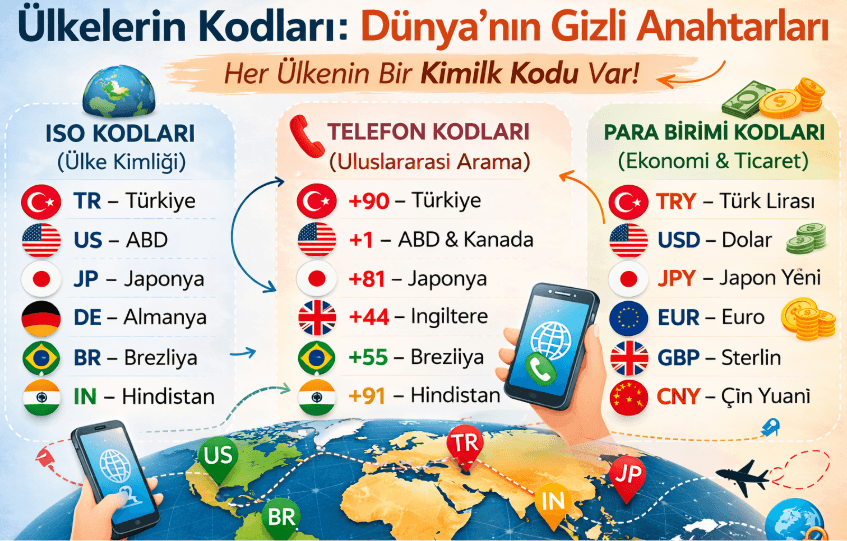
Country Codes Infographic (Generated by Artificial Intelligence)
International Organization for Standardization (ISO) assigns each country a unique ISO 3166 code. For example, Türkiye is coded as “TR”, the United States as “US”, and Japan as “JP”.
These short letter combinations are used in countless areas, from computer systems and airline reservations to banking and international trade. In short, each ISO code can be thought of as a country’s digital passport.
Telephone Codes (Generated by Artificial Intelligence)
When making international calls, the “+90”, “+1”, or “+81” you see at the beginning of a number are country codes. These not only direct calls to the correct country but have also become symbols of culture and geography.
Upon seeing a telephone code, you can instantly guess which continent or country the call is connected to.
Every country’s currency in global markets is identified by a unique three-letter code. For example, Türkiye uses TRY, Japan uses JPY, and the United States uses USD. These codes are vital not only for trade and foreign exchange transactions but also for understanding economic news and making global financial comparisons.
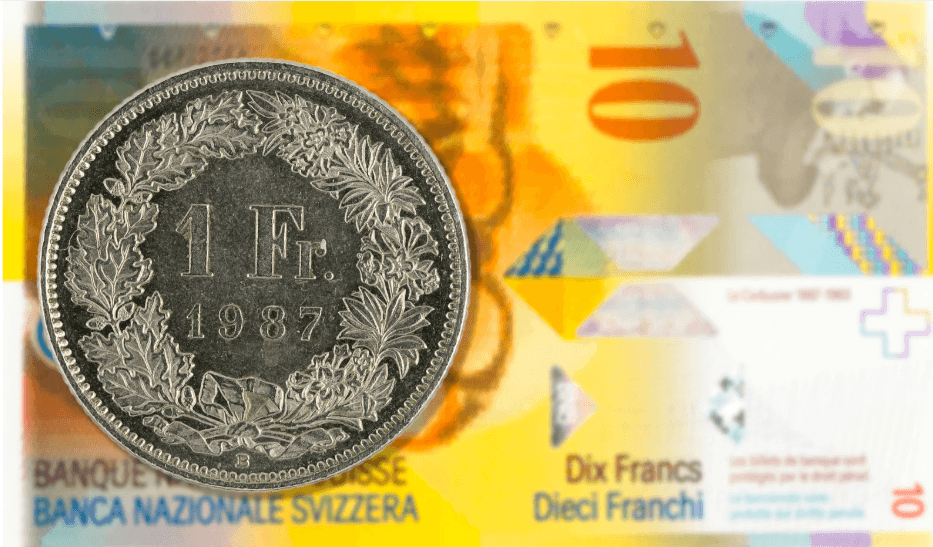
Swiss Franc (Confoederatio Helvetica) – (Generated by Artificial Intelligence)
The codes of countries sometimes conceal fascinating stories related to their history, culture, and abbreviations.
For instance, Switzerland’s ISO code is “CH”. Why “CH”? Because the country’s official Latin name is Confoederatio Helvetica. Thus, history and modern systems converge into a single code.
Codes facilitate international communication while preventing errors. An incorrect country code in an email address could misdirect a phone call abroad or cause confusion in foreign exchange transactions. In short, country codes form the silent but critical infrastructure of the global world.
If we think of the world as a map, each country is a point, and each point is represented by its own coded identity. These codes are the fundamental building blocks of an invisible network that ensures seamless international trade, communication, and cultural exchange.
Codes are more than just letters and numbers; each one is a small but powerful symbol representing a country’s digital and economic identity.
International Organization for Standardization. *ISO 3166 - Country Codes*. ISO, Accessed March 16, 2026. https://www.iso.org/iso-3166-country-codes.html.
Ministry of Foreign Affairs of the Republic of Türkiye, Translation Directorate. *Dünya Ülkelerinin Resmî İsimleri ve Sıfatlarının Yazımı*. January 2026. Accessed March 16, 2026. https://www.mfa.gov.tr/data/Terminoloji/dunya-ulkelerinin-resmi-isimleri-ve-sifatlarinin-yazimi-%28turkce-ingilizce%29-2026.pdf
Voss, Jakob. “Encoding Changing Country Codes for the Semantic Web with ISO 3166 and SKOS.” *arXiv* (2008). Accessed March 16, 2026. https://arxiv.org/abs/0801.3908
ISO Codes: The International Identity of Countries
Telephone Codes: The Key to Speaking with the World
Currency Codes: The Secret Signs of the Economy
An Interesting Fact: Codes Carry Cultural Stories
Why Are They Important?
