

This article was automatically translated from the original Turkish version.
Sedefkârlık is a wood inlay art form that involves embedding mother-of-pearl—obtained from the iridescent inner layer of shellfish such as oysters and mussels—into wooden surfaces using the inlay technique. The term “sedef” derives from the Arabic root sadef and is mentioned in the Qur’an as a symbol of purity, beauty, and clarity alongside pearls. In Ottoman culture, mother-of-pearl was regarded as a symbol of cleanliness and elegance; in Süleyman Çelebi’s Mevlid, which recounts the birth of the Prophet, Muhammad is likened to a pearl born within mother-of-pearl with the phrase “Ol Sadeften Doğdu Ol Dür Dânesi.”
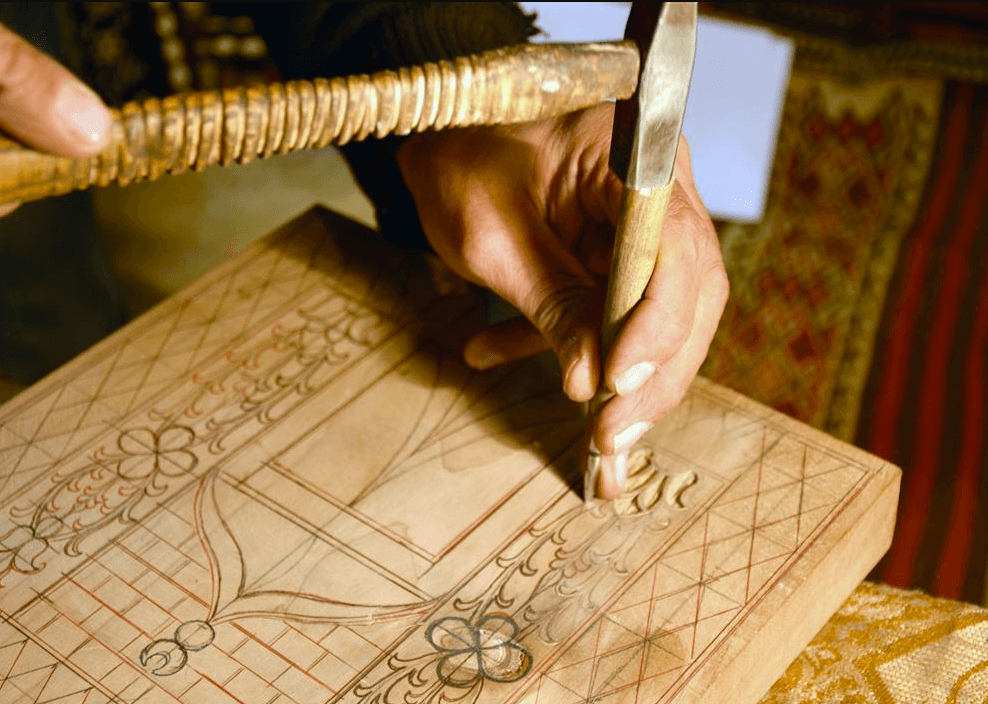
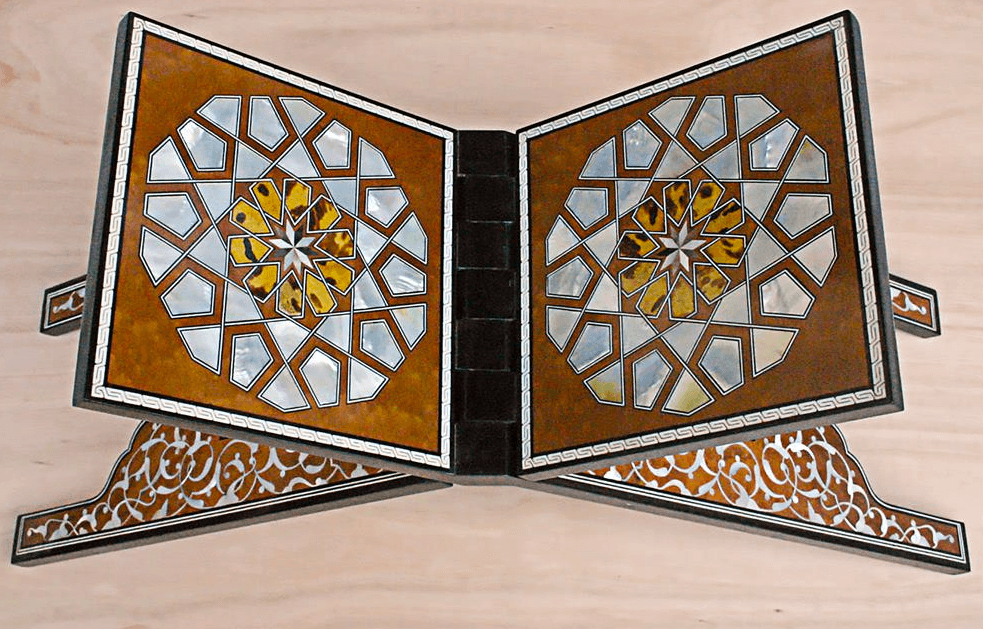
Sedefkârlık is primarily created by inlaying mother-of-pearl, abalone, ivory, bone, brass, or silver wires into recesses carved into wood. This technique has been used throughout history for both functional and aesthetic purposes, adorning items such as furniture, chests, mirrors, lecterns, door panels, pulpits, and Qur’an cases.
The use of mother-of-pearl as a decorative material dates back to Mesopotamian and Sumerian civilizations; excavations in the city of Ur have uncovered wooden game boards and musical instruments inlaid with mother-of-pearl and secured with bitumen. In Islamic art, the first known use of mother-of-pearl appears in the mosaics of the Samarra Palace in the 9th century. Geometric mother-of-pearl inlays are found on the doors of the II. Bayezid Mosque in Edirne from the 15th century; by the 16th and 17th centuries, this art had matured in Ottoman palace workshops and became known as Turkish-Ottoman sedefkârlık.
During the Ottoman period, figures such as Dalgıç Ahmed, Sedefkâr Mehmed Ağa, and II. Abdülhamid gained prominence as both architects and master inlayers. The doors of Topkapı Palace, Sultan Ahmed Camii, and Yenicami; the throne of IV. Murad from his Baghdad campaign; and the doors of the Hırka-i Saadet Chamber are among the finest examples of this art. In the 19th century, the Yıldız Sarayı Sedef Atölyesi established by II. Abdülhamid became the institutional center of modern mother-of-pearl production.
The center in Türkiye where sedefkârlık is most intensively practiced is Gaziantep. According to research, the roots of this craft in the city date back to 1963; the earliest examples emerged during the repair of pistol grips with mother-of-pearl. Over time, this practice evolved into an independent craft, and by the 1970s dozens of workshops were operating in the city.
The most commonly used wood in sedefkârlık is walnut; it is preferred for its ease of carving, uniform grain structure, and durability. Ebony, lignum vitae, and boxwood are also used. Alongside mother-of-pearl, brass, copper, and silver wires, velvet fabric (particularly for the interiors of chests), glue, and nitric acid are essential components of the production process.
The process of obtaining mother-of-pearl begins with removing and acid-cleaning the inner layer of oyster or mussel shells, then slicing them into thin plates. These plates are cut with a fine saw into shapes matching the intended motifs. The pieces are then fixed in place using a traditional adhesive made from oyster powder and egg white. The surface is finally sanded and polished to complete the work.
The motifs used in sedefkârlık are typically geometric, vegetal, or calligraphic in nature. Common examples include ten-pointed stars, sunbursts, rumi and palmette sequences, and floral designs such as tulips, roses, and carnations, as well as Kufic script bands.
Works are stylistically classified as “Istanbul work,” “Damascus work,” “Jerusalem work,” or “Vienna work,” reflecting regional differences in technique and compositional approach. Gaziantep sedefkârlık continues the Ottoman tradition but is distinguished by its use of walnut wood, brass wire, and dense geometric patterns.
The art of mother-of-pearl inlay continues in Türkiye, primarily through the enduring traditions of schools influenced by Istanbul, Damascus, Jerusalem, and Vienna. Today, only a small number of masters still produce works using traditional methods. However, local authorities, universities, and vocational training centers are opening courses to preserve this craft, and products are marketed in tourist markets.
The universal value of this art was internationally recognized in 2023 when Türkiye and Azerbaijan jointly submitted a dossier for its inscription on UNESCO’s Representative List of the Intangible Cultural Heritage of Humanity. Thus, sedefkârlık has been safeguarded as an art form that embodies the mastery of Anatolian craftsmanship and the continuity of Turkish-Islamic aesthetic heritage.
Diyanet İslam Ansiklopedisi. "Sedefkârlık." Türkiye Diyanet Vakfı İslâm Ansiklopedisi (TDV İA). Accessed October 17, 2025. https://islamansiklopedisi.org.tr/sedefkarlik
Eser, Faruk, and Bekir Cihad Bal. “Sedef Kakma Süslemesi ve Gaziantep Bölgesindeki Sedef Kakma Atölyelerinin Durumu Üzerine Bir Araştırma.” *Journal of Advanced Technology Sciences* (January 2017). Kahramanmaraş Sütçü İmam Üniversitesi. Accessed October 17, 2025. https://www.researchgate.net/publication/322056805_SEDEF_KAKMA_SUSLEMESI_ve_GAZIANTEP_BOLGESINDEKI_SEDEF_KAKMA_ATOLYELERININ_DURUMU_UZERINE_BIR_ARASTIRMA
Ministry of Culture and Tourism, Living Culture Inventory. "Sedef Kakma Sanatı." *Yaygın Kültürel Değerler ve Geleneksel El Sanatları Portalı*. Accessed October 17, 2025. https://yakegm.ktb.gov.tr/TR-359148/sedef-kakma-sanati.html.
Özdemir, Melda, and Şaban Yıldırım. “Gaziantep İlinde Sedef Kakmacılığının İncelenmesi.” *Akdeniz Sanat Dergisi* 9, no. 17 (2016): 416–423. Accessed October 17, 2025. https://dergipark.org.tr/tr/download/article-file/383411.
Şahan, Şirin, and Feryal Söylemezoğlu. “Gaziantep İlinde Sedef Kakmacılığı Üzerinde Bir Araştırma.” *Kültür ve Turizm Bakanlığı e-Kitap Koleksiyonu*, Cumhuriyet Üniversitesi El Sanatları Bölümü, 2002. Accessed October 17, 2025. https://ekitap.ktb.gov.tr/Eklenti/13820,68pdf.pdf.

Technical Features
Sedefkârlık Today and Its UNESCO Recognition