

This article was automatically translated from the original Turkish version.
+1 More
Author(s) | José Saramago | ||||||||
|---|---|---|---|---|---|---|---|---|---|
Original Name(s) | Essay on Lucidity | ||||||||
Publication Year | 2004 | ||||||||
Type(s) | Novel Political Allegory | ||||||||
ISBN | 9786052981320 | ||||||||
Seeing (Essay on Lucidity), is a novel published in 2004 by Portuguese writer José Saramago. This novel serves as a sequel to his 1995 work Blindness (Ensaio sobre a cegueira) and addresses democracy power and citizenship relations on an allegorical level.
In an unnamed country municipal elections see a large portion of voters cast blank ballots. After the first election results in 70 percent blank votes the elections are repeated but this time the proportion rises to 80 percent. The state interprets this unexpected outcome as a threat. The public’s silence and passive resistance expose the repressive reflexes of political authority. The situation evolves into a struggle of power between the state and its citizens.
The crisis of democracy and representation highlights the mismatch between popular will and representative mechanisms raising critical questions about the functionality of democratic processes. Social silence and resistance examine the strategies individuals and groups develop under pressure focusing on whether silence is a passive acceptance or a potential form of resistance. Unorganized collective action defines social movements that are informal spontaneous and horizontal in nature presenting alternative modes of participation and protest to traditional organized politics.
The novel draws attention through narrative features characteristic of Saramago’s style. Long uninterrupted sentences create a continuous chain of thought aiming to immerse the reader within the text. The limited use of conventional punctuation marks departs from established linguistic norms. A satirical and questioning narrative voice transforms the storytelling from mere event reporting into a critical perspective on social political and moral issues.
The novel progresses through characters defined by their roles rather than personal names. This anonymization strengthens the allegorical dimension of the narrative.
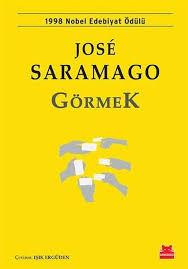
Saramago, José. *Görmek.* Kitap Kapağı Görseli. Trans. Ergüden, Işık. Istanbul: Kırmızı Kedi Yayınları, 2012. Accessed August 16, 2025. https://www.kitapyurdu.com/kitap/gormek/432629.html
[1]
Saramago, Jose. Körlük. Çevirmen: Derman, Aykut., Ergüden, Işık. Can Yayınları, 1995.

Author(s) | José Saramago | ||||||||
|---|---|---|---|---|---|---|---|---|---|
Original Name(s) | Essay on Lucidity | ||||||||
Publication Year | 2004 | ||||||||
Type(s) | Novel Political Allegory | ||||||||
ISBN | 9786052981320 | ||||||||
Plot
Themes
Narrative Features
Characters