


This article was automatically translated from the original Turkish version.
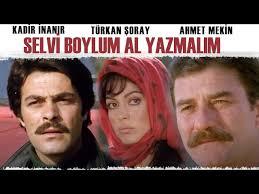
Selvi Boylum Al Yazmalım (Film)
Director(s) | Atıf Yılmaz | ||||||||
|---|---|---|---|---|---|---|---|---|---|
Screenwriter(s) | Ali Özgentürk (Original idea: Cengiz Aytmatov) | ||||||||
Lead Roles | Türkan Şoray (Asya), Kadir İnanır (Ilyas), Ahmet Mekin (Cemşit) | ||||||||
Production Year | 1977 | ||||||||
Duration | 1 hour 30 minutes | ||||||||
IMDb Rating | 8.5/10 | ||||||||
Genre | Drama Romantic | ||||||||
Selvi Boylum Al Yazmalım, is one of the significant productions of Turkish cinema, released in 1977. Directed by Atıf Yılmaz, the film is an adaptation by Ali Özgentürk of the novel of the same name by Kyrgyz writer Cengiz Aytmatov. Produced and distributed by Cankat Film, it stars Türkan Şoray, Kadir İnanır, and Ahmet Mekin. The film explores themes of love, loyalty, and labor, telling the tragic story of the relationship between truck driver İlyas and Asya. Released in Türkiye in 1977, the film was restored and re-released in 2010.
Selvi Boylum Al Yazmalım, begins with truck driver İlyas (Kadir İnanır) meeting and marrying Asya (Türkan Şoray). İlyas’s profession forces him to be frequently away from home, leaving Asya and their son Samet alone. When İlyas fails to return one day and betrays Asya, their relationship ends. Asya, with her son Samet, sets out on the road and meets a man named Cemşit (Ahmet Mekin). Cemşit opens his home to Asya and Samet. Years later, İlyas unexpectedly returns, forcing Asya to choose between him and Cemşit.
Selvi Boylum Al Yazmalım Trailer (YouTube)
Selvi Boylum Al Yazmalım, was filmed in 1977 in Istanbul, Ankara, and Kayseri. The screenplay, adapted by Ali Özgentürk from Cengiz Aytmatov’s novel, was shaped according to the emotional dynamics of Turkish society. Directed by Atıf Yılmaz and produced by Arif Keskiner, the film achieved a powerful visual and emotional aesthetic despite the technical limitations of its time. Cinematographer Çetin Tunca shot the village scenes in the rural areas of Kayseri, while urban scenes were filmed in Istanbul and Ankara. The film’s music was composed by Cahit Berkay.
The film questions whether love is merely passion or also sacrifice and labor. Asya’s choice between İlyas and Cemşit explores the multifaceted nature of love and leaves a lasting impression with its message: “Love is labor.”
Asya’s struggles as a single mother and the support offered by Cemşit open a discussion on gender roles of the era. Asya’s strength and Cemşit’s selflessness redefine traditional roles.
İlyas’s betrayal and Asya’s effort to build a new life reflect the emotional depth of loss and reconstruction. The film delicately portrays pivotal moments of rupture in human life.
Selvi Boylum Al Yazmalım, was released in 1977 and reached approximately 1.2 million viewers at the box office. After being restored and re-released in 2010, the film reached a broader audience. It received positive reviews from contemporary film critics and has since been recognized as an important work in Turkish cinema, continuing to be screened on television and digital platforms.
Beyazperde. "Selvi Boylum Al Yazmalım." Accessed May 2, 2025. https://www.beyazperde.com/filmler/film-186582/.
IMDb. "Selvi Boylum Al Yazmalım." Accessed May 2, 2025. https://www.imdb.com/title/tt0263975/?ref_=ls_t_18.
Selvi Boylum Al Yazmalım. Directed by Atıf Yılmaz. Yeşilçam Filmcilik, 1977. YouTube video, 2:50. Accessed May 2, 2025.
Sinemalar.com. "Selvi Boylum Al Yazmalım." Accessed May 2, 2025. https://www.sinemalar.com/film/891/selvi-boylum-al-yazmalim.
Selvi Boylum Al Yazmalım (Film)
Director(s) | Atıf Yılmaz | ||||||||
|---|---|---|---|---|---|---|---|---|---|
Screenwriter(s) | Ali Özgentürk (Original idea: Cengiz Aytmatov) | ||||||||
Lead Roles | Türkan Şoray (Asya), Kadir İnanır (Ilyas), Ahmet Mekin (Cemşit) | ||||||||
Production Year | 1977 | ||||||||
Duration | 1 hour 30 minutes | ||||||||
IMDb Rating | 8.5/10 | ||||||||
Genre | Drama Romantic | ||||||||
No Discussion Added Yet
Start discussion for "Selvi Boylum, Al Yazmalım (Film)" article
Plot
Cast
Production
Thematic Structure
Love and Labor
Social Gender and Sacrifice
The Pain of Loss and Rebuilding
Release and Reception
Awards and Nominations