


This article was automatically translated from the original Turkish version.
+2 More
Şereflikoçhisar is a district of Ankara Province located in the Central Anatolia Region of Türkiye. It is situated approximately 150 kilometers from the capital Ankara, to the southeast of Lake Tuz. The district covers an area of about 2,000 km² and features a typical Central Anatolian steppe landscape. The climate is continental, with hot and dry summers and cold, snowy winters.
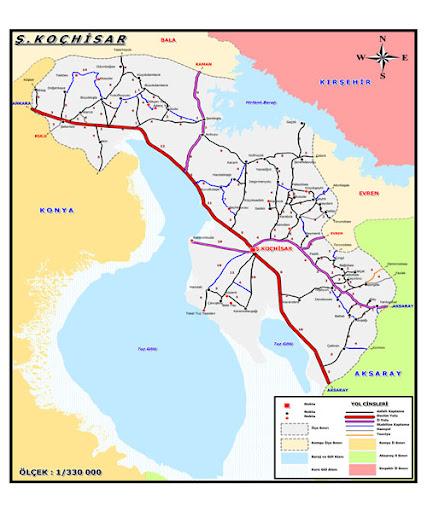
The district borders Bala and Evren districts of Ankara, Kaman district of Kırşehir, Ağaçören and Sariyahşi districts of Aksaray, and Kulu district of Konya. Lake Tuz, Türkiye’s second largest lake with an area of 1,642 km², lies entirely within the district boundaries. Additionally, the Hirfanlı Dam Lake, located in the northern part of the district, is used for irrigation and fish production.

Ankara, Aerial View of Şereflikoçhisar (Şereflikoçhisar Subprovince)
Şereflikoçhisar is an ancient settlement in Central Anatolia with historical roots extending back to the Hittites, Phrygians, Romans, Byzantines, and Seljuks. During the Anatolian Seljuk period, the town was known as “Koşhisar.” In the Ottoman era, it acquired the name “Koçhisar.” It suffered extensive damage during the Celali rebellions of the 17th century. From the 18th century onward, it began to be called “Koçhisar-ı Karaman” and later “Şerefli Koçhisar” due to the influence of the Şerefli Tribe, which settled in the region.
There are two main legends regarding the origin of the title “Şerefli.” According to the first, the name derives from the Şerefli Tribe, which lived in the area and held a special status within the Ottoman administrative system. According to the second legend, the title “Şerefli” was added during the reign of Sultan Abdülhamid II in recognition of the district’s population’s bravery and voluntary military support during the 1877–1878 Russo-Turkish War (the 93 War).
During the Republican period, to avoid confusion with other similarly named settlements, the official name “Şereflikoçhisar” was adopted, and the district was attached to Ankara in 1933.
The district consists largely of plains and steppe areas. One of its most notable geographical features is Lake Tuz, which lies directly along its border. Lake Tuz influences the region not only economically but also climatically; the surrounding area is typically dry and windy. Although the soil is partially suitable for agriculture, productivity is limited due to aridity and salinity. The district’s elevation is approximately 975 meters.
The climate is a harsh continental type characteristic of Central Anatolia. Summers are long, hot, and dry, while winters are cold, sometimes snowy, and prone to freezing conditions. Precipitation generally occurs in spring and autumn.
According to data from the Ankara Provincial Directorate of Culture and Tourism, the population of Şereflikoçhisar is 34,122. The majority of the population resides in the district center, while the remainder is distributed among surrounding villages and towns. In recent years, population growth has slowed significantly due to migration. In particular, the young population is migrating to larger cities such as Ankara, Konya, and Aksaray in search of education and employment opportunities.

Ankara, Map of Şereflikoçhisar (Ankara Governorship)
When examining the age distribution of the population, it is evident that the proportion of elderly residents is increasing while the youth population is declining. This trend has led to a reduction in the rural labor force and has resulted in the near-total depopulation of some villages. The ethnic composition of the district is largely homogeneous, with a Turkish majority. However, it is known that some families migrated to the district from the Balkans and Eastern Anatolia in the past. Social life retains its traditional structure, with kinship ties and neighborhood culture still holding significant importance.
The district’s economy is largely based on agriculture and animal husbandry, although arid climatic conditions limit agricultural production. One of the most important economic activities is salt production from Lake Tuz, which supplies a significant portion of Türkiye’s salt needs. In addition, there are small-scale businesses engaged in trade and handicrafts within the district.

Ankara, Lake Tuz Basin, Şereflikoçhisar (AA)
In addition to state schools, the district hosts a vocational college affiliated with Aksaray University. Educational levels have been rising in recent years. Culturally, traditional Anatolian life is preserved; weddings, holidays, and local festivals remain important community events. Cultural elements such as folk dances and regional costumes continue to be actively maintained.
The most famous natural attraction in Şereflikoçhisar is Lake Tuz. The lake is visited annually by thousands of domestic and international tourists, particularly during summer months for photography and nature walks. The historical ruins of Koçhisar Castle, after which the district is named, still remain today. Additionally, thermal springs such as Karakaya Hot Springs are located in the surrounding area.

Ankara, Lake Tuz, Şereflikoçhisar (Şereflikoçhisar Municipality)
Ankara Valiliği. "Şereflikoçhisar." Ankara Valiliği Resmî Web Sitesi. Accessed May 8, 2025. http://www.ankara.gov.tr/sereflikochisar
T.C. Ministry of Culture and Tourism. "Şereflikoçhisar." Ministry of Culture and Tourism Official Website. Accessed May 8, 2025. https://ankara.ktb.gov.tr/TR-152782/sereflikochisar.html
Şereflikoçhisar Belediyesi. "Coğrafyası." Şereflikoçhisar Municipality Official Website. Accessed May 8, 2025. https://www.sereflikochisar.bel.tr/sayfa/cografyasi.html
Şereflikoçhisar Belediyesi. "Tarihçemiz." Şereflikoçhisar Municipality Official Website. Accessed May 8, 2025. https://www.sereflikochisar.bel.tr/sayfa/tarihcemiz.html

No Discussion Added Yet
Start discussion for "Şereflikoçhisar (District)" article
History
Geography and Climate
Population and Demographic Structure
Economy
Education and Culture
Tourism and Natural Attractions