


This article was automatically translated from the original Turkish version.
+2 More
The Serial Peripheral Interface (SPI) protocol is a mechanism that enables fast and efficient data communication between electronic systems. Known for its simple yet effective structure, SPI is widely used especially in embedded systems.
The SPI protocol consists of four main signal lines:
The Serial Peripheral Interface (SPI) protocol is a simple yet effective serial communication method that enables full-duplex communication. This protocol typically facilitates data exchange between a master unit and one or more slave units. This section details the data communication technique of SPI.
SPI enables communication through four main lines:
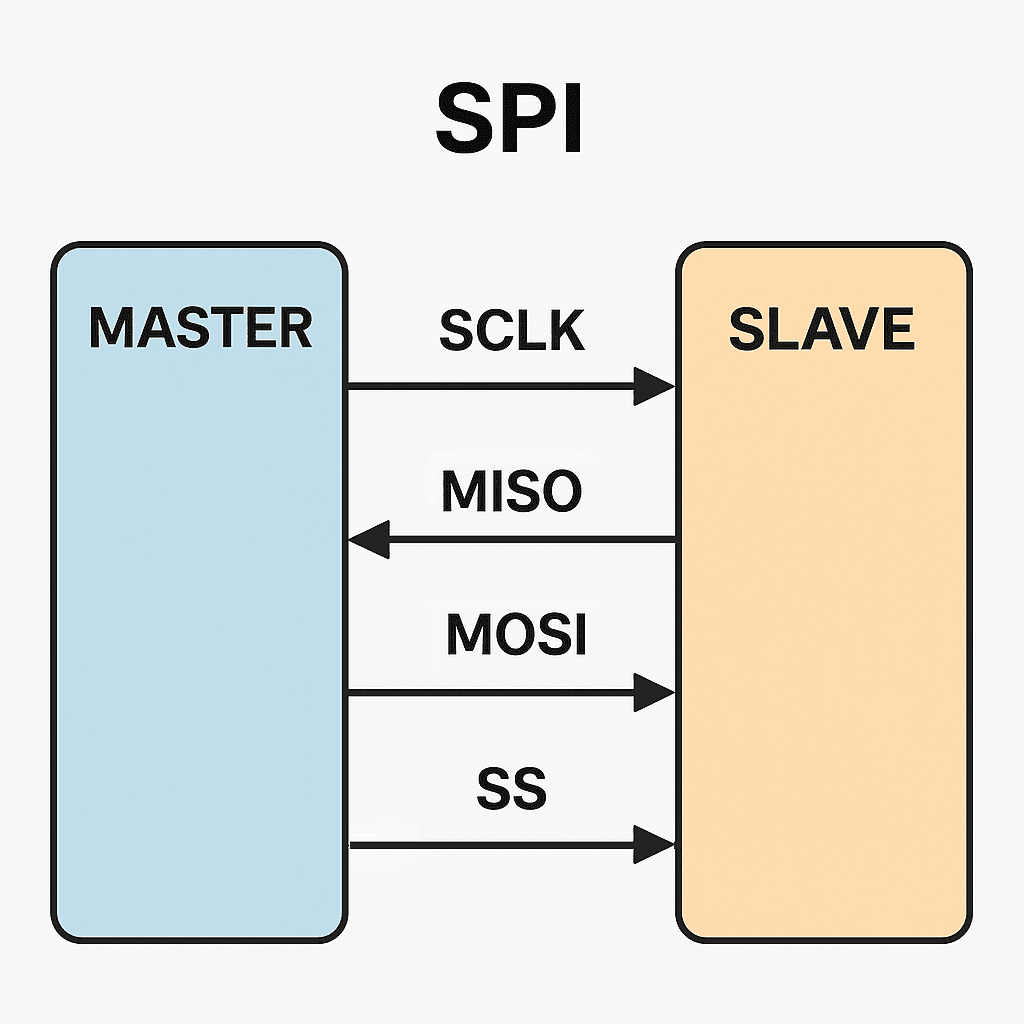
SPI Communication Protocol (generated by artificial intelligence.)
Data transmission occurs in a synchronized manner between the master and the selected slave unit:
SPI can operate in four different modes; these modes are defined by the clock polarity (CPOL) and clock phase (CPHA). These settings determine at which clock edge the data bit is sampled:
These modes enable compatibility between different devices and prevent erroneous data transfers.
SPI provides high-speed communication, with clock speed (SCLK frequency) being one of the most significant factors determining data transfer rate. Each device may support a different maximum SCLK frequency; therefore, system designers must select an appropriate clock frequency to ensure maximum efficiency.
In conclusion, the SPI protocol is a serial communication technique that enables flexible and high-speed data communication. With proper system design and selection of appropriate modes, SPI offers an effective solution for numerous embedded system applications.
SPI is widely used to achieve efficient and fast communication with various devices such as memory cards, display drivers, and sensors. It is particularly preferred in situations where data transfer speed is critical.
Analog Devices. "Introduction to SPI Interface." Analog Dialogue. Accessed https://www.analog.com/en/resources/analog-dialogue/articles/introduction-to-spi-interface.html.
Circuit Basics. "Basics of the SPI Communication Protocol." Circuit Basics. Accessed https://www.circuitbasics.com/basics-of-the-spi-communication-protocol/.
DevreYakan. "SPI Nedir?" DevreYakan. Accessed https://devreyakan.com/spi-nedir/.
Keysight. "What is SPI? The Basics of Serial Peripheral Interface." Keysight Technologies. Accessed https://www.keysight.com/used/us/en/knowledge/glossary/oscilloscopes/what-is-spi-the-basics-of-serial-peripheral-interface.
MegaPLC. "SPI Haberleşme Protokolü Nedir?" MegaPLC. Accessed https://www.megaplc.com.tr/spi-haberlesme-protokolu-nedir/.
SparkFun. "Serial Peripheral Interface (SPI)." SparkFun Electronics. Accessed https://learn.sparkfun.com/tutorials/serial-peripheral-interface-spi/all.
Total Phase Blog. "What is SPI Protocol & How to Debug SPI Communication?" Total Phase. Accessed https://www.totalphase.com/blog/2020/07/what-is-spi-protocol-how-to-debug-spi-communication/.

No Discussion Added Yet
Start discussion for "Serial Peripheral Interface (SPI) Communication Protocol" article
Basic Architecture and Components
Data Communication Technique
Structure of the Data Path
Data Transmission Process
SPI Modes
Data Transfer Speed and Optimization
Technical Characteristics and Advantages
Application Areas