


This article was automatically translated from the original Turkish version.
+2 More

Generated by Artificial Intelligence.
Serpentine Column
Type(s) | Monument | ||||||||
|---|---|---|---|---|---|---|---|---|---|
Date of Construction(s) | 478–477 BCE | ||||||||
Place of Origin | Temple of Apollo at Delphi (Greece) | ||||||||
City Where It Is Currently Located | Istanbul | ||||||||
Location | Sultanahmet Square | ||||||||
Location of the Single Snake Head | Istanbul Archaeology Museums | ||||||||
Serpentine Column is a bronze monument notable for its history spanning from the ancient Greek world through Byzantine and Ottoman times, located today in Istanbul’s Sultanahmet Square. Originally part of a tripod erected at the Temple of Apollo in Delphi as a victory monument following the Battle of Plataea (479 BCE), in which Greek city-states defeated the Persians, the column was designed in its original form as a three-legged tripod with a golden or gold-plated cauldron supported by three intertwined bronze serpents. Today, only the twisted shaft of the column remains standing.
Greek historians Herodotus and Thucydides record that the monument was erected in 478/477 BCE. At that time, it served as a symbolic dedication to the sacred site of Delphi, commemorating the united Greek victory. In the 4th century CE, during the transformation of Rome’s capital into Constantinople, Emperor Constantine I had it transported to Istanbul. Byzantine historians Sozomenos and Zosimos note that this relocation was tied to political and religious strategies. From that time onward, the monument continued to be displayed in the area known as the Hippodrome, later called Atmeydanı and then Sultanahmet Square.
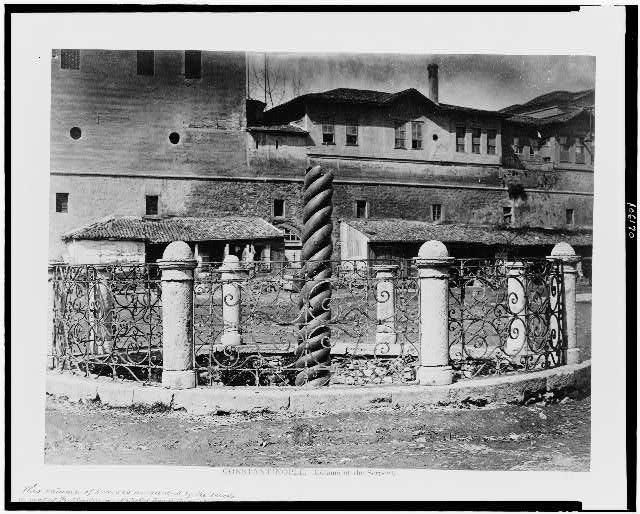
Constantinople Serpentine Column (Library of Congress)
The column was cast as a single piece of bronze and is hollow. It stands approximately 5.35 meters tall (its original height including the base was greater) and consists of three serpentine bodies rising through 29 spiral twists. Initially, the heads of these serpents, which supported the cauldron above, were separate. However, these heads were largely broken off in 1700, and only one was recovered in the 19th century and taken to the Istanbul Archaeology Museums.
The inscriptions on the column list the names of the 31 Greek city-states that participated in the Battle of Plataea. Initially, the inscription credited the victory to Spartan king Pausanias, but under pressure from other city-states it was revised to reflect a collective victory. These inscriptions are written in the Phokian variant of the Greek alphabet but in the Laconian (Spartan) dialect and remain legible today.
During the Byzantine period, the column was detached from its original cult of Apollo and reinterpreted as a symbol of imperial ideology. In the Ottoman period, it was regarded by the public as a charmed object protecting the city from serpents and was known by names such as “bronze dragon”, “three-headed dragon”, and “serpent charm”. In miniatures depicting Ottoman festivities, particularly those commissioned for the circumcision ceremony of Prince Mehmed III in 1582 in the Sûrnâme-i Hümâyûn, the Serpentine Column is frequently illustrated alongside the Obelisk of Theodosius and the Walled Obelisk.

The Three-Headed Serpentine Column depicted alongside the Obelisk of Theodosius and the Walled Obelisk in miniatures (Generated by Artificial Intelligence.)
The Serpentine Column is one of the rare monuments carrying layered historical and cultural meanings from antiquity to the present. Originally erected in the 5th century BCE at Delphi as a votive monument symbolizing the united Greek victory, it was later transported to Constantinople, the capital of Byzantium, and transformed into a political and ideological symbol. In the Ottoman period, it was perceived by the public as a charmed object believed to protect the city from evil. Over time, it became an aesthetic cultural artifact featured in travelers’ accounts; today, as one of the oldest bronze monuments displayed outdoors in Istanbul, it holds archaeological, artistic, and technical value.
Baran Çelik, Gülbahar. "Delfi’den Sultanahmet’e Bir Anıt Eserin Öyküsü." İstanbul: Eylül 2022. Accessed August 7, 2025.
Baran Çelik, Gülbahar. "Yılanlı Sütun Hakkında Bir Değerlendirme: Belgeleme ve Koruma Sorunları." Master's thesis, Kadir Has Üniversitesi, 2012. Accessed August 7, 2025.
Baran Çelik, Gülbahar. “Açık Havada 2500 Yıllık Bronz Bir Anıt: Yılanlı Sütun.” *Vakıf Restorasyon Yıllığı*, no. 6 (2013): 23–27. Accessed August 7, 2025. https://isamveri.org/pdfdrg/D03505/2013_6/2013_6_BARANCG.pdf
Library of Congress. *Konstantinopolis. Yılanlı Sütun.* Photograph. Library of Congress, Print and Photograph Division. Accessed August 7, 2025. https://loc.gov/pictures/resource/cph.3c06170/.
Mansel, Arif Müfid. “İstanbul’daki ‘Burmalı Sütun’: Bugüne Kadar Yapılan Araştırmalara Toplu Bir Bakış.” *Belleten* 34, no. 134 (1970): 189–209. Accessed August 7, 2025. https://belleten.gov.tr/tam-metin/3276/tur
Özaltın, Fatma Nilhan. “Theodosius Dikilitaşı ile Şeker İşleri, Sûrnâme-i Hümâyûn TSM H.1344.” *Sûrnâme-i Hümâyûn Araştırmaları*, no. 19 (2023): 101–111. Accessed August 7, 2025. https://dergipark.org.tr/tr/download/article-file/3179383

Generated by Artificial Intelligence.
Serpentine Column
Type(s) | Monument | ||||||||
|---|---|---|---|---|---|---|---|---|---|
Date of Construction(s) | 478–477 BCE | ||||||||
Place of Origin | Temple of Apollo at Delphi (Greece) | ||||||||
City Where It Is Currently Located | Istanbul | ||||||||
Location | Sultanahmet Square | ||||||||
Location of the Single Snake Head | Istanbul Archaeology Museums | ||||||||
History
Structural Features
Inscriptions
Cultural and Symbolic Interpretations
Locations and Functions of the Serpentine Column
Temple of Apollo at Delphi (Greece) – As a Votive Monument
Constantinople Hippodrome (Istanbul) – Political and Ideological Symbol
Ottoman Atmeydanı (Sultanahmet) – Charmed Protective Object
Travelogues and Engravings from the Ottoman and Republican Eras – Historical and Aesthetic Object
Present-Day Sultanahmet Square – Open-Air Cultural Heritage Site