


This article was automatically translated from the original Turkish version.
+1 More
Shahmaran Legend
Definition | The King of Snakes | ||||||||
|---|---|---|---|---|---|---|---|---|---|
Origin | Persian Mythological Figure | ||||||||
Characteristics | Wisdom Mystery | ||||||||
Anatomy | Woman's Head, Snake's Body | ||||||||
Habitat | Tarsus Underground Cave | ||||||||
Crime Scene | Şahmaran Bath (Tarsus) | ||||||||
Oral Tradition | Tarsus Folk Legends | ||||||||
Written Source | The Work Named Câmâsbnâme | ||||||||
The Shahmaran Legend; a traditional narrative cherished and preserved through oral and written cultural traditions within Turkish storytelling, reaching the present day in various forms.【1】 The mythical creature known as Shahmaran or Shahmeran, described as having a human head—largely female—and a serpent’s body, derives from the Persian expression “Shah-i Mârân,” meaning “king of serpents.” In Semitic legends, this being is referred to as “Yamliha,” a name carrying the meanings “to rule” or “to reign,” and is also regarded as one of the seven figures in the story of Ashâbu’l-Kahf (the Seven Sleepers).【2】
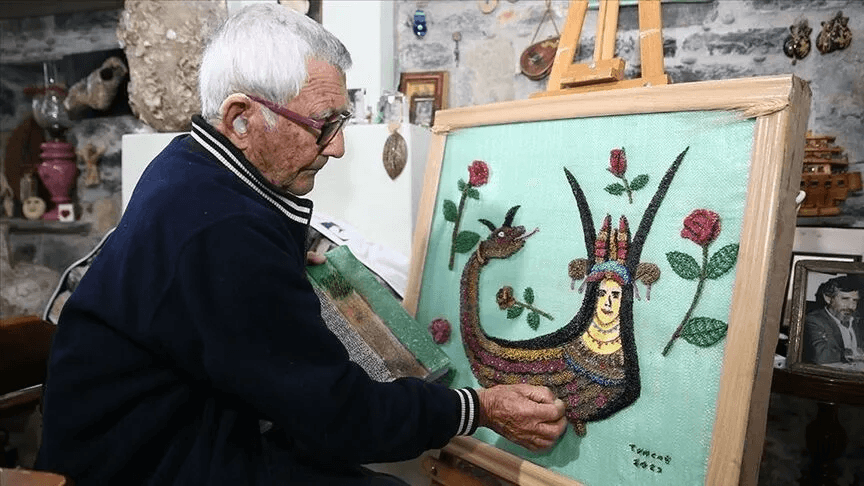
Şahmaran Tablosu (AA)
Shahmaran is a mythical character recognized as the king of serpents, embodying wisdom, mystery, and nature in folktales, legends, and folk art. The human head and serpent body in visual representations symbolize both human qualities and the power and danger inherent in the serpent lineage. This mythological contradiction arises from the fusion of the serpent’s cold and frightening image with the grace, light, and beauty associated with femininity, all united in a single form.【3】
In mythological narratives, Shahmaran is portrayed as a beautiful, young, and enchanting woman, shaped by specific morphological elements. The figure possesses striking eyes, face, and gaze, with jet-black hair. Upon her human head rests a radiant crown adorned with horns and precious stones. When examining Shahmaran’s body structure and color palette, the upper portion of the body begins with a milky white skin tone, gradually transitioning into a dark green serpent body and tail. The figure is also noted for its colorful and striking garments and jewelry. The extremities of her limbs end in serpent heads, completing this unified form.【4】
The oral and written literary sources of the Shahmaran narratives are rooted in Indo-Iranian mythology and literature, though researchers have proposed differing views regarding the origin of the legends as transmitted in Anatolia. In this context, studies suggest that the legend’s roots lie in the ancient Hittite narrative of “Illuyanka,” and that depictions of “Giants” in classical mythology provided a foundation for the emergence of this legend.
Tracing its historical trajectory from the 10th century BCE to the present, Western literary scholar E. J. W. Gibb argues that the foundational literary text containing the Shahmaran narratives, the Camasbname, originates from the One Thousand and One Nights.【5】 The geographical spread of the Shahmaran legend, which originated in the Indian subcontinent and spread through Iran to Anatolia, the Caucasus, and the Western world, is extensive. Indeed, data collected in the mid-19th century by the German traveler Fürs Pückler-Muskau during his visit to the Tarsus region document the legend’s presence in the oral traditions of Syria and Lebanon.【6】
The Shahmaran legend has acquired different names and symbolic interpretations depending on the regions where it was transmitted. In Eastern cultures, the legend manifests as the “Snake Woman” image, which bears resemblance in Western mythology to the female figure Medusa, whose hair consists of snakes and who turns those who meet her gaze to stone.【7】 The literary transmission channel is represented by a work presented to Sultan Murad II in the 15th century by Musa Abdi, a Turkish translation of the Persian One Thousand and One Nights, known as Camasbname. This text was embellished with Islamic elements and restructured to align with the sociocultural framework of Muslim society. In various regions of Anatolia, numerous geographical sites are associated with Shahmaran: the Snake Castle (Shahmaran Castle), Shahmaran Bath, and Shahmaran Statue in Tarsus, as well as the Shahmaran Cave in Siirt and Shahmaran Hill in Iğdır, exemplify this spatial connection.
The events underlying the Shahmaran legend unfold geographically in the district of Tarsus, Mersin, within a subterranean cave located seven levels beneath the earth, filled with precious stones, gardens, and prosperity. The literary foundation of these narratives rests upon the work known as Camasbname, which holds a prestigious position in Persian and Turkish literature.【8】 This work recounts the experiences of Camasb, the son of Danyal, who was both a physician and a prophet. While seeking a cure for his death, Danyal encounters the angel Jibril in human form on a bridge over the Ceyhan River. To verify his identity, Danyal consults a book of wisdom but accidentally drops it into the river, saving only a few pages. Before his death, Danyal placed these pages in a chest and entrusted them to his wife, instructing her to give them to their future sons.
After the death of Prophet Danyal, his son Camasb, who struggled in various endeavors, began working as a woodcutter using donkeys provided by his mother. One day, while gathering firewood with his friends, he took shelter from the rain in a cave and, while stirring the soil with a hoe, discovered a marble slab. When he and his friends lifted the slab, they encountered a mysterious well filled with honey. Camasb was lowered into the well by his friends to collect the honey. As the honey neared depletion, his friends abandoned him at the bottom, sealing the well and leaving. Alone in the dark, Camasb killed a scorpion approaching him, then widened the hole from which it emerged with his pickaxe, revealing an iron door. Behind the door lay a garden with a central pool. Camasb lay down on a throne and fell asleep; upon waking, he found himself surrounded by thousands of snakes. The king of serpents, Shahmaran, told Camasb not to fear and asked how he had come there. After listening to Camasb’s story, Shahmaran began recounting the tale of Bulukiya.【9】
Bulukiya, the son of an Egyptian ruler, ascended the throne after his father’s death and discovered a book containing Na’t-i Mustafa in a chest within the treasury. Driven by his love for Prophet Muhammad, he embarked on a journey. During his travels, he encountered a group of snakes on an island and met Shahmaran, the white serpent who was their king. Later, leaving Shahmaran, Bulukiya traveled to Damascus, where he met Affan, who was searching for the ring of Prophet Solomon. Learning that Bulukiya knew Shahmaran’s location, Affan deceived him, captured him, and took Shahmaran along. They crossed seven seas to reach the tomb of Prophet Solomon, but there an evil dragon killed Affan. In the end, Bulukiya was guided home by Khidr after encountering the King of the Fairies and other mystical beings.【10】
After finishing Bulukiya’s tale, Shahmaran permitted Camasb to return to his homeland but warned him not to visit the bathhouse. Upon returning home, Camasb eventually had no choice but to go to the bathhouse, where he learned that Sultan Keyhüsrev was ill. The sultan’s vizier, realizing Camasb had seen Shahmaran, pressured him to reveal the location of the well. Under duress, Camasb pointed out the well. After Shahmaran was extracted and killed, the water in which her body parts were boiled granted Camasb extensive knowledge in medicine and alchemy. Through Shahmaran’s remedy, Sultan Keyhüsrev recovered and appointed Camasb as his vizier.【11】
According to the legend of Shahmaran and Camasb, Camasb, who earned his living as a woodcutter, accidentally discovered a well filled with honey while working in the forest. His companions deceitfully lowered him into the well to retrieve the honey, then abandoned him at the bottom and sealed the entrance. Seeking escape in this dark underground space, the young woodcutter encountered Shahmaran, the ruler of serpents, whose upper body was human and lower body serpent-like, and who could speak human language. Observing Camasb’s desperate attempts to escape, Shahmaran declared that she had foreseen her death would come through human hands and initially refused to release him. But unable to remain indifferent to Camasb’s persistent pleas and supplications, she agreed to free him on the condition that he swear never to reveal the location of her hidden abode, then sent him back to his family.【12】
During this time, the sultan of Tarsus fell ill with a disease deemed incurable, and the physicians of the era concluded that the cure lay in consuming Shahmaran’s flesh. Although immense rewards and promises were offered to anyone who could find and bring Shahmaran, no one among the people dared undertake this dangerous quest. When the vizier informed the sultan that those who had seen Shahmaran developed scales resembling snake skin on their bodies—particularly on their backs—the sultan ordered all citizens of the city to bathe in the public bathhouse.【13】 Camasb, unwilling to break his sacred vow to Shahmaran, steadfastly avoided the bathhouse, but was forcibly taken there by guards. When the bath attendants noticed the scales on his back, he was immediately brought before the authorities and subjected to intense interrogation and pressure to reveal Shahmaran’s hiding place.
After Camasb was compelled to disclose Shahmaran’s location, the captured Shahmaran, honoring her promise to the youth, gave him instructions on what to do with her body after her death. She instructed that her flesh be boiled in a cauldron, and that the first boiling water be given to the vizier, the second to the sultan, and the third and final water to Camasb himself. Ultimately, Shahmaran was brought to the Tarsus bathhouse and killed; her body was boiled exactly as she had prescribed. Camasb, faithfully following Shahmaran’s strategic plan, gave the first water—containing poison—to the vizier, who died instantly. The sultan, drinking the second water—containing healing properties—fully recovered. Camasb, consuming the third water, gained heightened intellect and wisdom, and was appointed chief vizier by the sultan.【14】
According to this local narrative, the events begin when a young man named Cansab, who earned his living as a woodcutter, descended into a well with his friends to collect honey and encountered Shahmaran, the human-headed, serpent-bodied king of serpents. Betrayed by his companions, Cansab became trapped in the underworld and was captured by the snakes and brought before Shahmaran. Over time, a bond of mutual trust developed, and secrets were shared; fearing that these secrets would leak to the surface world, Shahmaran forcibly kept Cansab in the underground realm. After a long period of isolation, Shahmaran, unable to withstand Cansab’s persistent requests, allowed him to leave—but on the strict condition that he never visit a bathhouse, for if his skin came into contact with bathwater, it would become covered in snake scales, revealing that he had seen Shahmaran.【15】
Cansab maintained silence about his time underground for many years, until the ruling monarch fell victim to an incurable illness, altering the social balance. Upon the physicians’ declaration that the cure lay in Shahmaran, military forces were deployed to compel all citizens of the city to bathe in order to identify anyone who had seen her. Cansab attempted to evade this dangerous inspection but was ultimately captured and brought to the bathing area in Tarsus. As he was forcibly washed, Shahmaran’s prophecy came true: his entire body became covered in scales, exposing his secret. Under pressure, the young woodcutter revealed the location of Shahmaran’s hiding place. Shortly thereafter, Shahmaran was captured and killed in the historic bathhouse bearing her name; her body was divided into three parts and presented to the sultan. The sultan, healed by the remedy, rewarded Cansab by appointing him vizier. Upon learning of their leader’s death, the snakes, seeking vengeance, launched a collective assault on the human race.【16】
The historic Shahmaran Bath in Tarsus, Mersin, is regarded by the local population as a protective healing sanctuary endowed with mystical and medical powers, around which various rituals have formed. According to widespread folk belief, any person suffering from physical ailments who bathes there and prays will recover their health within a short time. At the center of this healing quest lies the bath’s central stone, believed to be the very spot where Shahmaran was killed and to bear her bloodstains. It is believed that those who rub their bodies three times against this stone will be purified of all illnesses and gain renewed energy. There is also a belief that those who touch these sacred areas, said to be stained with Shahmaran’s blood, will rejuvenate.【17】
Periodic changes in the bath’s architectural structure and the physical characteristics of the stains are interpreted as evidence supporting the idea of Shahmaran’s immortality. The annual, regular draining of accumulated fluids on the walls is linked by the people to the day Shahmaran was killed. This draining event is regarded as a tangible sign that the mythical being, like a serpent, sheds its skin and renews itself, thus never truly dying.【18】 Moreover, while organic bloodstains normally turn brown upon exposure to high heat and temperature, the sacred and extraordinary nature of Shahmaran’s blood causes the stains on the bath’s marble to defy this physical law, preserving their original color indefinitely.
According to another local legend from the Tarsus region, before leaving her underground palace, Shahmaran gathered her serpent subjects and informed them she would go to the bathhouse and then attend a celebration. Since then, the serpents underground have believed that the sound of drums heard from the surface signifies that Shahmaran’s wedding and festivities are still ongoing, and they await the day she will return. The legend states that if the drumbeats ever cease entirely, the serpents will understand that the celebration has ended and that Shahmaran has been killed; they will then launch a mass invasion of Tarsus, turning against humanity and erasing the city from the map. This collective invasion and destruction is termed the “Day of Judgment.”【19】
To prevent the serpents from emerging and harming humans, the tradition of playing drums during weddings, engagements, circumcisions, and military send-offs in Tarsus has become a customary obligation. To ensure uninterrupted sound, a special “drummers’ market” has been established in the district, where drums are played daily. According to this belief, the rhythmic sound of the drums reaches the layers of the underworld, keeping the serpents waiting for Shahmaran’s return and preventing their ascent to the surface. The local proverb “Adana selle, Ceyhan yelle, Tarsus yılanla yok olacak” (“Adana with wind, Ceyhan with flood, Tarsus will vanish with snakes”) clearly demonstrates how powerful and alive this legend and its associated collective fears remain in contemporary folk culture.【20】
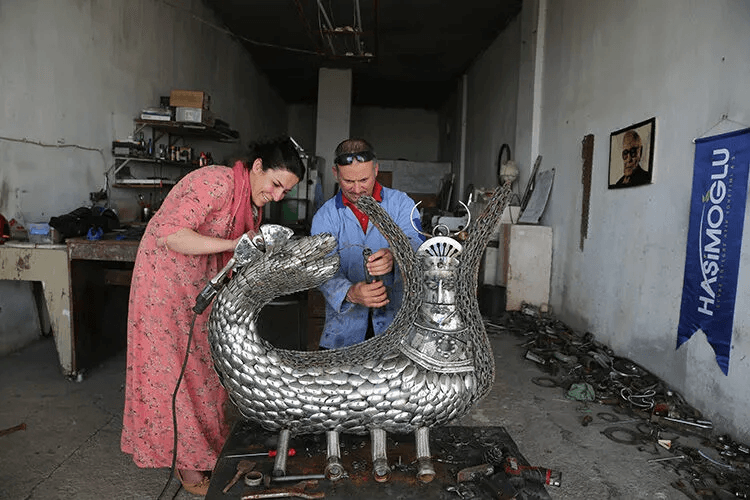
Şahmaran Heykeli (AA)
The mythological Shahmaran narrative has become a focal point of artistic interest across a broad spectrum, from poetry and theater to cinema, sculpture, painting, ceramics, and contemporary music compositions. In today’s art world, Shahmaran has moved beyond being a static element strictly bound to traditional textual forms; it has evolved into a dynamic structure continuously reinterpreted and recreated through its symbolic layers and imaginative power.【21】
In Turkish literature, the Shahmaran motif has been reimagined numerous times and has served directly or indirectly as the subject of many literary works. In narrative form, Tomris Uyar adapted the legend in her 1973 work “Ödeşmeler ve Şahmeran Hikâyesi,” Murathan Mungan in his 1993 work “Cenk Hikâyeleri,” and Erhan Bener in his 1998 work “Şahmaran Öyküsü.” Erhan Bener also wrote a play titled “Şahmaran” in 2000, while Hilmi Yavuz reinterpreted the myth in his 1994 narrative “Kuyu,” and Sennur Sezer did so in her 2006 book “Şahmaran.” In addition, authors such as Muhsine Helimoğlu, Yücel Feyzioğlu, and Ahmet Özdemir have also reconstructed the tale through their own perspectives. In children’s literature and performing arts, Gülşah Gülebenzer published a theatrical book for children titled “Şahmeran / Savaş Çiçekleri” in 2009.【22】
In poetry, the image of Shahmaran has become one of the central motifs enriching poets’ poetic worlds. Ahmet Telli produced an independent poem titled “Şahmeran,” while Behçet Aysan referenced the myth in his work “Şahmaran Kalesi.” Ali Büyükçapar published a poetry book titled “Şahmaran” in 2010, consisting of ninety-nine poems built around the narrative. In Ceyhan, one of the regions preserving the legend’s lineage, the “Yılankale Shahmaran Poetry Competition” has been organized to concretize this literary interest.【23】
Visual and auditory arts have brought the plastic values and dramatic structure of the Shahmaran legend to the silver screen and exhibition halls. In Turkish cinema history, Rahmi Kafadar (1972), Zülfü Livaneli (1993), and Yavuz Figenli (2004) directed films centered on the Shahmaran theme. In documentary filmmaking, Kenan Özer’s documentary “Yarısı İnsan Yarısı Yılan” (“Half Human, Half Snake”) was awarded Best Film in the National Amateur Category at the 2012 TRT Documentary Awards.【24】
The iconography of the Shahmaran figure has been explored in the visual arts disciplines of painting, sculpture, ceramics, tilework, and caricature. Artists Şükran Çelik Ergincan, Arzu Yıldan, Feyzaver Alpsar Turan, and Ataç Elalmış have held individual exhibitions focused directly on Shahmaran, institutionalizing this artistic legacy. Additionally, significant figures in Turkish painting—including Bedri Rahmi Eyüboğlu, Fikret Otyam, Balkan Naci İslimyeli, Serpil Akyıl, Yavuz Kılıçer, Ahmet Güneştekin, Nermin Han, Erol Deneç, Hüseyin Işık, Ali Asker Bal, Raziye Kubat, Fırat Bingöl, Zuhal Neccar, Tülin Yavuz, Murat Morova, Rafet Van, and Mehmet Akkaya—have created works centered on Shahmaran.【25】
In monumental and sculptural architecture, Emine Berika İpekbayrak created an iconic Shahmaran statue adorning the public squares of Tarsus; sculptors Mehmet Aksoy, Ozan Oganer, and Hüseyin Murathan Kesici have also reinterpreted the figure in three-dimensional form.【26】 In tilework, Süreyya Oskay and Fatma Şan; in ceramics, Ümit Can Gören and Orçun İlter; in wall decoration, Filiz Sünnetçioğlu; and in caricature, Cem Kızıltuğ, are among other artists who have incorporated the Shahmaran image into their works. In the field of auditory arts, composer Gökhan Tanacı created a special Shahmaran musical composition in 2012 for the thematic exhibition “Düş ya da Gerçek Şah-ı Maran” (“Dream or Reality: Shah-i Maran”) held in Istanbul, translating the legend into musical notation.【27】
In Anatolia’s cultural heritage, the Shahmaran motif is used as a symbolic decorative element in handwoven products such as carpets, kilims, and cicim, as well as in embroidered textiles. This motif exhibits similar structural characteristics across a geographical expanse stretching from Alanya (Cilicia) to the end of the Taurus Mountains, and from Central Anatolia to the South and East Anatolian regions; however, in some areas it is referred to as a dragon, while in others as a snake or Shahmaran.【28】 The motif, resembling compositions found in traditional under-glaze painting, typically consists of a female upper body fused with a coiled serpent tail. In textile products, Shahmaran’s presence is generally associated with goodness, health, immortality, happiness, protection, abundance, fertility, and prosperity.【29】
Altundal, Kevser Betül. "Türk Halk İnanışlarında Doğaüstü Ve Mitolojik Varlıklar." Master's thesis, Bilecik Şeyh Edebali Üniversitesi, 2025. Accessed July 12, 2026.https://tez.yok.gov.tr/UlusalTezMerkezi/TezGoster?key=V-oEQd0LkkqRGCXNzJWCTbvy9abB3sYAjC1VMfQUxa_aXTqBNeCCHZWqjxzVyef4
Ballı, Ali. "Üç Ayda 47 Bin Toplu İğneyle Şahmeran Tablosu Yaptı." Anadolu Ajansı. (2023). Accessed July 12, 2026.
Sincar, Halil İbrahim. "Çevre Kirliliğine Dikkati Çekmek İçin Atıklardan Şahmeran Heykeli Yaptı." Anadolu Ajansı. Accessed July 12, 2026.https://www.aa.com.tr/tr/yasam/cevre-kirliligine-dikkati-cekmek-icin-atiklardan-sahmeran-heykeli-yapti/2941325
Sökmen, Sultan, and Zeynep Balkanal. "Anadolu Sanatında Şahmeran Figürlü Örnekler." *Uluslararası Hakemli İnsan ve Sanat Araştırmaları Dergisi* 6, no. 3 (2021): 417-447. Accessed July 12, 2026.
Sökmen, Sultan, and Zeynep Balkanal. "Anadolu’da Önemli Bir Simge Olan Şahmeran’ın Halk İnanışlarındaki Yeri." *Bingöl Üniversitesi Sosyal Bilimler Enstitüsü Dergisi*, Volume 8, no. 15 (2018): 281-296. Accessed July 15, 2026.
Tepe, Fatıma Betül. "Şahmaran İle Fantastik Yolculuk: Musa Abdi’den Ignácz Kúnos Ve Oğuz Tansel’e." *Folklor Akademi Dergisi* 7, no. 3 (2024): 1467-1470. Accessed July 15, 2026.
Türkiye Kültür Portalı. "Şahmaran Efsanesi - Mersin." Türkiye Kültür Portalı. Accessed July 12, 2026.https://www.kulturportali.gov.tr/turkiye/mersin/kulturatlasi/sahmeran-tarsus
Önlü, Nesrin, and Neslihan Karadağ. "Anadolu Türk Kültüründe Şahmeran Efsanesi: Şahmeran’ın Tekstil Ürünlerinde Motif Olarak Kullanımı." *Dokuz Eylül Üniversitesi Güzel Sanatlar Enstitüsü Sanat ve Tasarım Dergisi*, no. 1 (2024): 62–78. Accessed July 12, 2026.
[1]
Fatıma Betül Tepe, “Şahmaran ile Fantastik Yolculuk: Musa Abdi’den Ignácz Kúnos ve Oğuz Tansel’e,” Folklor Akademi Dergisi 7, no. 3 (2024): 1468. Erişim tarihi: 15 Temmuz 2026.https://dergipark.org.tr/tr/download/article-file/4185606.
[2]
Kevser Betül Altundal, Türk Halk İnanışlarında Doğaüstü ve Mitolojik Varlıklar (Yüksek Lisans Tezi, Bilecik Şeyh Edebali Üniversitesi, 2025), 56. Erişim tarihi: 12 Temmuz 2026.https://tez.yok.gov.tr/UlusalTezMerkezi/TezGoster?key=V-oEQd0LkkqRGCXNzJWCTbvy9abB3sYAjC1VMfQUxa_aXTqBNeCCHZWqjxzVyef4.
[3]
Altundal, Türk Halk İnanışlarında Doğaüstü ve Mitolojik Varlıklar 57.
[4]
Altundal, Türk Halk İnanışlarında Doğaüstü ve Mitolojik Varlıklar, 57.
[5]
Sultan Sökmen ve Zeynep Balkanal, “Anadolu’da Önemli Bir Simge Olan Şahmeran’ın Halk İnanışlarındaki Yeri,” Bingöl Üniversitesi Sosyal Bilimler Enstitüsü Dergisi 8, no. 15 (2018): 285. Erişim tarihi: 15 Temmuz 2026.https://dergipark.org.tr/tr/download/article-file/462062.
[6]
Sökmen ve Balkanal, “Anadolu’da Önemli Bir Simge Olan Şahmeran’ın Halk İnanışlarındaki Yeri,” 284.
[7]
Sökmen ve Balkanal, “Anadolu’da Önemli Bir Simge Olan Şahmeran’ın Halk İnanışlarındaki Yeri,” 285.
[8]
Altundal, Türk Halk İnanışlarında Doğaüstü ve Mitolojik Varlıklar 59.
[9]
Altundal, Türk Halk İnanışlarında Doğaüstü ve Mitolojik Varlıklar 59.
[10]
Altundal, Türk Halk İnanışlarında Doğaüstü ve Mitolojik Varlıklar 60.
[11]
Altundal, Türk Halk İnanışlarında Doğaüstü ve Mitolojik Varlıklar 60.
[12]
Altundal, Türk Halk İnanışlarında Doğaüstü ve Mitolojik Varlıklar 60.
[13]
Altundal, Türk Halk İnanışlarında Doğaüstü ve Mitolojik Varlıklar 60.
[14]
Altundal, Türk Halk İnanışlarında Doğaüstü ve Mitolojik Varlıklar 60.
[15]
Altundal, Türk Halk İnanışlarında Doğaüstü ve Mitolojik Varlıklar 61.
[16]
Altundal, Türk Halk İnanışlarında Doğaüstü ve Mitolojik Varlıklar 62.
[17]
Altundal, Türk Halk İnanışlarında Doğaüstü ve Mitolojik Varlıklar 62.
[18]
Altundal, Türk Halk İnanışlarında Doğaüstü ve Mitolojik Varlıklar 62.
[19]
Altundal, Türk Halk İnanışlarında Doğaüstü ve Mitolojik Varlıklar 62.
[20]
Altundal, Türk Halk İnanışlarında Doğaüstü ve Mitolojik Varlıklar 62-63.
[21]
Sultan Sökmen ve Zeynep Balkanal, “Anadolu Sanatında Şahmeran Figürlü Örnekler,” Uluslararası Hakemli İnsan ve Sanat Araştırmaları Dergisi 6, no. 3 (2021): 419-420. Erişim tarihi: 12 Temmuz 2026.https://dergipark.org.tr/en/download/article-file/1909602.
[22]
Sökmen ve Balkanal, “Anadolu Sanatında Şahmeran Figürlü Örnekler,” 420.
[23]
Sökmen ve Balkanal, “Anadolu Sanatında Şahmeran Figürlü Örnekler,” 420.
[24]
Sökmen ve Balkanal, “Anadolu Sanatında Şahmeran Figürlü Örnekler,” 420.
[25]
Sökmen ve Balkanal, “Anadolu Sanatında Şahmeran Figürlü Örnekler,” 420.
[26]
Sökmen ve Balkanal, “Anadolu Sanatında Şahmeran Figürlü Örnekler,” 420.
[27]
Sökmen ve Balkanal, “Anadolu Sanatında Şahmeran Figürlü Örnekler,” 420.
[28]
Nesrin Önlü ve Neslihan Karadağ, “Anadolu Türk Kültüründe Şahmeran Efsanesi: Şahmeran’ın Tekstil Ürünlerinde Motif Olarak Kullanımı,” Dokuz Eylül Üniversitesi Güzel Sanatlar Enstitüsü Sanat ve Tasarım Dergisi, no. 1 (2024): 66. Erişim tarihi: 12 Temmuz 2026.https://dergipark.org.tr/en/download/article-file/4406054.
[29]
Önlü ve Karadağ, “Anadolu Türk Kültüründe Şahmeran Efsanesi: Şahmeran’ın Tekstil Ürünlerinde Motif Olarak Kullanımı,” 66.

Shahmaran Legend
Definition | The King of Snakes | ||||||||
|---|---|---|---|---|---|---|---|---|---|
Origin | Persian Mythological Figure | ||||||||
Characteristics | Wisdom Mystery | ||||||||
Anatomy | Woman's Head, Snake's Body | ||||||||
Habitat | Tarsus Underground Cave | ||||||||
Crime Scene | Şahmaran Bath (Tarsus) | ||||||||
Oral Tradition | Tarsus Folk Legends | ||||||||
Written Source | The Work Named Câmâsbnâme | ||||||||
No Discussion Added Yet
Start discussion for "Shahmaran (Shahmeran) Legend" article
Depiction of Shahmaran
Origin of the Legend
Shahmaran Narratives and Variants
Geographical Setting
Plot Structure
Camasb’s Encounter with Shahmaran
The Tale of Bulukiya and Shahmaran’s Role
Betrayal, Sacrifice, and Transformation into Wisdom in the Shahmaran and Camasb Legend
Legend at the Entrance of the Historical Shahmaran Bath
Revelation of the Secret and the Legend’s Conclusion
Shahmaran in Folk Beliefs
Drum Ritual and the Doomsday Myth
Artistic Reflections