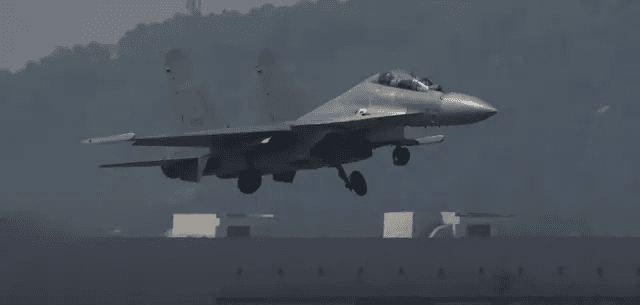



The Shenyang J-16 is a twin-seat, twin-engine, multirole combat aircraft manufactured by the Shenyang Aircraft Corporation (SAC) for the Chinese People's Liberation Army Air Force (PLAAF). The J-16 is a derivative of the Russian-made Su-27 Flanker family, equipped with China's domestically developed avionics and weapon systems. It is capable of performing a wide range of missions, including air superiority, ground attack, and anti-ship strike.

Shenyang J-16 (Anna Zvereva)
The development process for the J-16 is based on the experience China gained from the Su-27/Su-30MKK aircraft, which it purchased from Russia in the 1990s and later produced under license. Although the J-16 has a design similar to the Su-30MKK, its weight has been reduced and its radar cross-section lowered by using more composite materials in the fuselage. The aircraft's maiden flight was conducted between 2011 and 2012. The PLAAF began inducting J-16s into its inventory in 2014, and it entered operational service in 2015. The aircraft was first publicly displayed in 2017 during the parade for the 90th anniversary of the Chinese People's Liberation Army.
Shenyang J-16 (LovePlan)
One of the aircraft's achievements is the integration of domestically produced WS-10B "Taihang" turbofan engines in place of Russian-made engines. This has reduced China's dependence on foreign engine technology in its aviation industry.
Thanks to its powerful engines and modern avionics, the J-16 offers high performance and situational awareness.

Shenyang J-16 (LovePlan)
The J-16 can carry a wide and diverse range of ordnance thanks to its up to 12 external weapon hardpoints. This makes the aircraft flexible in both air-to-air and air-to-ground missions.
The J-16 is a critical platform for the PLAAF's air superiority and deep strike operations. It generally operates alongside more advanced stealth fighters like the J-20 as an "air superiority-strike" duo. After the J-20 clears the enemy airspace, the J-16 conducts precision attacks against ground and naval targets using its heavy ordnance load.
The most important variant of the J-16 is the J-16D model, which is specially designed for electronic warfare missions. Having made its maiden flight in 2015, the J-16D carries electronic warfare pods on its wingtips and is used for the Suppression of Enemy Air Defenses (SEAD).
Anna Zvereva. “Chinese Air Force, 61248, Shenyang J-16.” Flickr. Accessed: October 19, 2025. https://www.flickr.com/photos/130961247@N06/51524684603/in/photolist-2mv4tD6
Defense News. “Images reveal China’s J-16 jets stepping up introduction into service.” Defense News. Accessed: October 19, 2025. https://www.defensenews.com/air/2018/01/10/images-reveal-chinas-j-16-jets-stepping-up-introduction-into-service
Fandom. “Shenyang J-16.” Fandom. Accessed: October 19, 2025. https://aircraft.fandom.com/wiki/Shenyang_J-16
GlobalSecurity.org. “J-16 Red Eagle.” GlobalSecurity.org. Accessed: October 19, 2025. https://www.globalsecurity.org/military/world/china/j-16.htm
Jiayao, Li. “PLA Air Force holds flight drills.” Eng.Chinamil. Accessed: October 19, 2025. http://eng.chinamil.com.cn/CHINA_209163/TopStories_209189/9416890.html
LovePlane. “China Air Force J-16 Fighter: Beauty and Power Combined 歼16多用途战斗机 颜值与实力并存.” YouTube. Accessed: October 19, 2025. https://www.youtube.com/watch?v=797yJTj5Lo0
Military Factory. “Shenyang J-16.” Military Factory. Accessed: October 19, 2025. https://www.militaryfactory.com/aircraft/detail.php?aircraft_id=1157
Rusnavy.com. “Chinese J-16 fighter gets new engines, can take over Su-30MKK.” Rusnavy.com. Accessed: October 19, 2025. http://rusnavy.com/news/othernavies/index.php?ELEMENT_ID=13692


Design and Development
Domestic Engine in Tegration
Technical Specifications and Avionics
Weapon Systems
Operational Role and Variants
This article was created with the support of artificial intelligence.