


This article was automatically translated from the original Turkish version.
Generated with artificial intelligence.
Skill Maturity Model
Definition(s) | and portfolio management processes. program The Capability Maturity Model (CMM) is a five-level process maturity framework used by organizations to progressively develop their project | ||||||||
|---|---|---|---|---|---|---|---|---|---|
Primary Objective | Systematically defining and improving processes ensures effectiveness (achieving goals) and efficiency (reducing resource waste) and provides assurance to both internal and external stakeholders. | ||||||||
Maturity Levels | Optimizing Quantitatively Managed Defined Managed Initial | ||||||||
The Capability Maturity Model (CMM) holds a significant place among approaches developed to systematically enhance quality in software engineering and organizational process management. Initially focused solely on the discipline of software development, this model has gained widespread adoption over time as a tool for improving process capability across various industries.
Modern organizations require diverse management approaches to plan, execute, and monitor complex projects and programs. However, these approaches are insufficient if they consist only of technical methods; sustainable success requires processes that are integrated into the corporate culture and matured progressively. This need formed the foundation for the emergence of the Capability Maturity Model.
CMM assumes that organizational development is not merely a goal but a continuous journey of progress. In this context, the model provides a roadmap that guides institutional processes from their initial chaotic and reactive state toward a planned, measurable, and continuously improvable level.
Today, the maturity model is applied not only in the public sector or defense industry but also across diverse fields such as software, manufacturing, services, and logistics, strengthening organizations’ competitive capabilities in core areas such as quality management, project success, and resource optimization.
The primary objective of the Capability Maturity Model is to assist an organization in systematically enhancing its competence in managing projects, programs, and portfolios. This development is addressed from two main perspectives: internal capability development and external assurance provision.
The internal perspective aims for the organization to review its own processes, identify deficiencies, optimize resource utilization, and increase investment efficiency. The greatest gain here is not merely documenting processes but deeply embedding them into the organizational culture. In this way, success becomes based on institutionalized and repeatable patterns rather than individual anecdotes.
The external perspective seeks primarily to instill confidence in external stakeholders. For contractors, subcontractors, or service providers, achieving a high level of maturity offers a strong performance guarantee to potential customers and business partners. In this context, the capability maturity level becomes a measurable and comparable performance indicator not only within the organization but also across the industry.
The model’s scope encompasses every stage of organizational processes: from project planning and resource management to quality assurance mechanisms and a culture of continuous improvement. All subprocesses are structured within the CMM framework according to progressive maturity levels. Thus, organizations lay the groundwork not only for short-term project success but also for long-term competitive advantage.
The emergence of the Capability Maturity Model stems from the need for controllable quality management in the rapidly growing field of software engineering. In the 1980s, large-scale software projects in the public sector and defense industry frequently resulted in costly delays and failures, necessitating the development of objective criteria to systematically evaluate processes.
In this context, the foundations of the model were laid by the Software Engineering Institute at Carnegie Mellon University, and the first version was published in 1987. The initial users of the model were predominantly defense industry contractors. These organizations gained the opportunity to evaluate their software development processes against an independent framework and improve their weak areas.
Over time, the model’s structured improvement approach extended beyond the software sector and was adapted to other domains such as hardware development, service delivery, systems engineering, and organizational management. During this expansion, the CMM structure was enhanced and integrated under the Capability Maturity Model Integration (CMMI) framework, creating a unified structure that facilitated cross-disciplinary transitions.
This historical development trajectory demonstrates that CMM is not merely a certification or audit tool but a methodology that guides organizations on a continuous journey of learning and growth.
The Capability Maturity Model does not view the development of organizational competence solely as the improvement of technical processes; it also incorporates elements such as organizational culture, human resources, leadership, and management skills into this process. The fundamental premise of the model is that the key to sustainable success lies in the structured, phased, and measurable maturation of capabilities.
In this framework, the model is based on several core principles:
These core principles ensure that CMM functions not as a static collection of documents but as a dynamic development ecosystem.
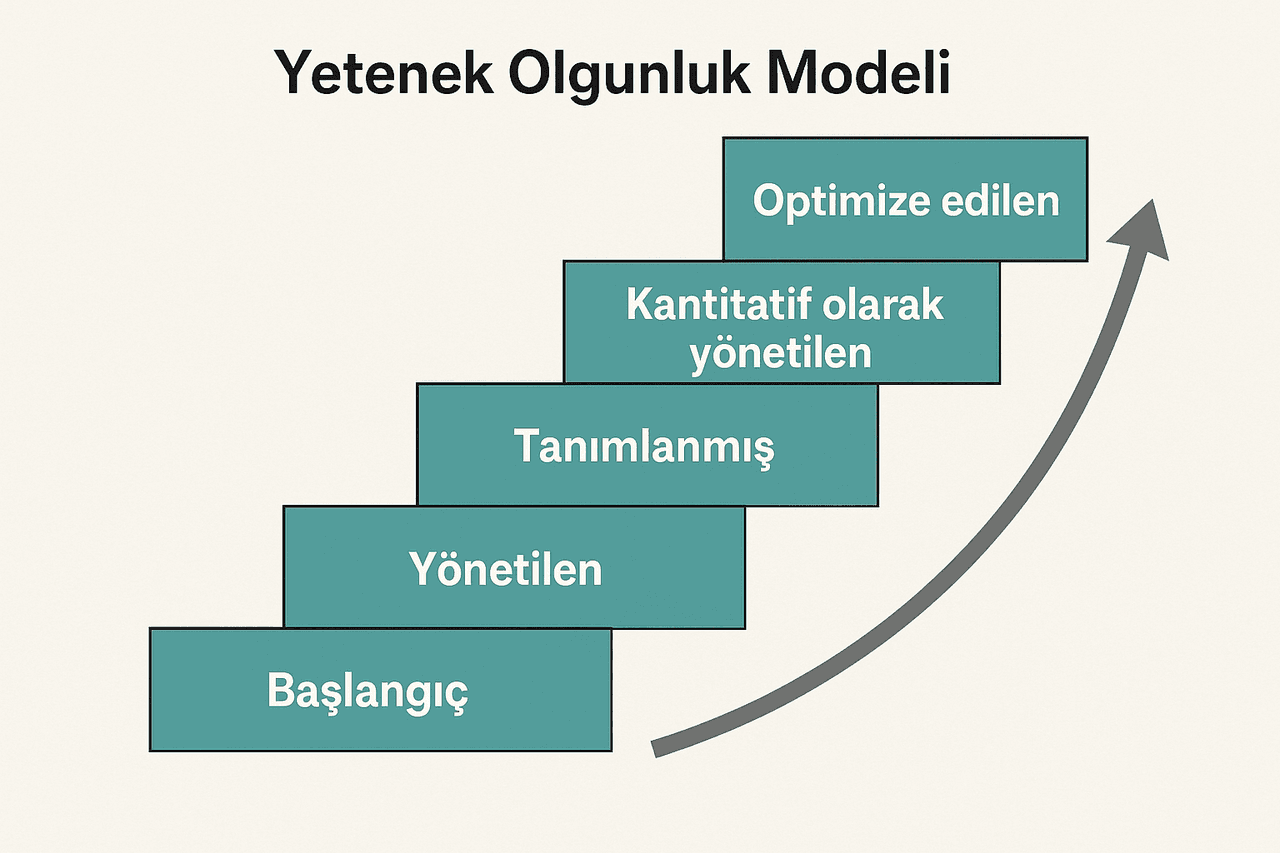
One of the most distinctive features of the Capability Maturity Model is its evaluation of organizations according to a five-stage maturity scale. This scale represents the evolution of organizational processes from random and chaotic structures to planned and optimized systems.
Organizations at the lowest level typically lack defined processes. Operations depend on individual efforts, so success or failure is tied to personal performance. Processes are reactive; planning, control, and documentation are nearly nonexistent.
At this level, basic project management disciplines are introduced. Methods derived from experience enable repeatable success in similar projects. Fundamental management areas such as requirements management, configuration management, and quality assurance become evident. Projects become planable, trackable, and reportable.
The third level is the stage where the organization establishes its own standard set of processes. All teams adhere to these standards. Documentation is detailed, inter-functional coordination is enhanced, and employee competencies are continuously supported through training programs.
In this phase, process performance is continuously monitored using quantitative data. Statistical control methods enable predictable product quality and project outputs. Data-driven management increases predictability and prevents deviations.
The highest maturity level focuses on continuous improvement. Organizations use quantitative feedback to continually update and enhance their processes with innovative techniques. Mechanisms to prevent recurrence of errors and the adoption of new technologies are key characteristics of this level.

Capability Maturity Model (generated by artificial intelligence.)
This five-stage structure, along with the defined competence areas at each level, aims to systematically and sustainably enhance an organization’s capabilities.
One of the conceptual pillars of the Capability Maturity Model is the concept of Key Process Areas (KPA). KPAs clearly define the fundamental requirements an organization must meet at each maturity level. This makes the success criteria for each level concrete and measurable.
A Key Process Area includes a specific set of objectives and the application methods required to achieve them. For example, at Level 2, key process areas for an organization include project planning, requirements management, software quality assurance, configuration management, and subcontractor management. These areas ensure that projects are grounded in a structured, predictable, and trackable framework.
In higher levels, process areas become more complex and support the organization’s institutional learning capacity. At Level 3, organizational process definition, peer reviews, and continuous training take center stage. At Levels 4 and 5, advanced areas such as quality measurement, statistical process control, process change management, and technology management come into play.
KPAs can be flexibly adapted to suit an organization’s internal structure and industry. Thus, the model functions not as a rigid template but as a guiding framework.
The evolved version of the Capability Maturity Model, Capability Maturity Model Integration (CMMI), was designed to address the limitations of the original CMM structure and to evaluate different disciplines through a holistic perspective.
While CMM focused primarily on software development processes, CMMI expanded this scope to integrate hardware development, systems engineering, service delivery, and procurement under a single framework. This ensures cross-disciplinary compatibility and holistic management capability.
Another difference lies in structure and flexibility. CMM is based on a predefined, fixed phased progression model, whereas CMMI offers two distinct representations: staged and continuous. This allows organizations to mature their processes either through phased maturity levels or by addressing each process area individually.
Another innovation of CMMI is its alignment with modern software development approaches. Particularly, the shortening of feedback cycles and the integration of Agile-compatible practices enable organizations to respond effectively to rapidly changing market dynamics.
A contemporary approach that preserves the foundational elements of traditional maturity models while flexibly adapting them to project, program, and portfolio management (P3 Management) is the Praxis Competency and Maturity Model.
The Praxis model distinguishes between competence and maturity, enabling organizations to develop functional capabilities suited to their specific context. The model is built on a function-based framework, where each function is evaluated using defined indicators and competence criteria.
The central idea here is that an organization does not need to mature all functions simultaneously; instead, each function can be prioritized and enhanced according to organizational needs. This flexibility increases Praxis’s applicability across diverse sectors in the modern business world.
The Praxis approach brings the flexible implementation spirit of ISO 9000 quality management standards to project and program management. Thus, each organization can design a maturity system aligned with its internal operations while remaining faithful to common principles.
The Capability Maturity Model offers numerous strengths by systematizing and making organizational development measurable. First, its phased development approach allows even complex processes to be improved step by step. This incremental structure reduces the difficulty organizations face in adapting to sudden changes.
Another strength is its ability to foster a common way of working across the organization through documented and standardized processes. This culture minimizes dependency on individual performance and ensures sustainable quality. The principle of measurability strengthens data-driven decision-making processes.
However, the model is not without criticism. In some cases, excessive documentation can force organizations to focus on procedures rather than tangible outcomes. In small-scale or Agile-oriented teams, the model’s rigid structure may hinder flexibility.
Additionally, self-assessment methods can introduce weaknesses in objectivity. Struggling to keep pace with rapid technological advancements may render CMM insufficient on its own in certain sectors.
The Capability Maturity Model and its evolved versions have played a decisive role in the success stories of many international companies. These examples illustrate concretely how the model delivers benefits across different sectors.
For instance, global software and consulting firm Tata Consultancy Services successfully used the CMMI model to sustain high-quality standards in its software development processes. This improved customer satisfaction, shortened project delivery times, and minimized resource waste.
Similarly, Infosys enhanced its project management and quality assurance processes using CMM principles, achieving process consistency and predictability, which contributed to its position as a trusted business partner in international markets.
Lockheed Martin, active in aerospace and defense, integrated CMM practices into its internal processes to establish a standardized process management culture even in complex and high-risk projects. This enabled the company to maintain high levels of quality assurance, particularly in safety-critical systems.
These examples demonstrate that the Capability Maturity Model is not merely a theoretical concept; when properly applied, it delivers tangible improvements in key performance indicators such as cost, quality, schedule, and human resource management in real-world projects.
Geeksforgeeks. "Capability Maturity Model (CMM) - Software Engineering". 2024. Accessed July 11, 2025. Accessed Adresi.
Herbsleb, James, David Zubrow, Dennis Goldenson, Will Hayes, and Mark Paulk. "Software quality and the capability maturity model." Communications of the ACM 40, no. 6 (1997): 30-40. Accessed Adresi.
IT Governance Europe Ltd. "Software Capability Maturity Model (CMM)". Accessed July 11, 2025. Accessed Adresi.
Lutkevich, Ben. "Capability Maturity Model (CMM)". Accessed July 11, 2025. Accessed Adresi.
Paulk, Mark C. "A history of the capability maturity model for software." ASQ Software Quality Professional 12, no. 1 (2009): 5-19. Accessed Adresi.
Paulk, Mark C., Bill Curtis, Mary Beth Chrissis, and Charles V. Weber. "Capability maturity model, version 1.1." *IEEE Software* 10, no. 4 (1993): 18-27. Accessed Adresi.
PlexTrac. "The Capability Maturity Model (CMM)". 2020. Accessed July 11, 2025. Accessed Adresi.
Praxis. "Maturity." Accessed July 11, 2025. Accessed Adresi.

Generated with artificial intelligence.
Skill Maturity Model
Definition(s) | and portfolio management processes. program The Capability Maturity Model (CMM) is a five-level process maturity framework used by organizations to progressively develop their project | ||||||||
|---|---|---|---|---|---|---|---|---|---|
Primary Objective | Systematically defining and improving processes ensures effectiveness (achieving goals) and efficiency (reducing resource waste) and provides assurance to both internal and external stakeholders. | ||||||||
Maturity Levels | Optimizing Quantitatively Managed Defined Managed Initial | ||||||||
No Discussion Added Yet
Start discussion for "Skill Maturity Model" article
Objective and Scope of the Capability Maturity Model
History and Development Process
Core Principles of the Model
Five Maturity Levels
Level 1 – Initial
Level 2 – Managed
Level 3 – Defined
Level 4 – Quantitatively Managed
Level 5 – Optimizing
Key Process Areas (KPA)
CMM and CMMI Comparison
Praxis Approach and Modern Applications
Strengths and Criticisms
Success Stories