

This article was automatically translated from the original Turkish version.
+1 More
Socotra Island is the largest of the Socotra Archipelago, located at the intersection of the northwestern Indian Ocean, the Gulf of Aden and the Arabian Sea, consisting of four main islands and two rocky islets. Strategically positioned south of mainland Yemen and east of the Horn of Africa, the island has hosted one of the planet’s most unique and undisturbed ecosystems due to its millions of years of isolation. Owing to its high proportion of endemic species, the area was inscribed on the UNESCO World Heritage List in 2008 and is regarded by the scientific community as the “Galapagos of the Indian Ocean.”【1】 Historically known for its control over maritime routes and rare natural resources, the island has become a focal point of geopolitical interest for regional and global powers.【2】

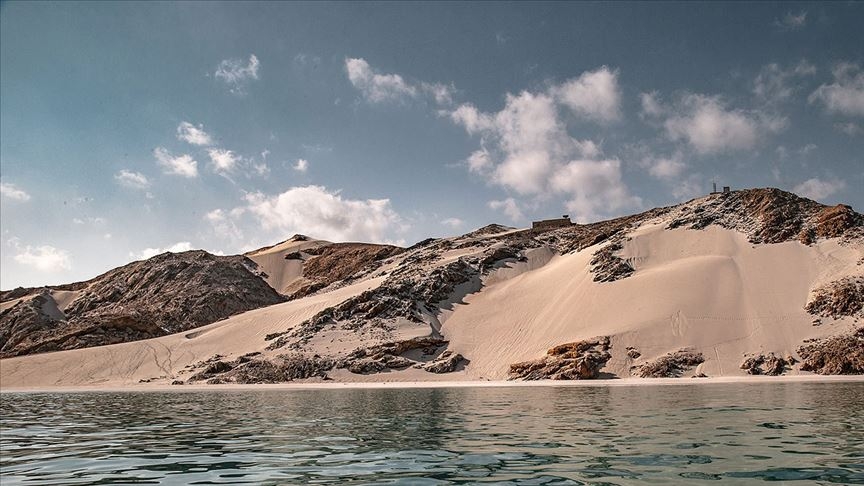
Socotra Island (Anadolu Ajansı)
Socotra Island measures approximately 132 kilometers in length and 49 kilometers in width, with total land area cited in various academic sources between 3,650 and 3,796 square kilometers.【3】 Located 240 kilometers east of Cape Guardafui in Somalia and 380 kilometers south of Yemen’s Al-Mahra region, the island occupies a geographically isolated position.【4】 Geologically, Socotra has no volcanic history; it is a continental fragment that separated from the ancient southern supercontinent Gondwana around six million years ago due to tectonic movements.
The island’s topography consists of three distinct regions. Coastal plains form narrow flatlands encircling the island, expanding in places. Limestone plateaus, covering much of the island, reach elevations of 300 to 700 meters and contain numerous caves, grottos and deep canyons due to their karstic structure.【5】 Rising in the interior, the granite Hagghier (Hacer) Mountains, whose highest peak, Skand, exceeds 1,520 meters, serve as the primary source of the island’s water resources and contribute to its microclimatic diversity.【6】
The island generally experiences a tropical and semi-arid climate. Average annual temperatures exceed 25°C, rising to 38°C along the coast.【7】 The most significant factor shaping life on the island is the seasonal monsoon winds:
Socotra is recognized as one of the five most critical island ecosystems for global biodiversity conservation.【8】 The island’s isolation has enabled species to evolve independently from those on the mainland.

Dragon’s Blood Tree (Pexels)
Of the approximately 825 plant species recorded on the island, 37 percent (308 species) are endemic.【9】
Ninety percent of reptile species and 95 percent of land snail species are endemic to Socotra. The island hosts 192 bird species, including the critically endangered Socotra warbler (Onychognathus frater), Socotra bunting (Emberiza socotrana), and the Egyptian vulture (Neophron percnopterus). Marine life is rich with 253 species of reef-building corals and 730 species of coastal fish.【13】
Socotra Island (NTV)
Several theories exist regarding the origin of the name Socotra. One suggests it derives from the Sanskrit phrase dvipa sukhadhara, meaning “island of bliss.”【14】 Another theory links it to the Arabic words for “market” (souk) and “drop” (qotra), referring to the dripping resin of frankincense trees.【15】 In ancient Greek sources, it was referred to as Dioscorida, in reference to Dioscuri.
Throughout history, the island’s strategic location has brought it under the control of numerous powers. In 1507, it was occupied by the Portuguese and abandoned in 1511; in 1839, it came under British protection and served as a base for the capture of Aden.【16】 In the modern era, following the independence of South Yemen in 1967, the island became part of Yemen and was used by the Soviet Union for military purposes during the Cold War.【17】
The island’s estimated population of 50,000 to 175,000 is rooted in deep tribal traditions.【18】 Some residents do not know their exact age or birth date and continue to live in traditional stone huts. The most important cultural element is the endangered Socotri language, spoken only on this island. With a structure distinct from modern Arabic, it is at risk of being forgotten as younger generations increasingly adopt Arabic.【19】
Socotra is described as the “Cyprus of the Indian Ocean” due to its strategic position dominating key global maritime trade routes, including the Bab el-Mandeb Strait and the Strait of Hormuz.【20】 This has positioned the island at the center of regional and global power struggles.

UAE Intervention on Socotra Island (Anadolu Ajansı)
Following the outbreak of the Yemeni Civil War in 2015, the United Arab Emirates (UAE) began establishing a military presence on the island. In 2018, the UAE’s deployment of tanks and heavy weaponry to the island was labeled an “occupation” by Yemen’s internationally recognized government.【21】 In June 2020, forces of the UAE-backed Southern Transitional Council (STC) seized Hadibu, the island’s capital, assumed control and declared “self-rule.” Saudi Arabia has established a “humanitarian air bridge” to ensure food security on the island.
The United States’s regional strategies and Russia’s desire to demonstrate presence against maritime piracy have heightened the island’s strategic importance. SIGINT (signals intelligence) systems installed on the island indicate its transformation into a military and intelligence hub.【22】
Socotra Island (Bilim Peşinde)
Primary livelihoods include traditional fishing, animal husbandry (especially goats), and trade in natural resins. The commercial airport, built in 1999, connected the island to the outside world.【23】 Despite its ecotourism potential, according to 2022 data, the absence of an effective marketing strategy has prevented Socotra from achieving adequate global visibility.【24】 Although the island has a total accommodation capacity of 52,000 beds, only 12,000 meet international standards.【25】
The island’s fragile ecosystem is threatened by unplanned development, goat populations that consume rare plant seedlings, and illegal species trafficking. Cyclones in 2015 and an oil spill from the “Gulf Dove” tanker in early 2023 have polluted the coastline.【26】 UNESCO is implementing educational programs to enhance local capacity to respond to oil spills.【27】
[1]
UNESCO World Heritage Convention. "Socotra Archipelago." Accessed 25 March 2026. https://whc.unesco.org/en/list/1263/
[2]
Anadolu Ajansı. "Yemen's Strategic Socotra Island: UAE Military Ambitions Under Debate." 5 September 2020. Accessed 25 March 2026. https://www.aa.com.tr/tr/dunya/yemenin-stratejik-sokotra-adasinda-baenin-askeri-emelleri-tartisiliyor-/1963825
[3]
TRT Haber. “The New Epicenter of Crisis in Yemen: Socotra Island.” 22 June 2020. Accessed 25 March 2026. https://www.trthaber.com/haber/dunya/yemende-krizin-yeni-adresi-sokotra-adasi-494794.html
[4]
Anadolu Ajansı, “The UAE Has Turned Its Eyes to Yemen’s Natural Wonder and Strategic Island,” 22 June 2019, Accessed 25 March 2026, https://www.aa.com.tr/tr/dunya/bae-gozunu-yemenin-doga-harikasi-stratejik-adasina-cevirdi/1512611
[5]
Ameen Thabet Abdullah Sallem Rageh, “Assessment of Socotra Island’s Tourism Marketing,” Master’s Thesis, Anadolu University, 2022, pp. 111–112, Accessed 25 March 2026. https://acikerisim.anadolu.edu.tr/server/api/core/bitstreams/bbdf5862-1d10-49fa-8c2e-1ed2d66b2d73/content
[6]
BBC, “Stepping back in time in Socotra,” 10 May 2013, Accessed 25 March 2026, https://www.bbc.com/travel/article/20130430-stepping-back-in-time-in-socotra
[7]
TRT Haber, “The New Epicenter of Crisis in Yemen: Socotra Island,” 22 June 2020. Accessed 25 March 2026, https://www.trthaber.com/haber/dunya/yemende-krizin-yeni-adresi-sokotra-adasi-494794.html
[8]
Anadolu Ajansı, “Yemen's Strategic Socotra Island: UAE Military Ambitions Under Debate,” 5 September 2020, Accessed 25 March 2026. https://www.aa.com.tr/tr/dunya/yemenin-stratejik-sokotra-adasinda-baenin-askeri-emelleri-tartisiliyor-/1963825
[9]
UNESCO World Heritage Convention, “Socotra Archipelago.” Accessed 25 March 2026, https://whc.unesco.org/en/list/1263/
[10]
BBC, “In pictures: Flora and fauna of Socotra,” 19 July 2018, Accessed 25 March 2026, https://www.bbc.com/news/in-pictures-44846904
[11]
BBC, “In pictures: Flora and fauna of Socotra,” 19 July 2018, Accessed 25 March 2026, https://www.bbc.com/news/in-pictures-44846904
[12]
TRT Haber, “The New Epicenter of Crisis in Yemen: Socotra Island,” 22 June 2020. Accessed 25 March 2026. https://www.trthaber.com/haber/dunya/yemende-krizin-yeni-adresi-sokotra-adasi-494794.html
[13]
UNESCO World Heritage Convention, “Socotra Archipelago.” Accessed 25 March 2026, https://whc.unesco.org/en/list/1263/
[14]
TRT Haber, “The New Epicenter of Crisis in Yemen: Socotra Island,” 22 June 2020. Accessed 25 March 2026, https://www.trthaber.com/haber/dunya/yemende-krizin-yeni-adresi-sokotra-adasi-494794.html
[15]
Anadolu Ajansı, “The Background to the UAE’s Occupation of Socotra,” 15 May 2018. Accessed 25 March 2026, https://www.aa.com.tr/tr/analiz-haber/baenin-sokotra-isgalinin-arka-plani/1146414
[16]
TRT Haber, “The New Epicenter of Crisis in Yemen: Socotra Island,” 22 June 2020. Accessed 25 March 2026, https://www.trthaber.com/haber/dunya/yemende-krizin-yeni-adresi-sokotra-adasi-494794.html
[17]
Anadolu Ajansı, “The Background to the UAE’s Occupation of Socotra,” 15 May 2018. Accessed 25 March 2026. https://www.aa.com.tr/tr/analiz-haber/baenin-sokotra-isgalinin-arka-plani/1146414
[18]
TRT Haber, “The New Epicenter of Crisis in Yemen: Socotra Island,” 22 June 2020. Accessed 25 March 2026, https://www.trthaber.com/haber/dunya/yemende-krizin-yeni-adresi-sokotra-adasi-494794.html
[19]
BBC, “Stepping back in time in Socotra,” 10 May 2013. Accessed 25 March 2026, https://www.bbc.com/travel/article/20130430-stepping-back-in-time-in-socotra
[20]
Anadolu Ajansı, “The Background to the UAE’s Occupation of Socotra,” 15 May 2018. Accessed 25 March 2026, https://www.aa.com.tr/tr/analiz-haber/baenin-sokotra-isgalinin-arka-plani/1146414
[21]
Anadolu Ajansı, “The UAE Has Turned Its Eyes to Yemen’s Natural Wonder and Strategic Island,” 22 June 2019. Accessed 25 March 2026, https://www.aa.com.tr/tr/dunya/bae-gozunu-yemenin-doga-harikasi-stratejik-adasina-cevirdi/1512611
[22]
Engin Koç and Taha Yahya Hussein Al Aqari, “UAE and Iran’s Geopolitical Interests in Yemen,” p. 1628. Accessed 25 March 2026, https://dergipark.org.tr/tr/download/article-file/4406028
[23]
BBC, “Stepping back in time in Socotra,” 10 May 2013. Accessed 25 March 2026, https://www.bbc.com/travel/article/20130430-stepping-back-in-time-in-socotra
[24]
Ameen Thabet Abdullah Sallem Rageh, “Assessment of Socotra Island’s Tourism Marketing,” p. 129. Accessed 25 March 2026, https://acikerisim.anadolu.edu.tr/server/api/core/bitstreams/bbdf5862-1d10-49fa-8c2e-1ed2d66b2d73/content
[25]
Ameen Thabet Abdullah Sallem Rageh, “Assessment of Socotra Island’s Tourism Marketing,” p. 87. Accessed 25 March 2026, https://acikerisim.anadolu.edu.tr/server/api/core/bitstreams/bbdf5862-1d10-49fa-8c2e-1ed2d66b2d73/content
[26]
Engin Koç and Taha Yahya Hussein Al Aqari, “UAE and Iran’s Geopolitical Interests in Yemen,” p. 1627. Accessed 25 March 2026,https://dergipark.org.tr/tr/download/article-file/4406028
[27]
UNESCO World Heritage Convention News, “Strengthening Local Capacities to Respond to Oil Spills in Socotra Archipelago, Yemen,” 18 January 2024, Accessed 25 March 2026, https://whc.unesco.org/en/news/2649/


Geographical Structure and Geological Origin
Climate and Seasonal Dynamics
Biodiversity and Ecological Heritage
Flora
Fauna
History and Etymology
Socio-Cultural Structure and Language
Geopolitical Significance and Current Conflicts
Regional Actors and Interventions
International Interest
Economy and Tourism Marketing
Environmental Threats and Conservation