


+1 More

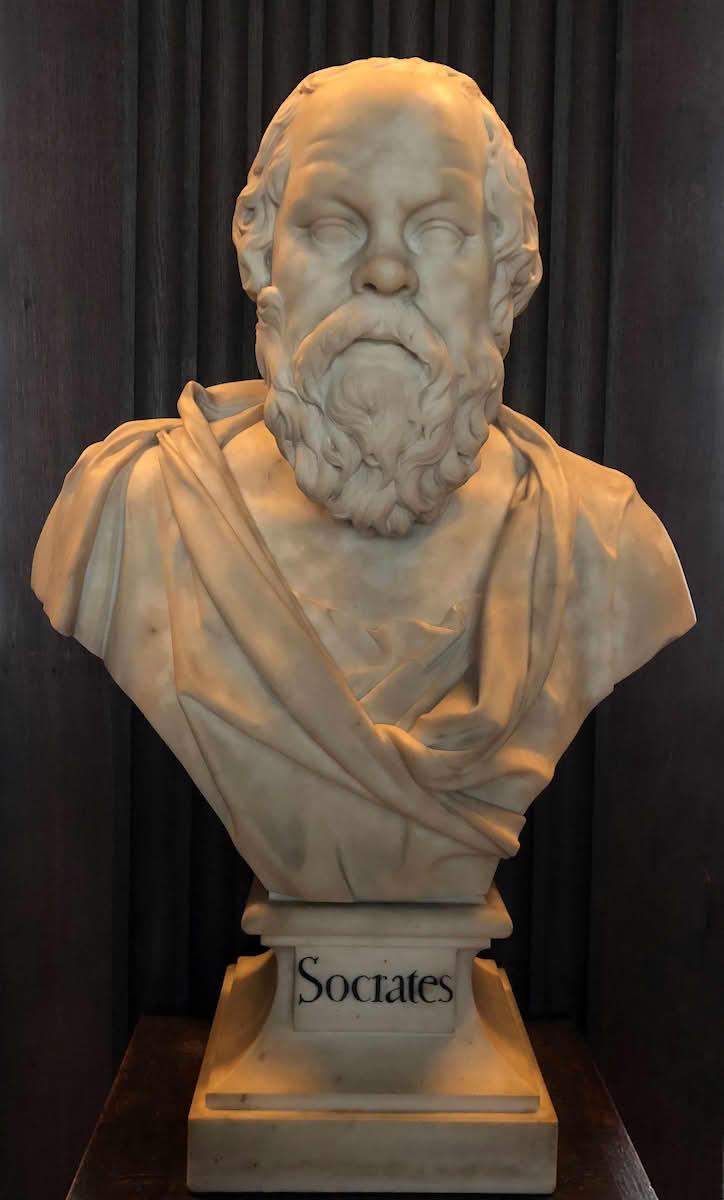
Socrates
Estimated Birth Date | 470 BCE | ||||||||
|---|---|---|---|---|---|---|---|---|---|
Place of Birth | Alopeke District of Athens | ||||||||
Annesi | Phaenarete | ||||||||
Babası | Sophroniskos | ||||||||
Students | Xenophon Plato | ||||||||
Estimated Death Date | 399 BCE | ||||||||
Place of Death | Athens | ||||||||
Socrates is regarded as one of the foundational figures of ancient Greek philosophy. Living in Athens during the 5th century BCE, he deepened philosophical thought through inquiry and critical dialogue. His teachings and methods have reached us through his students Plato and Xenophon.
Socrates’ exact birth year is unknown, but he is believed to have been born around 470 BCE in the Alopeke district of Athens. His father, Sophroniscus, was a stonemason, and his mother, Phaenarete, was a midwife. In his youth, he tried his father’s trade but later turned to philosophy. He also served as a soldier in the Athenian army during the Peloponnesian Wars and gained recognition for his courage.
Socrates was a philosopher whose approach to philosophy left profound impacts both in his own time and in subsequent centuries. Although he left no written works, his ideas and methods were transmitted primarily by his student Plato and his contemporary Xenophon. His fundamental philosophical method is known today as the Socratic method or the elenctic method. This method relies on dialogue and mutual questioning to test the consistency of individuals’ beliefs and knowledge. Through this process, Socrates aimed to reveal that views appearing superficially true often contain internal contradictions, thereby encouraging thought to rest on deeper and more solid foundations.
Socrates’ philosophical life was notably focused on the nature of knowledge and the concept of virtue. For him, true knowledge was not merely theoretical but also moral and practical. He argued that virtue is linked to knowledge and that genuine virtue arises from recognizing that wrongful actions stem from ignorance.
In this context, the often attributed phrase “The most important thing I know is that I know nothing” reflects a central concept of Socrates’ understanding of wisdom. In Plato’s “Apology of Socrates”, Socrates explains that after the Delphic Oracle declared him the wisest man, he realized his wisdom lay precisely in being aware of his own ignorance.【1】 Thus, for Socrates, wisdom consists in acknowledging one’s ignorance and knowing what one does not know. However, this expression is not a direct quote from Socrates himself but rather a summary of the philosophical perspective presented in Plato’s writings.
Moreover, Socrates emphasized ethical living and individual responsibility. He believed that the most important duty of a person is to improve their soul and life. Material success and fleeting pleasures are not as valuable as cultivating a virtuous and knowledgeable soul. These ideas are embodied in his concise sayings such as “Know thyself” and “The unexamined life is not worth living.”
Socrates’ philosophical life is also significant in terms of his interaction with society. He did not view philosophy as merely an academic pursuit; rather, he sought to encourage everyone to think by engaging in dialogue on the streets, in marketplaces, and with young people. In this way, Socrates transformed philosophy from an elitist form of knowledge into an activity that directly touched and guided everyday life.
In conclusion, Socrates’ philosophical life presents a unified whole of inquiry, ethical awareness, and individual responsibility. His philosophical method and way of life continue to serve as a fundamental reference for intellectual and ethical debates, not only in his own time but also today.
One of the most distinctive elements in Socrates’ philosophical practice was his claim of an inner voice or sign (Daimonion) that consistently prevented him from committing wrongful actions. Socrates stated that this voice originated from a divine source and served only to warn him negatively, never to issue commands. Because of this inhibitory function, the Daimonion is described in philosophical literature as an apotreptical principle.
In academic circles, the Daimonion is interpreted as an individual moral authority guiding Socrates’ ethical decisions. This concept opened the door to the idea that an individual’s internal values could serve as an independent standard, distinct from traditional social norms and state laws. Indeed, during his trial in 399 BCE, Socrates’ belief in the Daimonion was viewed as contrary to traditional Athenian religious understanding and formed one of the main grounds for the accusation of “inventing new gods.”
Two critical features distinguish Socrates’ philosophical system: the identification of virtue solely with knowledge (intellectual virtue), and the view that the ultimate goal of this virtuous life is happiness (Eudaimonia). For Socrates, the only goal human nature inherently pursues is Eudaimonia, and this can be achieved only through a virtuous life; thus, virtue is both necessary and sufficient for happiness.
This conception of happiness differs from the Epicurean approach based on bodily pleasures, because for Socrates, the virtuous life itself generates lasting happiness. Furthermore, for Socrates, virtues such as justice, courage, and wisdom are not theoretically separate entities; rather, all these moral qualities are one and indivisible (Unity of Virtue).
The presence of one virtue in a person necessarily implies the presence of all others, since all virtues are grounded in knowledge.
Misconduct arises from a lack of this integrated knowledge. Therefore, Socrates viewed ethical life as a practical philosophy of action, emphasizing that virtue is not an abstract concept definable in theory but a skill or disposition (hexis) that can only be identified through action, guided by a sense of duty. Socrates deepened the ethical foundation of his philosophy by asserting that the soul’s inherent order and harmony are equivalent to conformity with law (nomos), and that virtue, which establishes this order, is the fundamental element that makes the soul good.
Socrates was an active figure within the social and political atmosphere of ancient Athens. Throughout his life, he did not confine his philosophical inquiries and critical approach to individual thought alone; he also profoundly influenced the functioning of society and the state.
During Socrates’ time, Athens faced the destructive aftermath of the Peloponnesian War, political turmoil, and the challenges of its democratic system. In this complex political environment, Socrates’ attitudes and views were sometimes criticized and even met with hostility by city authorities and the public. Although he did not explicitly avoid politics, he prioritized the moral and intellectual development of individuals over active participation in politics.
One reason Socrates was a controversial figure in Athenian society was his persistent questioning of traditional values and popular beliefs through his inquisitive and critical method.
His refutation of the claims to knowledge and virtue held by powerful families and politicians generated opposition. Moreover, the politically controversial roles assumed by some of his close associates—such as Critias and Alcibiades—negatively affected his reputation in society.
In 399 BCE, Socrates was accused by the Athenian court of corrupting the youth and not believing in the city’s gods, instead “inventing new gods.” These charges were directly linked to his commitment to intellectual freedom and his practice of critical philosophy. The trial is detailed in Plato’s work “Apology.” In his defense, Socrates refused to abandon his ideas or his method, symbolizing a conflict between the foundational values of Athenian democracy and the practice of philosophy.
In conclusion, Socrates’ social and political life is closely tied to his philosophical stance and methods. The political climate of his time made it difficult for the public to understand his ideas, yet it also reopened debate on the boundaries and freedoms of philosophical inquiry. Socrates’ execution is regarded as a historical marker of the tension between democracy and freedom of thought.
Every academic study of Socrates faces a fundamental methodological challenge known as the Socratic Problem, arising from the fact that he left no written works of his own. This forces historians and philosophers to rely heavily on secondary testimonies to reconstruct his thoughts, lifestyle, and personality.
The most important information about Socrates comes from three primary contemporary sources, which are inconsistent with each other:

Socrates (left) and his student Plato (right) in the fresco “The School of Athens” by Raffaello Sanzio da Urbino (Picryl)
Socrates’ critical philosophical life culminated in a confrontation with Athenian democracy in 399 BCE. He was accused by the Athenian court of “corrupting the youth” and of not believing in the city’s gods, instead “inventing new gods.” These charges were rooted in political motivations.
The trial is recorded in detail in his student Plato’s work “Apology.” In his defense, Socrates refused to abandon his philosophical mission or his method of inquiry. The philosopher chose not to defy Athenian laws, but also refused blind obedience. After being sentenced, he calmly accepted the death penalty by drinking poison.
Socrates’ death became the ultimate testament to his philosophical stance and his sense of moral responsibility toward individual autonomy. His ethical life, philosophical method, and tragic end immortalized the tension between freedom of thought and state authority, establishing both a methodological and ethical starting point for subsequent Western philosophy—particularly through Plato and Aristotle. Socrates’ legacy, grounded in the belief that “the unexamined life is not worth living,” continues to serve as a fundamental reference for contemporary ethical and political debates.
"Sokrates Büstü Görseli." Photograph. SNL.
"Sokrates and Platon Escuela de Atenas." Picryl, 2002. Photograph.
IEP (Internet Encyclopedia of Philosophy). "Socrates." Accessed October 24, 2025.
Odabaş, Uğur Köksal. "Eudaimonia’nın Sokratik Görünümü: Erdem Bilgidir ve Hiç Kimse Bilerek Kötülük Yapmaz." Atatürk Üniversitesi Sosyal Bilimler Enstitüsü Dergisi 23, no. 1 (2019): 93–102. Accessed October 24, 2025. https://dergipark.org.tr/en/pub/ataunisosbil/issue/43928/538460.
Sokrates’in Savunması. Online PDF. Hukukbook. Accessed October 24, 2025. https://hukukbook.com/wp-content/uploads/2017/09/SOKRATESIN-SAVUNMASI.pdf.
Stanford Encyclopedia of Philosophy. "Socrates." September 16, 2005. Accessed October 24, 2025. https://plato.stanford.edu/entries/socrates/#toc.
World History Encyclopedia. "Socrates." Accessed October 24, 2025.
Önal, Mehmet. “SOKRATES'E GÖRE ERDEM VE ERDEM EĞİTİMİ.” Felsefe Dünyası, no. 44 (2006): 133-145. Accessed October 24, 2025. https://www.researchgate.net/publication/348937869_SOKRATES'E_GORE_ERDEM_VE_ERDEM_EGITIMI .
Özkan, Fatih. "Sokrates’in Entelektüalist Ahlâkı". Iğdır Üniversitesi Sosyal Bilimler Dergisi, no. 4 (2013): 35–53. Accessed October 24, 2025. https://dergipark.org.tr/tr/pub/igdirsosbilder/issue/66809/1044833?utm.

Socrates
Estimated Birth Date | 470 BCE | ||||||||
|---|---|---|---|---|---|---|---|---|---|
Place of Birth | Alopeke District of Athens | ||||||||
Annesi | Phaenarete | ||||||||
Babası | Sophroniskos | ||||||||
Students | Xenophon Plato | ||||||||
Estimated Death Date | 399 BCE | ||||||||
Place of Death | Athens | ||||||||
Life
Philosophical Approach
The Daimonion and the Philosophical Origin of Individual Conscience
Foundations of Socrates’ Ethical System: The Unity of Virtue and Happiness
Social and Political Life
The Socratic Problem and the Reliability of Philosophical Sources
Contradictory Nature of the Sources
Conviction and Death