

This article was automatically translated from the original Turkish version.
+1 More
The Solingen Attack was a racist assault that occurred on the night of 29 May 1993 in the city of Solingen, located in the German state of North Rhine-Westphalia, resulting in the deaths of five Turkish women and a young girl. The incident, which began with the arson of the home of the Genç family, is recorded as one of the deadliest racist attacks in the history of the Federal Republic of Germany since World War II.
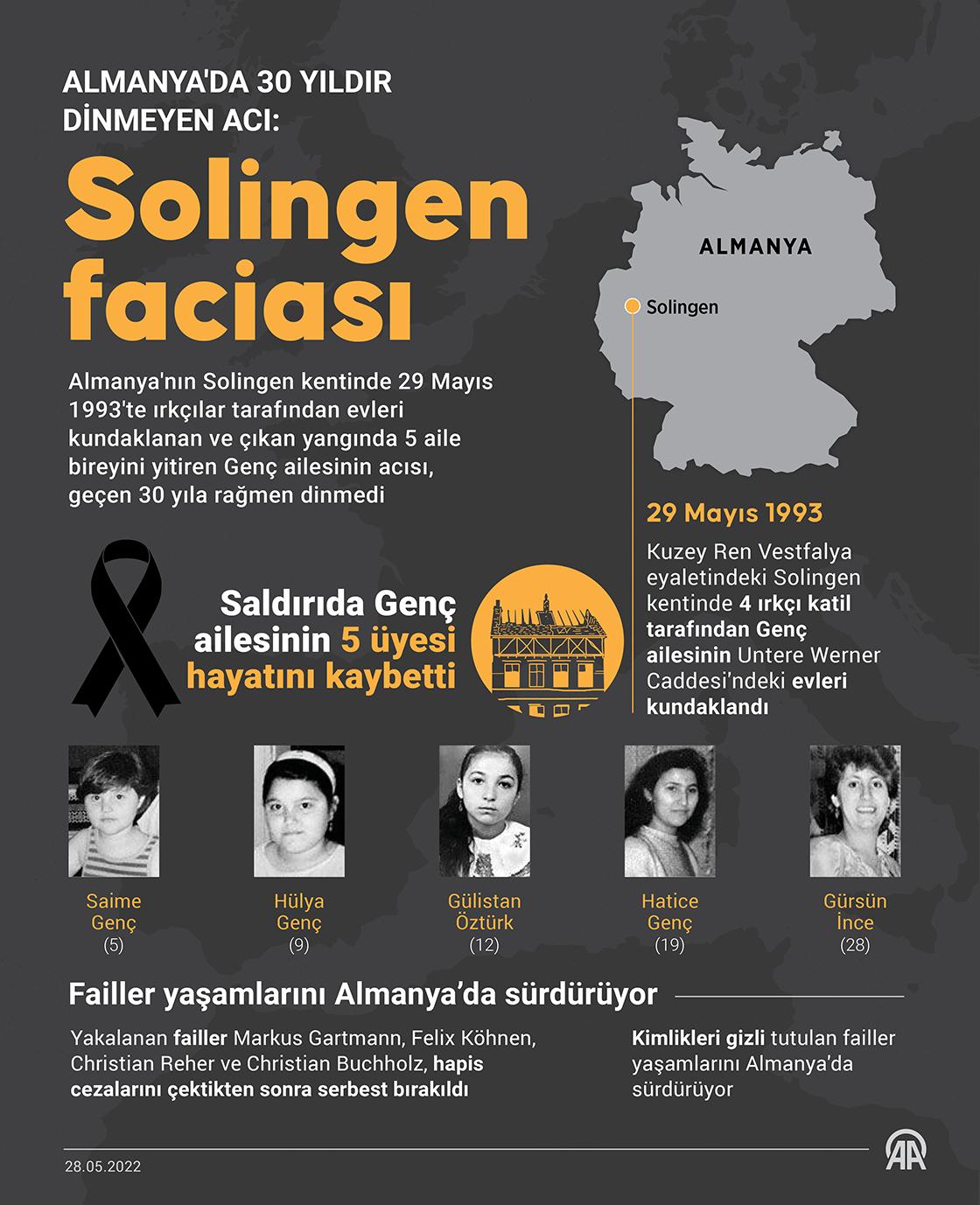
Infographic of the Solingen Attack (Anadolu Agency)
The early 1990s were a period of profound political and social transformation in Germany. The fall of the Berlin Wall in 1989 and German reunification in 1990 triggered major changes in economic structures and social balances. During this time, migration from East Germany to the West, rising unemployment rates, and the restructuring of the welfare state contributed to widespread social unrest. Simultaneously, the civil war in the former Yugoslavia, regime changes in Eastern Europe, and instability in the Middle East led to a significant increase in the number of asylum seekers arriving in Germany.
These developments sparked intense public and political debates, often framed as an “asylum crisis.” In the Federal Parliament and the media, the growing number of asylum seekers was frequently portrayed as a “social burden” or a “security threat.” Between 1991 and 1993, demands to restrict the right to asylum gained momentum, and immigration and integration policies became central to public discourse. Leading newspapers of the time frequently used headlines such as “Das Boot ist voll” (“The boat is full”), reinforcing negative public perceptions of foreigners.
Within this atmosphere, the number of racist attacks across the country rose sharply. In 1991, attacks on refugee hostels in Hoyerswerda, in 1992, pogrom-like riots in Rostock-Lichtenhagen, and the arson of two Turkish families’ homes in the town of Mölln in Schleswig-Holstein, all demonstrated the extent of societal tension. Many people were injured in these incidents, including children who lost their lives.
At the political level, mounting societal pressure following xenophobic actions led to constitutional reforms aimed at limiting asylum rights. On 26 May 1993, the Federal Parliament adopted the “Asylkompromiss,” a constitutional amendment that restricted Germany’s asylum policy. In the aftermath of this decision, attacks against migrants and foreigners surged in a new wave.
A defining feature of this period was the targeting of migrant communities, particularly those of Turkish origin, amid increasing societal polarization. The large Turkish population in Germany, which had arrived since the 1960s under the “Gastarbeiter” (guest worker) program, had largely become a permanent second-generation community. However, these groups faced narratives of “cultural incompatibility” and “foreignness” from certain segments of society.
The economic anxieties, national identity debates, and anti-immigrant political rhetoric of the early 1990s created an environment conducive to the strengthening of racist violence in German society.
Documentary on the Solingen Attack (Presidency of Turks Abroad and Related Communities)
The Solingen Attack occurred shortly after midnight on 30 May 1993 in the city of Solingen, located in the German state of North Rhine-Westphalia. The incident began with the arson of a three-story detached house at Untere Wernerstraße 81, belonging to the Turkish-origin Genç family. At the time of the attack, 18 members of the family across four generations were inside the house. According to witness statements and fire department reports, the fire was discovered around 1:00 AM.
Technical investigations determined that a flammable liquid such as gasoline had been poured into the building’s entrance area and then ignited, causing the fire. The wooden veranda on the front facade caught fire rapidly, enabling the flames to spread to upper floors. The stairwell was completely engulfed in flames, trapping the family members on the upper levels.
Many occupants of the house were in deep sleep when the fire broke out. Rapidly spreading flames generated thick smoke on the upper floors. Medical examinations at the scene revealed that most of the victims died from carbon monoxide poisoning, while some were directly burned by the flames. The five victims were Gürsün İnce (28), Hatice Genç (19), Gülüstan Öztürk (12), Hülya Genç (9), and Saime Genç (4).
The other 13 people in the house survived with varying degrees of burns and injuries. Some escaped by jumping from windows or were rescued by neighbors. Firefighters arrived quickly after being alerted by nearby residents and managed to bring the fire under control, but much of the house was rendered unusable.
Criminal investigations at the scene following the attack uncovered traces of accelerants near the entrance and stairwell. These findings confirmed that the incident was a deliberate arson attack.
After the attack, police closely monitored local Neo-Nazi circles and racially motivated youth groups. In the initial days, investigators considered alternative scenarios including accidental fire; however, evidence collected at the scene and witness testimonies led authorities to conclude that the attack was an organized act of arson motivated by racism.
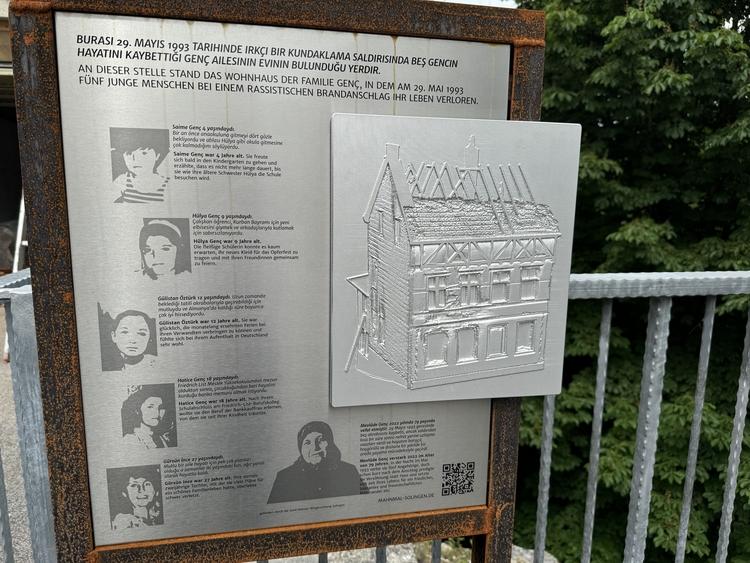
Solingen Attack Memorial (Anadolu Agency)
The investigation into the Solingen Attack was conducted by local police and the Criminal Investigation Department of North Rhine-Westphalia. The discovery of accelerant residues at the building’s entrance strengthened the initial conclusion that the fire had been deliberately set. Based on witness statements and physical evidence, several young men linked to far-right extremist circles in Solingen were placed under surveillance shortly after the attack.
In the following days, four German citizens aged between 16 and 23 — Felix Köhnen, Christian Reher, Christian Buchholz, and Markus Gartmann — were arrested. Investigations revealed their connections to local Neo-Nazi groups, their xenophobic views, and prior involvement in racist acts. One of the suspects lived near the attack site and had previously been accused of attempting arson.
The prosecution’s case was carefully prepared, relying largely on circumstantial and technical evidence, as none of the suspects provided a direct confession. Nevertheless, the court concluded that the attack had been carried out in an organized manner with racist motives. The trial, which began in October 1994 at the Düsseldorf Higher Regional Court, lasted a total of 127 hearing days. During the proceedings, the planning of the attack, the materials used, and the defendants’ ties to Neo-Nazi networks were examined in detail.
On 13 October 1995, the court delivered its verdict. Three of the defendants were sentenced to 15 years in prison, and one received a 10-year sentence. The ruling formally recognized the attack as having been committed “with racist and xenophobic motives.” However, due to the young age of all the defendants, their sentences were assessed under Germany’s Juvenile Criminal Code (Jugendstrafrecht).
After serving their sentences in different prisons, all defendants were released in the early 2000s. Their identities were changed for security reasons and concealed from public view. This outcome sparked controversy, particularly among the victims’ families and the Turkish community in Germany. Numerous civil society organizations and legal experts argued that the sentences were disproportionate to the gravity of the crime.
The legal proceedings opened important debates in Germany regarding the investigation and prosecution of racist crimes. The Solingen case set a precedent for later cases — particularly the NSU (National Socialist Underground) trial — by encouraging judicial authorities to more explicitly recognize racist motivations.
Victims of the Solingen Attack (Anadolu Agency)
The five individuals who lost their lives in the Solingen Attack were members of the Turkish-origin Genç family. The family had migrated to Germany from Turkey in the early 1970s under the “Gastarbeiter” program and had lived in Solingen for many years. Father Durmuş Genç and his wife Mevlüde Genç lived in a multigenerational household with their children and grandchildren. On the night of the attack, 18 family members across four generations were under the same roof. The victims were:
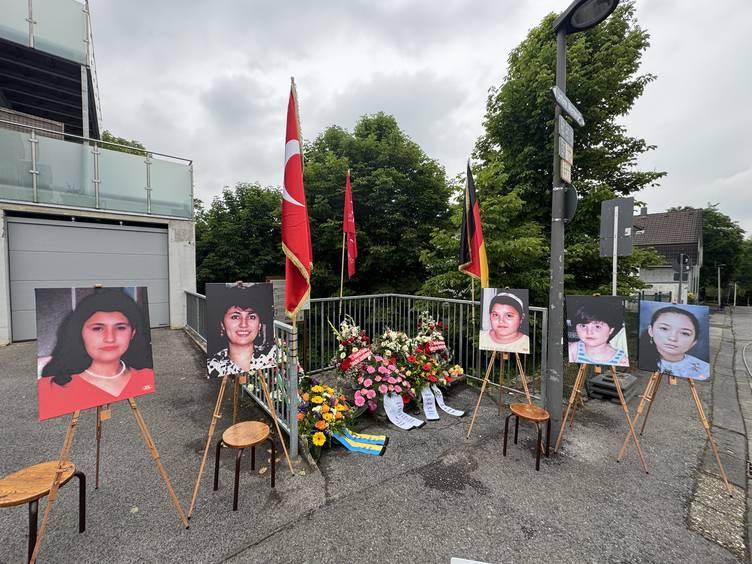
Victims of the Solingen Attack (Anadolu Agency)
Among those who survived the fire were Mevlüde Genç and her husband Kamil Genç. Kamil Genç underwent prolonged hospital treatment due to severe burns. Despite losing two daughters, two grandchildren, and a niece, Mevlüde Genç became known for her public appeals for peace and dialogue after the attack. She emerged as a unifying figure in German society and, after her death in 2022, was honored with the Federal Cross of Merit of Germany for her consistent advocacy of tolerance against racism.
The funerals of the five victims were attended by thousands in a joint ceremony involving communities from both Germany and Turkey. Some of the victims were buried in Solingen, while others were laid to rest in Turkey. The attack was remembered not only as the tragedy of one family but also as a symbol of the fragile sense of security experienced by migrant communities in Germany.
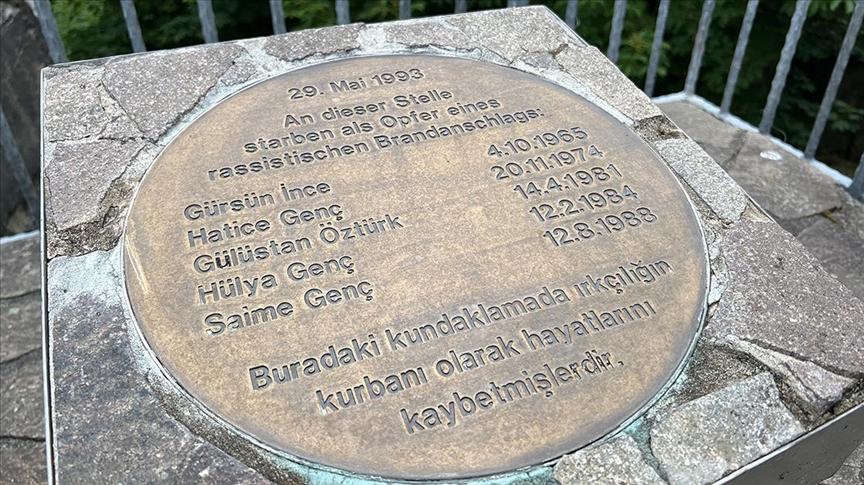
Today, at the address Untere Wernerstraße 81, a memorial plaque and commemorative space honor the five victims. Every year on 29 May, memorial ceremonies are held, during which the victims’ names are read aloud, with representatives from both Germany and Turkey in attendance. Thus, the victims of the Solingen Attack have secured a lasting place in the collective memory of society’s resistance to racist violence.
Solingen Attack (TRT News)
Immediately after the attack, widespread reactions emerged in both Germany and Türkiye. The incident was perceived not merely as a racist assault on one family but as a concrete manifestation of anxieties regarding the safety and social integration of migrants in Germany.
In the days following the attack, fear and anger prevailed among migrant communities in Solingen and its surroundings. Thousands participated in silent marches near the burned house and in the city center to protest racism. Simultaneously, demonstrations against xenophobia took place in many German cities, especially Berlin, Cologne, Hamburg, and Frankfurt. Trade unions, churches, civil society organizations, and human rights associations issued joint statements condemning racist violence as incompatible with the fundamental values of a democratic society.
Leading figures in German politics strongly condemned the attack. Shortly after the incident, then-President Richard von Weizsäcker called on all segments of society to take responsibility. The President of the Federal Parliament, Rita Süssmuth, and several federal ministers visited Solingen to offer condolences to the family. However, Chancellor Helmut Kohl’s statement, “I will not go to Solingen because I oppose condolence tourism,”【1】 provoked public outrage and triggered a brief diplomatic tension in German-Turkish relations.
In Türkiye, the attack generated massive public outcry. The government officially protested the incident and demanded a thorough investigation by German authorities. Turkish media prominently featured the event under headlines such as “Solingen Massacre.” Protests were held outside German diplomatic missions in Ankara, Istanbul, and other major cities, and the attack was raised in the Turkish Grand National Assembly.
German political parties made efforts to present a unified response. Official statements at both federal and state levels emphasized the necessity of a determined struggle against far-right extremist groups threatening democratic order. During this period, civil society initiatives particularly called on different segments of society to unite against racism. In Solingen, local residents launched long-term awareness campaigns under movements named “Solinger Appell” and “SOS Rassismus.”
The attack undermined the trust of the Turkish-origin population in Germany toward the state and society. However, the solidarity initiatives that followed demonstrated the strengthened capacity of civil society to respond to racism. Numerous institutions — from churches and trade unions to student associations and local governments — launched programs to support the social integration of migrants.
The incident also attracted international attention. The Council of Europe, the European Parliament, and the United Nations Human Rights Commission called on Germany to adopt comprehensive measures against xenophobia.
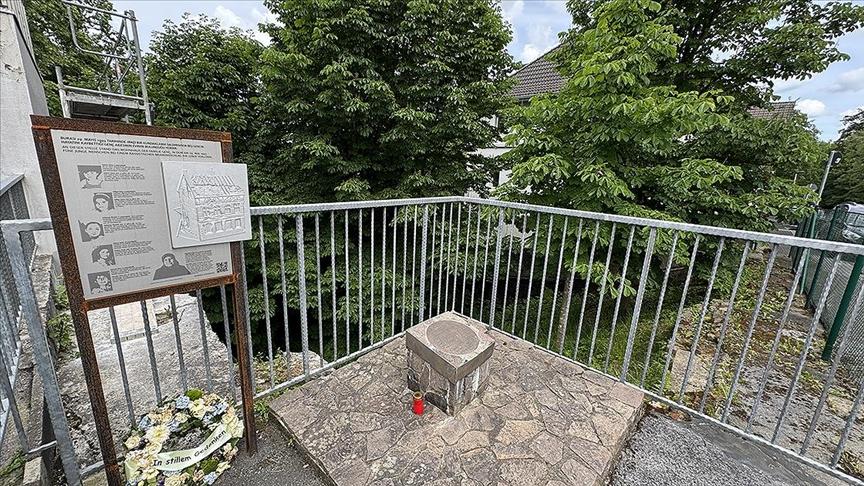
Solingen Attack Memorial (Anadolu Agency)
The incident temporarily strained diplomatic relations between the two countries. In Türkiye, public opinion and the media criticized the German state for failing to adequately protect migrants and demanded justice for the perpetrators. Turkish newspapers carried the attack on front pages for an extended period. Protests were held outside German diplomatic missions in Ankara, Istanbul, and İzmir. The Turkish government formally called on Germany to conduct an effective investigation and ensure justice.
In the aftermath of the attack, Türkiye expressed its concerns, through diplomatic channels, regarding the safety of approximately two million Turkish-origin migrants living in Germany. The Turkish government urged Germany to implement structural measures to protect migrants. At the same time, Turkish associations, mosque communities, and labor federations in Germany called for dialogue with German authorities.
The Solingen Attack has become one of the defining symbols of both racist violence and societal confrontation in modern German history. It did not merely result in the deaths of five individuals; it also initiated a long-term public debate on migration, identity, citizenship, and integration.
Today, Solingen continues to be remembered both as a symbol and a test of Germany’s progress in the areas of democracy, tolerance, and multiculturalism.
[1]
Anadolu Ajansı. “Almanya’da 32 Yıldır Dinmeyen Acı: Solingen Faciası.” Anadolu Ajansı. Erişim 12 Kasım 2025. https://www.aa.com.tr/tr/dunya/almanyada-32-yildir-dinmeyen-aci-solingen-faciasi/3581646

Historical and Social Context
The Attack
Perpetrators and Legal Proceedings
The Victims
Social and Political Reactions
Impact on German-Turkish Relations
