


This article was automatically translated from the original Turkish version.
+2 More
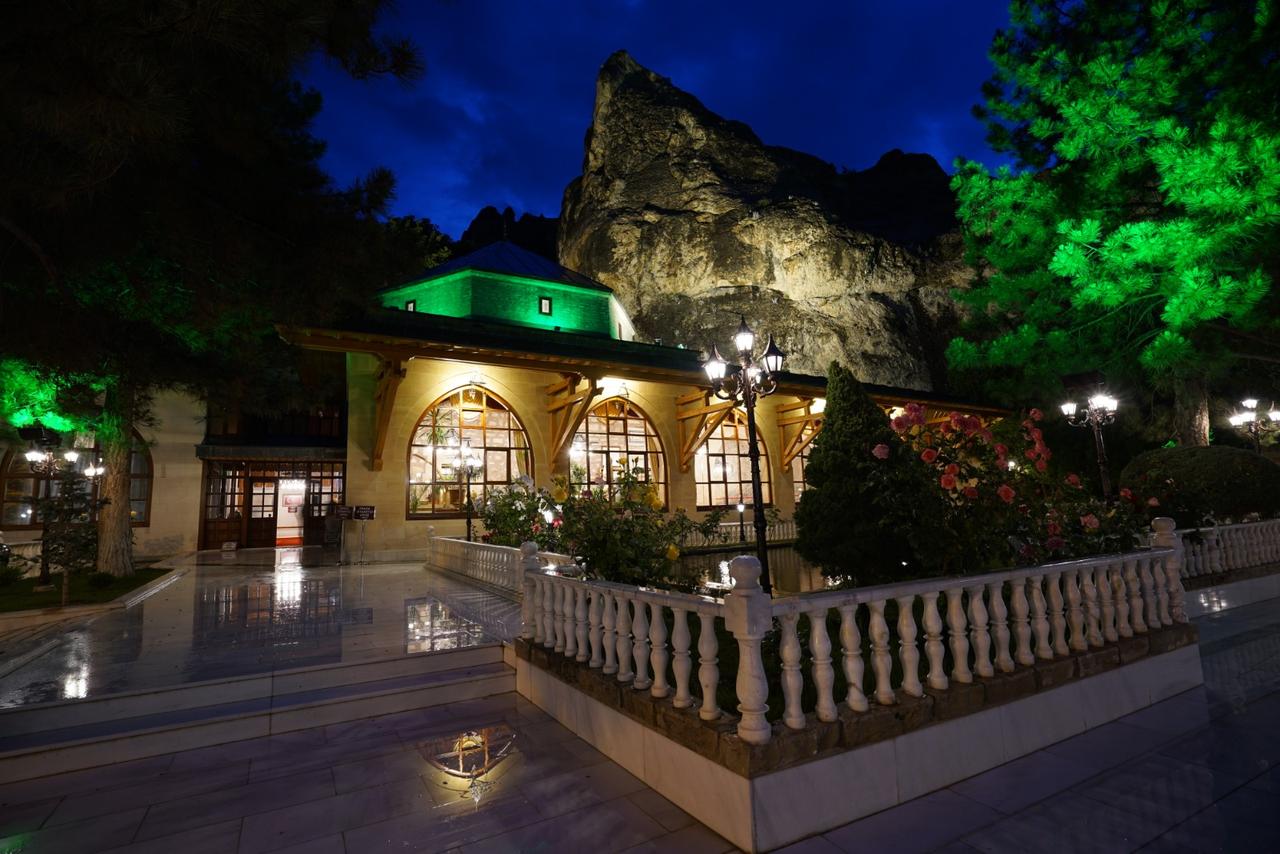
Somuncu Baba Türbesi
Location | Zaviye Mahallesi Türkiye Malatya Darende | ||||||||
|---|---|---|---|---|---|---|---|---|---|
Initial Construction | 4th century (Yıldırım Bayezid period) | ||||||||
Architectural Style(s) | Seljuk-Ottoman | ||||||||
Tomb | Tombs of Şeyh Hâmid-i Velî (Somuncu Baba) and his son Halil Taybî | ||||||||
The Sheikh Hamid-i Vali (Somuncu Baba) Mosque and Tomb is a religious and cultural heritage site located in the Zaviye Neighborhood of Darende District, Malatya Province, Türkiye, beside the Tohma River. This complex is also known as the Somuncu Baba Külliyesi and comprises a multifaceted ensemble of structures including a mosque, tomb, cemetery, museum, library, fish pond, crown gate, additional mosques, and social facilities.
Sheikh Hamid-i Vali, who lived in the 14th century, is widely known by the epithet Somuncu Baba. It is generally accepted that his real name was Abdullah and that he was born in Kayseri. He received his Sufi education from his father, Musa Efendi, continued his training at the Bayezidiyye Dergah in Damascus, and later became a disciple of Sheikh Hacı Alaeddin Erdebili at the Erdebil Tekke. After settling in Bursa and living closely among the people, he earned the name Somuncu Baba for distributing bread while saying, “The loaves are for the believers!”
His Sufi influence is particularly evident on Hacı Bayram-ı Veli. As the spiritual master of Hacı Bayram-ı Veli, the founder of the Bayramiyye order, this underscores the magnitude of Somuncu Baba’s impact on Anatolian Sufism. It has also been noted that Somuncu Baba served as a spiritual precursor to other orders such as the Halvetiyye, Celvetiyye, and Melâmiyye.
Although there are differing opinions regarding the date of his death, the widely accepted year is 1412. He passed away in Darende, Malatya, and was buried in the area where the mosque and zawiya bearing his name are located.
The exact construction date of the tomb is unknown, but the mosque’s minaret bears the date 1686. The main structure has been restored multiple times over different periods using stone and wood. The tomb is square in plan and crowned with a seven-sided drum supporting a dome. This architectural form symbolically references the seven verses of the Fatiha Sura. The dome is covered by a seven-sided pyramidal roof.
Inside the tomb lie the graves of Somuncu Baba and his son Halil Taybî. The graves are constructed of stone and are covered with walnut caskets crafted in the Republican period using woodwork techniques. To the south of the mosque is a rectangular room now used as a library. In the basement lies the Somuncu Baba and Hulusi Efendi Museum.
The hazire, located on the qibla side of the mosque, contains the graves of prominent figures of the order and descendants of Somuncu Baba who served as sheikhs. The most recent burial is that of Osman Hulusi Efendi, who died in 1990. The cemetery contains a total of 22 graves. Most of the tombstones are inscribed in Arabic and Ottoman Turkish using celî sülüs and celî ta’lîk calligraphy. The tops of the stones feature turbans, fezzes, circular, and oval shapes; titles such as “hafız,” “müderris,” “imam-hatip,” and “seyyid” are commonly found. Above the tombstones, inscriptions begin with attributes of Allah, followed by elegies and biographical details. The footstones are typically triangular or arched in form.

Somuncu Baba Tomb (Türkiye Culture Portal)
Designed with a 13×13 meter square plan, its architectural details follow the Seljuk-Ottoman tradition. The ceiling features inverted woodwork made from “sapella” timber imported from South Africa. Walls display imperial decrees (fermans) sent by Ottoman sultans to the descendants of Somuncu Baba.
Measuring 25×25 meters, its wooden ceiling incorporates Seljuk and Ottoman artistic motifs. From the center outward, five eight-pointed star patterns expand to form 40 star corners, symbolizing the spiritual significance of the number “40” in Islam. The pulpit, mihrab, and kürsü are each carved from single blocks of wood using traditional craftsmanship.

Somuncu Baba Tomb (Türkiye Culture Portal)
Artistic elements within the külliye’s interior include:
Güzel, Emine. “Darende Şeyh Hamid-i Velî (Somuncu Baba) Camii Haziresi’ndeki Mezar Taşları / Tombstones at the Hazīre of Shaykh Hamid-i Velī (Somuncu Baba).” *Mesned İlahiyat Araştırmaları Dergisi / The Journal of Mesned of Theological Studies* 15, no. 2 (December 2024): 154–183. .
“Darende Somuncu Baba.” Malatya İl Kültür ve Turizm Müdürlüğü. Accessed June 1, 2025. https://www.malatyakultur.com/malatya-tanitim/darende-somuncubaba.
“Somuncu Baba Camii ve Türbesi.” Kültür Portalı. T.C. Kültür ve Turizm Bakanlığı. Accessed June 1, 2025. https://www.kulturportali.gov.tr/turkiye/malatya/gezilecekyer/somuncu-baba-camii-ve-turbesi.
“Somuncu Baba Türbesi Mimari Özellikleri ile Külliye.” *somuncubabaturbesi.com*. Accessed June 1, 2025. https://somuncubabaturbesi.com/mimari-ozellikleri-ile-kulliye/.
“Somuncu Baba Türbesi ve Külliyesi.” Es-Seyyid Osman Hulûsi Efendi Vakfı. Accessed June 1, 2025. https://hulusiefendivakfi.org.tr/somuncu-baba-turbesi-ve-kulliyesi/.

Somuncu Baba Türbesi
Location | Zaviye Mahallesi Türkiye Malatya Darende | ||||||||
|---|---|---|---|---|---|---|---|---|---|
Initial Construction | 4th century (Yıldırım Bayezid period) | ||||||||
Architectural Style(s) | Seljuk-Ottoman | ||||||||
Tomb | Tombs of Şeyh Hâmid-i Velî (Somuncu Baba) and his son Halil Taybî | ||||||||
No Discussion Added Yet
Start discussion for "Somuncu Baba Mosque and Tomb" article
Sheikh Hamid-i Vali (Somuncu Baba)
Historical and Architectural Structure of the Külliye
Main Mosque and Tomb
Hazire (Cemetery)
Additional Structures
Additional Mosque (2002)
New Mosque (2009–2013)
Other Components of the Külliye
Artistic and Calligraphic Features