

This article was automatically translated from the original Turkish version.
+2 More
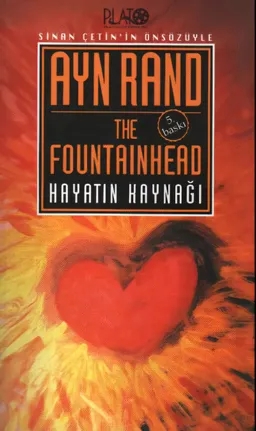
The Fountainhead (original title: The Fountainhead) is a philosophical novel by Ayn Rand that centers on the themes of individualism and creative independence, exploring the individual’s stance against social pressure in accordance with personal values.
The Fountainhead places concepts such as originality, independence, and inner integrity at its core, narrating the conflict between the creative individual and society. Through the character of Howard Roark, an idealistic and independent architect, the novel emphasizes the importance of remaining faithful to oneself and resisting external influences.
While defending individual values, the novel highlights intrinsic motivation. With this work, Ayn Rand not only presents a literary narrative but also introduces the foundational principles of her developed philosophy, Objectivism. In this sense, the novel is not merely a work of fiction but also a text designed to encourage readers to reflect on their personal philosophy of life.
1. The Primacy of the Individual: Individualism is presented as the most fundamental value in the novel. The protagonist, Howard Roark, is an architect who refuses to conform to societal expectations and chooses to live according to his own principles. In contrast, characters such as Peter Keating and Ellsworth Toohey are depicted as individuals who sacrifice their own identities to gain approval from others and adapt to societal norms.
2. Society and Nonconformity: Through Roark’s character, the novel critiques a society that rewards mediocrity and imitation over creativity, where the majority accepts conformity and ordinariness. In this context, the novel questions the ways in which society suppresses individual creativity.
3. The Objectivist Approach: The Fountainhead is the first literary expression of the philosophy of Objectivism, which Rand later systematized. In this approach, reason, logic, and individual freedom are foundational. These philosophical principles are reflected in the decisions and actions of the characters throughout the novel.
Howard Roark: An independent, creative, and principle-driven architect. His character embodies individual integrity and moral independence.
Peter Keating: An architect who compromises his own values to gain societal approval, pursuing success through conformity rather than authenticity.
Ellsworth Toohey: A figure who manipulates the masses through media and ideology, viewing individual achievement as a threat to collective control.
Dominique Francon: A complex character who admires Roark yet seeks to harm him, convinced that society will destroy him. In this way, she represents the internal conflicts experienced by the individual in confrontation with society.
The novel’s narrative style carries significant literary and philosophical weight. Characters are primarily foregrounded through their intellectual and ideological frameworks. Dialogues serve not merely to advance the plot but to explore ideas and provoke thought in the reader.
While following a classical plot structure, the novel emphasizes philosophical conflicts. The events that befall Roark are structured to reveal his steadfastness and his struggle against society.
Lack of Realism in Characters: Some critics have argued that the characters fail to reflect the complexity of human psychology and are constructed primarily as vehicles for philosophical ideas.
Didactic Narrative: The novel’s occasionally instructional tone has been viewed as undermining its literary flow, rendering it at times more pedagogical than narrative.
Disconnection from Social Reality: Roark’s individualistic approach has been interpreted by some readers as idealistic and unrealistic. In particular, the novel’s portrayals of the workings of the professional world and society have been criticized by some reviewers as one-dimensional.

No Discussion Added Yet
Start discussion for "Source of Life (Book)" article
Overview of the Book
Individualism and Philosophical Themes
Characters and the Concepts They Represent
Structure and Narrative Style
Criticisms of the Novel