This article was automatically translated from the original Turkish version.
Type(s) | Southern Cassowary | ||||||||
|---|---|---|---|---|---|---|---|---|---|
Family | Casuariidae | ||||||||
Genus | 1.7 - 1.9 m | ||||||||
Weight(s) | 55 - 85 kg | ||||||||
Lifespan | 18-20 years in the wild; 40 years in captivity | ||||||||
Habitat | Northern Queensland (Australia) Indonesia (Ceram and Aru Islands) Papua New Guinea | ||||||||
Conservation Status | International Union for Conservation of Nature (IUCN) – Vulnerable | ||||||||
Southern Cassowary (Casuarius casuarius) is a large, flightless bird species native to the rainforests and surrounding habitats of Southeast Asia and northeastern Australia. Measuring on average 1.7 to 1.9 meters in height and weighing 55 to 85 kilograms, it is considered the third largest bird in the world after the ostrich and the emu.
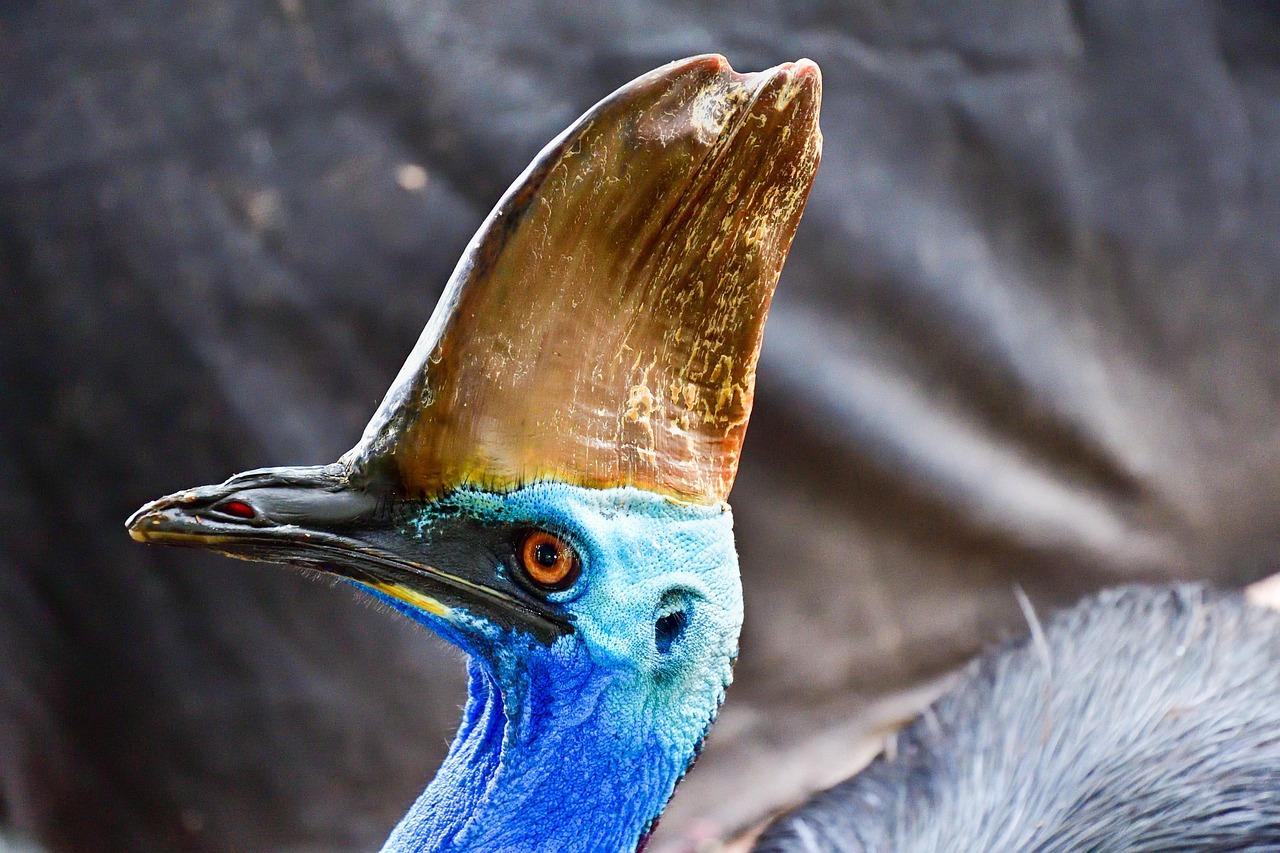
The southern cassowary is distinguished by its large body covered in black, satin-like feathers and a long, brightly colored neck with vivid blue and red hues. On top of its head is a keratinous, hollow, pointed casque (a horn-like structure) that may play a role in thermoregulation and is assessed by potential mates during sexual selection. The neck and facial area are covered in colorful skin. Each foot has three large toes, each bearing a dagger-shaped claw measuring 10 to 12 centimeters in length. These claws play a crucial role in defense and locomotion.

Southern Cassowary (Pixabay)
Southern cassowaries generally lead solitary lives, coming together only during the breeding season. Males construct nests from plant material, incubate the eggs, and care for the chicks. Females typically mate with multiple males, laying three to five dark green eggs in each male’s nest. Chicks become mobile shortly after hatching, but remain dependent on their fathers for about nine months before achieving independence.
Southern cassowaries are primarily frugivorous, feeding on fallen fruits in the forest understory. This helps disperse seeds through their digestive systems, promoting the regeneration of forests and enhancing biodiversity. They also occasionally consume small animals, reptiles, and fungi.
This species inhabits northern Queensland in Australia, the forests of Papua New Guinea, and the islands of Ceram and Aru in Indonesia. It can be found in a variety of habitats including dense tropical rainforests, savannas, forest edges, riverbanks, and mangroves.
The southern cassowary is classified as Vulnerable by the International Union for Conservation of Nature (IUCN). Its population is declining due to deforestation, habitat loss, and hunting. Populations in Australia have significantly decreased, while hunting remains a major threat in Papua New Guinea and Indonesia. Conservation efforts are vital for the long-term survival of the species and the ecosystems it inhabits.
Southern cassowaries communicate using deep, low-frequency booming calls that can travel long distances through the forest. During the breeding season, males use these sounds to signal to potential mates. In the presence of danger, they puff up their feathers and erect their necks to appear larger.
In the wild, southern cassowaries live between 18 and 20 years, but under human care they can live up to 40 years.
In conclusion, the southern cassowary is a species that plays a critical role in biodiversity and exhibits numerous evolutionary traits reminiscent of dinosaurs. It is regarded as an important indicator species for the health and conservation of forest ecosystems.
National Zoo. "Güney Kazuvarı."Smithsonian Ulusal Zoo and Conservation Biology Institute. Accessed June 23, 2025. https://nationalzoo.si.edu/animals/southern-cassowary.
One Earth. "Haftanın Türü: Güney Kazuvarı." Accessed June 23, 2025. https://www.oneearth.org/species-of-the-week-southern-cassowary/.
Pixabay. "Cassowary, Kuş, Hayvan." December 6, 2022. Accessed June 23, 2025. https://pixabay.com/tr/photos/cassowary-ku%C5%9F-hayvan-7575747/.
Pixabay. "Güney Cassowary, Kuş." December 6, 2022. Accessed June 23, 2025. https://pixabay.com/tr/photos/g%C3%BCney-cassowary-ku%C5%9F-7575749/.
San DiegoZoo Hayvanlar and Plants. "Southern Cassowary." San Diego Zoo Wildlife Alliance. Accessed June 23, 2025. https://animals.sandiegozoo.org/animals/southern-cassowary.

Type(s) | Southern Cassowary | ||||||||
|---|---|---|---|---|---|---|---|---|---|
Family | Casuariidae | ||||||||
Genus | 1.7 - 1.9 m | ||||||||
Weight(s) | 55 - 85 kg | ||||||||
Lifespan | 18-20 years in the wild; 40 years in captivity | ||||||||
Habitat | Northern Queensland (Australia) Indonesia (Ceram and Aru Islands) Papua New Guinea | ||||||||
Conservation Status | International Union for Conservation of Nature (IUCN) – Vulnerable | ||||||||
No Discussion Added Yet
Start discussion for "Southern Cassowary (Casuarius casuarius)" article
Physical Characteristics
Behavior and Lifestyle
Diet
Habitat and Distribution
Conservation Status
Communication
Lifespan