
This article was automatically translated from the original Turkish version.
+1 More
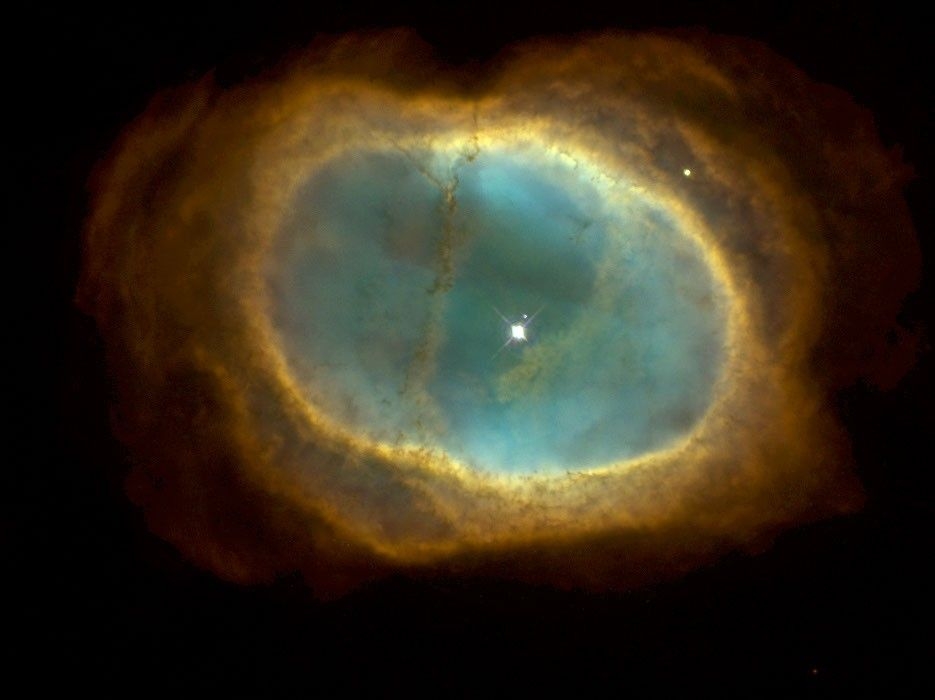
Southern Ring Nebula (NGC 3132) is a planetary nebula located in the direction of the Vela constellation. It is also commonly known as the "Eight-Burst Nebula." This celestial object formed when the outer layers of a central aging star were ejected into space. It was first discovered in 1835 by John Herschel.

Southern Ring Nebula (NASA)
NGC 3132 is a planetary nebula formed during the final stages of an aging Sun-like star’s life, as it ejected its outer layers. The remaining hot core illuminates the surrounding material by ionizing it, making the nebula visible. Although the nebula appears as a symmetric ring, three-dimensional analyses show that its structure is in fact a combination of two nested ellipsoidal shells.
At the center of the nebula are two stars: one brighter and similar in properties to the Sun, and the other much hotter but fainter—the central star responsible for ionizing the nebula. The presence of this binary star system is crucial to explaining the nebula’s asymmetric and complex structure.
NGC 3132 has been studied in great detail through high-resolution images captured by the Hubble Space Telescope. Visually, its nested ring structure, the central pair of stars, bright edge features, and ionized gas layers stand out. Image analyses using different filters have mapped the distribution of elements such as hydrogen, oxygen, and nitrogen.
The Southern Ring Nebula is an important research object for understanding the evolution of planetary nebulae, the dynamic effects of binary star systems, and the terminal behavior of stellar masses. Such nebulae provide critical data on the final evolutionary stages of low- and intermediate-mass stars. They also represent processes contributing to galactic chemical enrichment.
NGC 3132 is a typical planetary nebula distinguished by its complex structure, interaction with a binary star system, and ionized gas composition. Although its observation is not particularly easy, detailed study has been made possible through modern telescopic spectral analysis and imaging. From an astronomical perspective, it is one of the key examples for understanding the formation and subsequent dynamics of planetary nebulae.

No Discussion Added Yet
Start discussion for "Southern Ring Nebula (NGC 3132)" article
Technical Characteristics
Formation and Visual Features
Astrophysical Significance