


This article was automatically translated from the original Turkish version.
+2 More
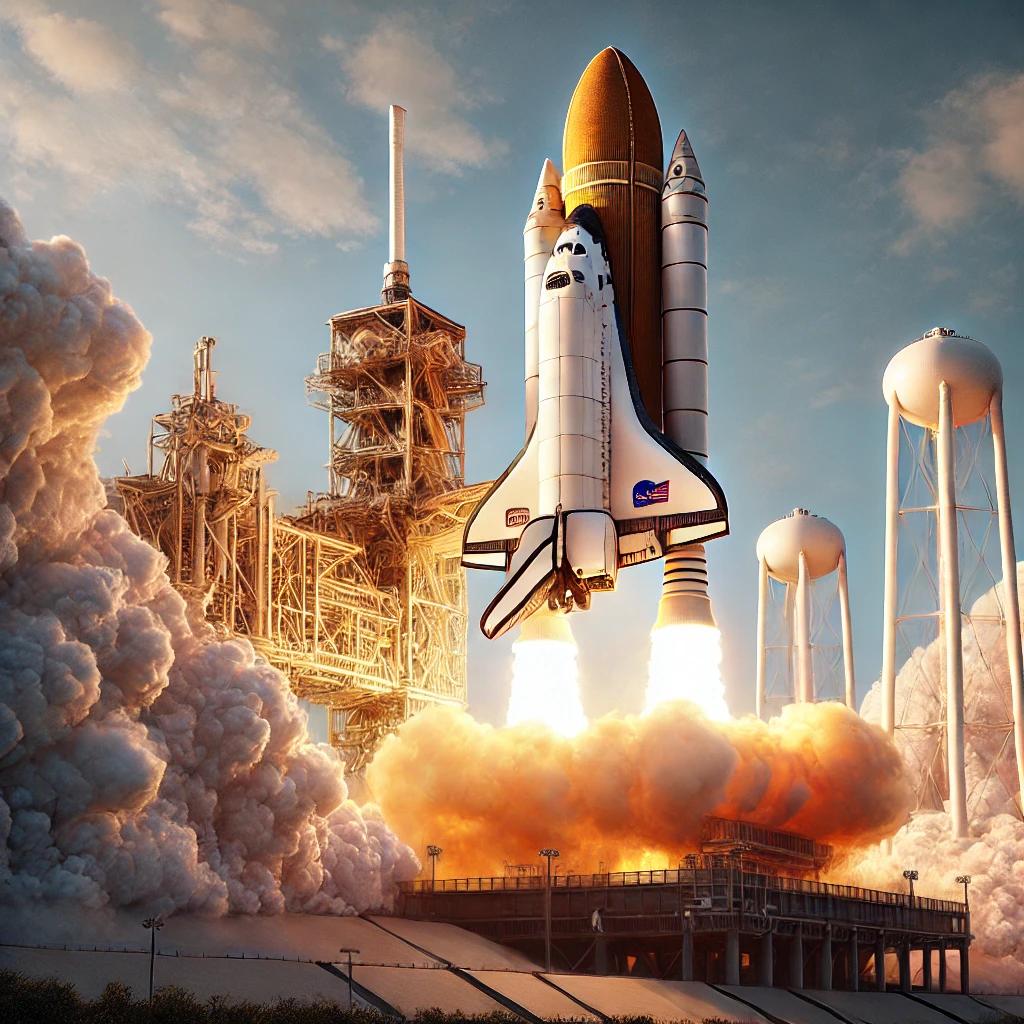
Launch of Atlantis Generated by Artificial Intelligence from the Kennedy Space Center.
Official Name(s) | Atlantis OV-104 | ||||||||
|---|---|---|---|---|---|---|---|---|---|
Project Owner | NASA | ||||||||
Function(s) | Orbital Vehicle | ||||||||
First Flight Date | 3 October 1985 | ||||||||
Last Flight Date | 8 July 2011 | ||||||||
The Space Shuttle Atlantis was a spacecraft developed under NASA’s Space Shuttle Program and designed to be reusable. From its first flight in 1985 to its final mission in 2011, it completed numerous important missions.
NASA’s Space Shuttle Program, launched in the 1970s, aimed to make human spaceflight more economical and sustainable. Atlantis, one of the five shuttles developed under this program, was actively used from 1985 onward and completed 33 successful missions.
Atlantis made its first flight on 3 October 1985 on mission STS-51-J. The shuttle is approximately 37 meters long, has a wingspan of 24.5 meters and a launch weight of 680,000 kilograms.
Over its 26 years of service, Atlantis carried out many critical missions, including:

Atlantis docked with the International Space Station, generated by artificial intelligence.
The Space Shuttle Atlantis played a vital role as a platform for scientific experiments, the construction of space stations, and the continuity of space exploration. In particular, its servicing missions to the Hubble Space Telescope and its flights to the ISS provided critical insights for future space missions.
The Space Shuttle Atlantis marked one of the pivotal period milestones in human spaceflight and undertook critical missions that paved the way for space exploration. Following the conclusion of NASA’s Space Shuttle Program in 2011, Atlantis was retired and placed on display at the Kennedy Space Center.

Atlantis on display at the Kennedy Space Center, generated by Artificial Intelligence.
Brown, J. Space Shuttle Atlantis: The Last Missions. Cambridge: Cambridge University Press, 2018.
Green, M. Military and Civilian Space Missions. Oxford: Oxford University Press, 2021.
Johnson, P. The History of NASA's Space Shuttle Program. Berlin: Springer, 2012.
NASA. Kennedy Space Center Visitor Complex: Atlantis Exhibit. 2023.
NASA. Space Shuttle Program Overview. 2020.
Nelson, R. Future of Space Exploration: Lessons from Atlantis Missions. Cambridge: MIT Press, 2022.
Smith, D. The Role of Atlantis in Space Science Advances. Cambridge: Harvard University Press, 2015.
Taylor, K. International Space Station and Shuttle Collaborations. London: Routledge, 2019.
White, L. Hubble Space Telescope: Servicing Missions and Achievements. Princeton: Princeton University Press, 2017.

Launch of Atlantis Generated by Artificial Intelligence from the Kennedy Space Center.
Official Name(s) | Atlantis OV-104 | ||||||||
|---|---|---|---|---|---|---|---|---|---|
Project Owner | NASA | ||||||||
Function(s) | Orbital Vehicle | ||||||||
First Flight Date | 3 October 1985 | ||||||||
Last Flight Date | 8 July 2011 | ||||||||
No Discussion Added Yet
Start discussion for "Space Shuttle Atlantis: History, Missions, and Contributions" article
History and Technical Specifications of Atlantis
Key Missions Conducted
Atlantis’s Contribution to Space Research