


 Recently Added:
This article was automatically translated from the original Turkish version.
Adamuz High-Speed Train Crash is a high-speed rail accident that occurred on 18 January 2026 near the town of Adamuz in the Andalusia region of southern Córdoba, following a collision between two high-speed trains south of Spain. The accident resulted in the deaths of 42 peoplethree-day national mourning period.
Search and rescue operations in the area following the Spanish train crash, 18–19 January 2026 – (Associated Press)
The accident occurred on Sunday, 18 January 2026, near the town of Adamuz in the province of Córdoba, within the autonomous community of Andalusia in southern Spain. The incident took place at approximately 19:40 local time (21:40 CET). It happened on a straight and recently refurbished section of the high-speed railway line operated by Adif. Spanish Minister of Transport Óscar Puente stated that the accident occurred on a line that had been renewed in May 2025.
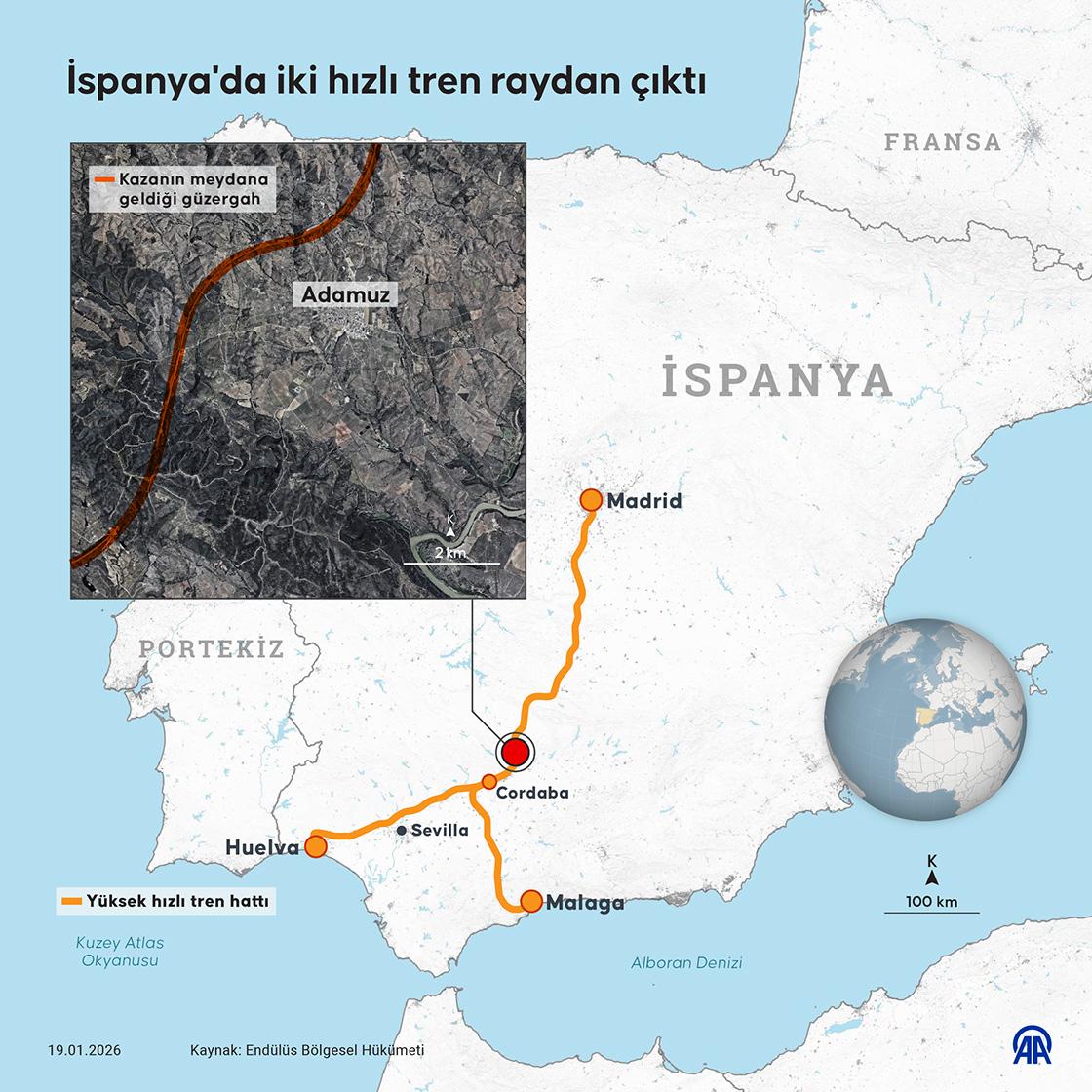
Infographic showing the location of the accident in the media, 19 January 2026 – (Anadolu Agency)
The accident occurred when a train operated by the private rail company Iryo, traveling from Málaga to Madrid, derailed and its carriages collided with a train traveling in the opposite direction operated by the state-owned company Renfe, which was en route from Madrid to Huelva.
It is reported that the Iryo train was carrying approximately 317 passengers at the time of the incident. As the train approached Adamuz station, its last three carriages derailed and crossed onto the adjacent track. At the same time, a Renfe Alvia-type train, carrying between 100 and 184 passengers, collided with the derailed carriages of the Iryo train.
As a result of the collision, the first two carriages of the Renfe train derailed and plunged four metres down a slope. Minister Puente described the technical sequence as follows: “The rear section of the first train derailed and struck the front of the other train, causing its first two carriages to fall down a four-metre embankment.”
Structural damage occurred to the front sections of both trains following the collision. The most severe destruction was reported in the front carriages of the Renfe train. Immediately after the accident, all rail services in the region were suspended and the crash site was declared a “restricted area” for security reasons.
According to official statements issued on 21 January 2026, the number of fatalities in the Adamuz High-Speed Train Crash had risen to 42. The minister stated that the identities of 10 of the 42 deceased had been confirmed, while the remaining victims would be identified through forensic examinations. According to data from the Ministry of the Interior dated 19 January, 152 people were injured. As of 21 January, 13 victims remained in intensive care and a total of 39 people were receiving hospital treatment.
More than 150 people received initial medical assistance at a field hospital established in the town of Adamuz. Identification efforts for the deceased were carried out by the Civil Guard (Guardia Civil) and forensic medicine teams. In this context, offices were set up in the cities of Madrid, Seville, Málaga, Córdoba and Huelva to collect DNA samples.
Rescue teams prioritized transporting the injured to hospitals in and around Córdoba. The Spanish Red Cross (Cruz Roja Española) deployed psychosocial support teams to the area to provide counseling to families of victims waiting at the scene. Authorities reported that approximately 400 passengers were on board the two trains at the time of the accident. The engineer of the Renfe train was among those who lost their lives.
A large-scale emergency response operation was launched immediately after the accident. The Spanish Civil Guard (Guardia Civil), the Military Emergency Unit (Unidad Militar de Emergencias – UME), fire departments, the 112 Andalusia Emergency Service, and medical teams were dispatched to the scene.
Guardia Civil reported that more than 220 personnel participated in the operation. The personnel were drawn from units responsible for public safety, traffic control, special intervention forces (GRS), and air services.
UME was deployed with approximately 40 soldiers and 15 vehicles. The Andalusian regional government activated its Regional Civil Protection Emergency Plan to coordinate rescue, logistical and medical support activities. The Adamuz municipal sports hall (polideportivo municipal) was converted into an emergency medical facility where lightly injured passengers received treatment.
Following the accident, statements were issued by the Spanish central government, regional authorities, and international institutions. Spanish Minister of Transport Óscar Puente, in his initial remarks after the incident, confirmed that an investigation into the cause was underway and described the accident as “an extremely unusual event.” Puente indicated that the investigation to determine the cause could take at least one month.
Following the accident, the Spanish government convened the Emergency Commission, and operations have begun under the coordination of the Ministries of Transport and Interior. Prime Minister Pedro Sánchez canceled all planned official engagements and withdrew his participation in the World Economic Forum meeting in Davos.
In a statement on the social media platform X, Sánchez said: “We are enduring a deeply painful night for our country due to the tragic train crash in Adamuz.”
King Felipe VI and Queen Letizia, in a message issued regarding the incident, stated: “We extend our deepest condolences to the families of those who lost their lives and our affection and wishes for a swift recovery to the injured.” It was noted that the Royal Family has been following the incident with great concern.
The Spanish Congress of Deputies (Congreso de los Diputados) observed a one-minute silence on the afternoon of January 19, 2026, in memory of those who died in the accident. The city of Huelva declared a three-day period of mourning following the crash.
Andalusia Regional President Juan Manuel Moreno traveled to the site to assess the situation firsthand. In a statement following the incident, Moreno described the accident as “a very difficult day for Andalusia” and confirmed that regional rescue teams continue their operations.
On the international level, French President Emmanuel Macron sent a message of solidarity to Spain via X, stating: “France stands with you.” European Commission President Ursula von der Leyen also expressed support, saying: “I wish the injured a swift and full recovery.” Additionally, Italian Prime Minister Giorgia Meloni issued a message of condolence to those affected by the accident.
Teams from the Civil Guard’s Criminal Investigation Department, active in the region, stated that investigations are ongoing into the last three carriages of the Malaga-Madrid train involved in the collision. Civil Guard officials confirmed that examinations of the seventh and eighth carriages have been completed and emphasized that work on the sixth carriage—the first to leave the tracks—is of critical importance to the investigation.
Transport Minister Oscar Puente, in a statement to the press, said that initial investigations revealed a section of the track was broken, and it is currently being determined whether this was a cause or a consequence of the collision.
According to reports in the Spanish press citing sources involved in the investigation, it is believed that the malfunction on the track likely caused the rear carriages of the Malaga-Madrid high-speed train to derail. It was noted that the high number of fatalities and injuries resulted from the Madrid-Huelva train, traveling in the opposite direction, colliding with the derailed carriages just 20 seconds after they left the tracks. After Prime Minister Pedro Sánchez visited the crash site and the hospital to meet the injured, King Felipe VI and Queen Letizia also traveled to the region. The Andalusia rail line, still closed due to the accident, is expected to resume full operations on February 2.
Spain has the most extensive high-speed rail network in Europe. According to European Union data, the country has over 3,100 kilometers of track designed for trains operating at speeds exceeding 250 kilometers per hour.
The last major railway accident in Spain occurred in 2013 in the Galicia region. In that incident, a train traveling from Madrid to Galicia derailed while moving at 179 kilometers per hour on a section with a speed limit of 80 kilometers per hour, resulting in 80 fatalities and 179 injuries. This event remains the deadliest train accident in Spain in the 21st century.
The Spain–Adamuz High-Speed Train Accident has become the train crash in Spain with the highest number of fatalities since the 2013 Galicia disaster.
Al Jazeera. “Spain Train Crash Live: At Least 39 Killed in High-Speed Collision.” Al Jazeera. Accessed January 19, 2026. https://www.aljazeera.com/news/liveblog/2026/1/19/spain-train-crash-live-at-least-39-killed-in-high-speed-collision
Anadolu Ajansı. “İspanya’da İki Hızlı Trenin Karıştığı Kazada Yaşamını Yitirenlerin Sayısı 39’a Yükseldi.” Accessed January 19, 2026. https://www.aa.com.tr/tr/dunya/ispanyada-iki-hizli-trenin-karistigi-kazada-yasamini-yitirenlerin-sayisi-39a-yukseldi/3803456
Associated Press. “Spain Train Collision Kills at Least 39 as Rescue Efforts Continue.” YouTube video. Accessed January 19, 2026. https://www.youtube.com/watch?v=qdBEgevU2-E
BBC News. “High-speed train crash in Spain kills at least 39.” BBC News. Accessed January 19, 2026. https://www.bbc.com/news/articles/cedw6ylpynyo
El País. “Última hora del accidente de tren en Adamuz, Córdoba, en directo | Se eleva a 39 la cifra de muertos en el descarrilamiento de tren en Adamuz.” El País. Accessed January 19, 2026. https://elpais.com/espana/2026-01-18/ultima-hora-del-descarrilamiento-de-dos-trenes-en-adamuz.html
Euronews. “Death toll in Spain train collision rises to at least 39 as rescue efforts continue, police say.” Euronews. Accessed January 19, 2026. https://www.euronews.com/2026/01/18/at-least-5-dead-after-two-spanish-high-speed-trains-collide-in-cordoba
RTVE. “Al menos 39 muertos y más de cien heridos al descarrilar dos trenes de alta velocidad en la localidad cordobesa de Adamuz.” RTVE Noticias. Accessed January 19, 2026. https://www.rtve.es/noticias/20260118/descarrilan-dos-trenes-localidad-cordobesa-adamuz/16899512.shtml

On January 18, 2026, two high-speed trains collided near the town of Adamuz in the province of Córdoba, Spain. The accident resulted in 42 deaths and over 150 injuries. The collision occurred when an Iryo train traveling from Málaga to Madrid derailed and struck a Renfe train coming from the opposite direction. Following the incident, rail services in the region were suspended. In the aftermath of the crash, the Spanish government declared three days of national mourning.
No Discussion Added Yet
Start discussion for "Spain - Adamuz High-Speed Train Accident (2026)" article
January 19, 2026
Location, Time, and Course of the Accident
January 19, 2026
Deaths and Injuries
January 19, 2026
Rescue and Emergency Response Operations
January 19, 2026
State and Institutional Responses
January 19, 2026
Investigation Findings
January 19, 2026
Historical Context