


This article was automatically translated from the original Turkish version.

Condition
Developer(s) | Poimandres | ||||||||
|---|---|---|---|---|---|---|---|---|---|
Type(s) | State Management Library | ||||||||
Programming Language | TypeScript JavaScript | ||||||||
Initial Release | 2020 | ||||||||
License | MIT | ||||||||
The complexity of modern web applications brings state management—a factor that directly impacts user experience—to the forefront. In component-based architectures like React, the ability to manage state consistently and efficiently across components directly affects application maintainability. In this context, Zustand stands out as a lightweight, flexible, and modern state management library. Designed for JavaScript/TypeScript applications, Zustand offers easy integration through a minimal code structure, optimizing the developer experience while aiming to preserve application performance.
Zustand (German for “state”) is an open-source state management library developed by the Poimandres collective. Although designed for React, it can operate independently of the React context. Key advantages of Zustand include minimal dependencies, reduced boilerplate, performance optimization, and a simple API design.
Zustand allows the creation of a single “store” accessible to all components. This store is defined via a function that encapsulates relevant state variables along with functions to modify them. The store definition is implemented using the create function, which provides developers with a clean and readable structure.
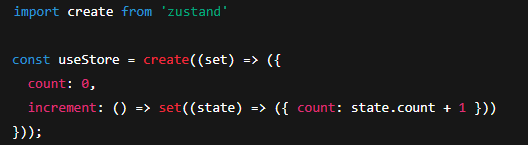
(Example code created by the author.)
Through the useStore hook, React components can easily subscribe to this state and re-render only when the specific parts they depend on change.
One of Zustand’s most notable features is selective subscription. React components can subscribe only to the specific portions of the store they need. This reduces unnecessary re-renders and significantly improves application performance.

(Example code created by the author.)
In this usage, the component re-renders only when the count value changes. This enables efficient and effective use of React’s reactive nature.
Zustand integrates seamlessly with various middleware solutions that support development workflows such as logging, persistence, and devtools. This support is provided via the zustand/middleware module, enhancing the developer experience in complex applications.
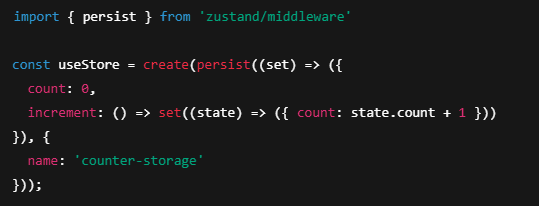
(Example code created by the author.)
Asynchronous Data Handling
Zustand is designed to handle both synchronous and asynchronous operations. Developers can update store values directly within an async function, enabling API calls or other delayed operations to modify state.
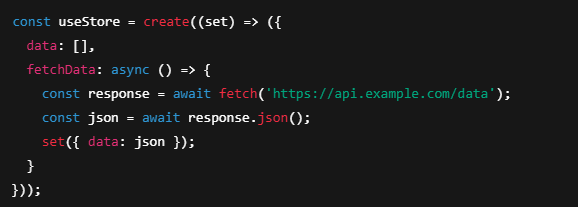
(Example code created by the author.)
This capability offers Zustand as a viable alternative to libraries like React Query or Redux-Thunk for data management.
Zustand is widely adopted in both individual and enterprise projects across various scenarios. It is particularly preferred over heavier solutions like React Context API or Redux in small to medium-sized applications.
The excessive boilerplate common in solutions like Redux can reduce developer productivity. Zustand minimizes this issue through a streamlined API. It is well-suited for application-wide state needs such as page-level state tracking, user session management, and theme or language preferences.
Academic and independent evaluations show that Zustand offers lower code complexity and consumes fewer resources compared to Redux. Its selective subscription feature reduces the re-render rate per component even within a global store structure, delivering a more consistent user experience. Its observation-based rendering architecture improves application performance by reducing CPU and memory usage, especially on mobile devices.
In large, modular applications where state needs to be divided into separate modules, Zustand can introduce configuration complexity. However, methods such as combine and slice simplify the management of such complexity. For highly layered and interactive data structures, TypeScript’s type safety can further strengthen the architecture.
Thanks to its rapid adoption within the open-source ecosystem, Zustand has become a continuously evolving software project. Community-driven features and integrations expand its applicability to a broader range of use cases.
Zustand, developed under the Poimandres umbrella, boasts thousands of stars on GitHub and an active contributor base. Its compatibility with other tools developed by the same team—such as Valtio and Jotai—enables the creation of more flexible and comprehensive state management solutions across applications.
Zustand’s documentation is supported by clear examples and practical use cases. It is increasingly being adopted in academic settings, including software engineering and Human-Computer Interaction (HCI) courses, as a modern example of state management with React. This makes it significant from the perspective of software engineering education.
Zustand’s future development focuses on strengthening TypeScript support to improve scalability for larger applications and enhance type safety. Additionally, plans are underway to ensure compatibility with emerging approaches such as React Server Components, Concurrent Rendering, and Edge Computing. These advancements will further solidify Zustand’s position within modern software architectures.
Sehgal, Jai, and Akash Yadhav. “A Comparative Study of State Management Libraries: Redux, MobX, Recoil, and Zustand.” *IJRASET Journal for Research in Applied Science and Engineering Technology* 11, no. 6 (2023): 556–577. Accessed June 1, 2025. Accessed Adresi.
Sharma, Nikhil, Sarit Charan, Shaan Dadapeer, and Dr. Suma. “Performance and Developer Experience Comparison of Redux, Context API, and Zustand in React Applications.” *International Journal of Science, Advance Technology, and Engineering* 12, no. 2 (2025): 45–62. Accessed June 1, 2025. Accessed Adresi.
Zustand Documentation. "Getting Started: Introduction." Accessed June 1, 2025.

Condition
Developer(s) | Poimandres | ||||||||
|---|---|---|---|---|---|---|---|---|---|
Type(s) | State Management Library | ||||||||
Programming Language | TypeScript JavaScript | ||||||||
Initial Release | 2020 | ||||||||
License | MIT | ||||||||
Core Architecture and Technical Features of Zustand
Centralized State Model
Selective Subscription (Selector) Support
Middleware Integration
Practical Use Cases and Performance Evaluation
Use in Small and Medium-Sized Projects
Performance Comparisons
Challenges in Large-Scale Applications
Evolution and Future Directions of Zustand
Ecosystem and Community Support
Documentation and Education
Future Vision