

This article was automatically translated from the original Turkish version.

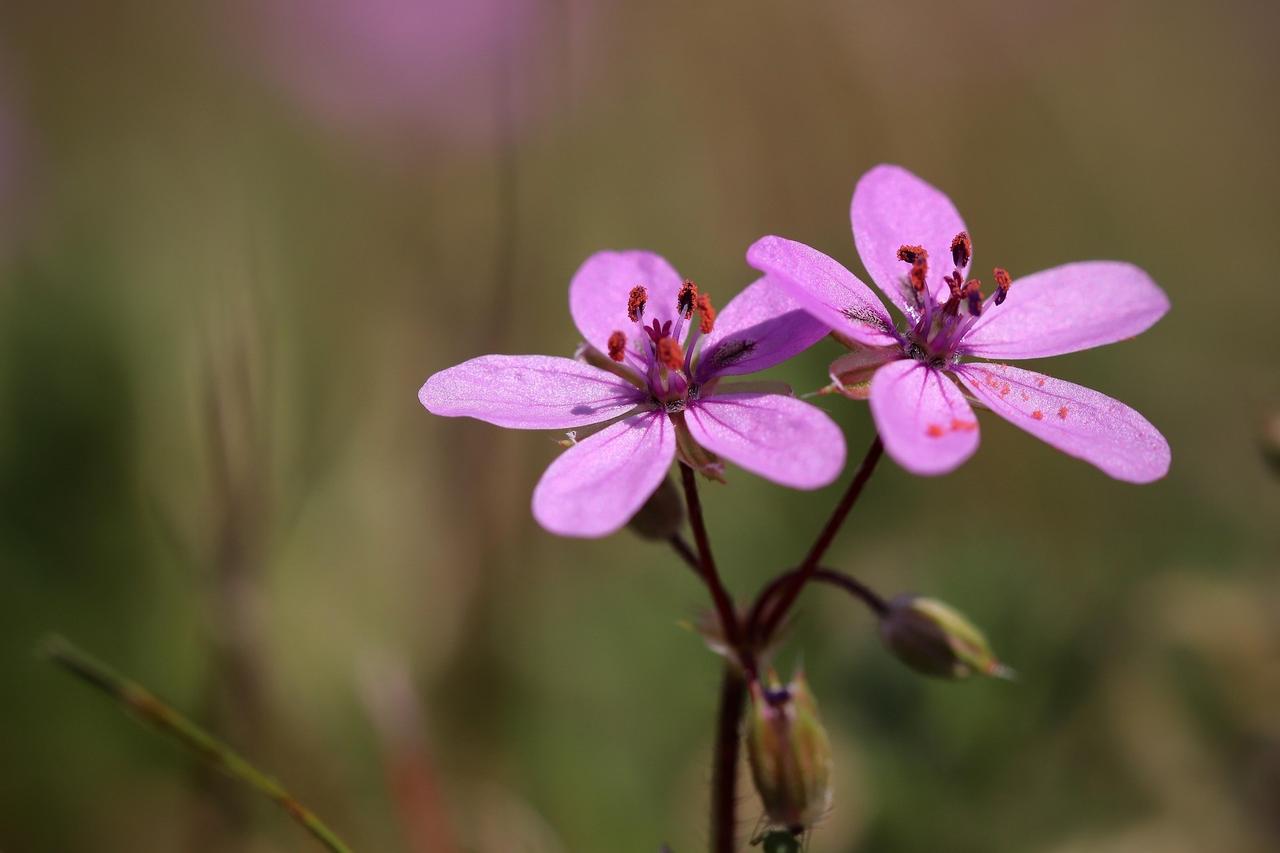
İğnelik Otu (Pixabay)
Erodium cicutarium L’Hér. is a herbaceous plant species belonging to the family Geraniaceae, exhibiting annual, winter annual, or occasionally biennial growth patterns. This taxon, commonly known in Türkiye as iğnelik, leylekgagası, or dönbaba, is endemic to the Mediterranean biogeographic region but has been widely dispersed across many temperate regions of the world due to anthropogenic activities, particularly acquiring an invasive character in North America.
Taxonomically, the plant is characterized by a prostrate basal rosette, hairy stems ranging from 10 to 50 cm in length, and deeply dissected leaves resembling those of a carrot. Its flowers, which bloom between March and May, are typically pentamerous, pink or lilac in color; after flowering, the fruit develops into a stylar column 2–5 cm long resembling a stork’s beak.Canadian Journal of Plant Science 92, no. 7 (2012): 1360, accessed 30 March 2026, https://doi.org/10.4141/cjps2012-076
'>【1】
The plant’s surface morphology is covered with both secretory and non-secretory trichomes. Electron microscopy studies have revealed three distinct types of capitate secretory trichomes on the calyx, leaves, and stems; these microscopic structures play a significant role in the plant’s taxonomic differentiation and volatile oil production processes. One of the most remarkable biological features of Erodium cicutarium is its seed dispersal and sowing mechanism. Mature mericarps possess a hygroscopic awn that responds to changes in humidity; during cycles of wetting and drying, the awn twists spirally, enabling the seed to drill itself into soil cracks autonomously. This mechanism protects the seed from environmental stressors such as fire, drought, and predation, and ensures it reaches an optimal depth for germination.

Morphological Structure of İğnelik Otu (Image Generated by Artificial Intelligence)
The plant thrives in a wide variety of ecosystems including sandy dry grasslands, agricultural fields, roadside verges, and disturbed habitats. Although best adapted to the Mediterranean climate, its drought-resistant structure allows it to become dominant in semi-arid regions. In areas such as Canada and the United States, the adoption of conservation tillage practices has led to its emergence as a significant weed problem in croplands, where it competes with cereal, canola, and legume crops for water and nutrients, resulting in substantial yield losses. Conversely, in natural pastures, it serves as a seasonal forage source for rodents, desert tortoises, and domestic animals; its seeds are consumed by numerous bird species and small mammals. Additionally, pollen records from this species are used as dating material in paleobotanical and archaeological studies.

Geographic Distribution of İğnelik Otu (Image Generated by Artificial Intelligence)
Erodium cicutarium possesses a rich phytochemical profile containing numerous pharmacologically active compounds. Modern analyses have demonstrated that the plant is a significant source of vitamins A, D, E, and K. The presence of these fat-soluble vitamins supports its nutritional value and potential role in biological processes such as immune response. Examination of its phytosterol content has identified ergosterol, stigmasterol, and particularly high concentrations of beta-sitosterol. Its organic acid profile consists of nine distinct acids, with acetic, succinic, malic, citric, and oxalic acids being the most prominent. Studies on its volatile oils indicate that hexadecanoic acid, citronellol, and caryophyllene oxide are dominant constituents, suggesting potential anti-inflammatory and antimicrobial properties.
Historically, various cultures have used Erodium cicutarium for medicinal purposes. In Iraq, it has been employed to treat hemorrhage and edema; among the Mapuche communities of South America, it has been used for dermatological conditions. In Ecuador and Peru, it has been reported for the treatment of stomach pain, heart ailments, and hypertension. In Türkiye, it is traditionally consumed in folk medicine for its anti-inflammatory, diuretic, and hemostatic effects, as well as as a laxative tonic. Scientific studies have evaluated the antioxidant activity of plant extracts, as well as the antiviral properties of its volatile oils and phenolic compounds. Current evidence suggests that this species should be regarded not merely as a weed but also as a potential functional food ingredient and natural pharmaceutical raw material.
Warning: The content presented here is intended solely for general encyclopedic information. The information provided should not be used for diagnosis, treatment, or medical advice. Always consult a physician or qualified healthcare professional before making decisions regarding health matters. The author and KÜRE Encyclopedia assume no responsibility for any consequences arising from the use of this information for diagnostic or therapeutic purposes.
Francis, Ardath, Stephen J. Darbyshire, Anne Légère, and Marie-Josée Simard. "The Biology of Canadian Weeds. 151. *Erodium cicutarium* (L.) L'Hér. ex Aiton." *Canadian Journal of Plant Science* 92, no. 7 (2012): 1359–80. Accessed March 30, 2026. https://doi.org/10.4141/cjps2012-076
Klimešová, Markéta. "erodium cicutarium pumpava." Pixabay. Accessed March 30, 2026. https://pixabay.com/tr/photos/erodium-cicutarium-pumpava-5222169/
Ljoljić Bilić, V., E. Stabentheiner, D. Kremer, V. Dunkić, R. J. Grubešić, and J. V. Rodríguez. "Phytochemical and Micromorphological Characterization of Croatian Populations of *Erodium cicutarium*." *Natural Product Communications* 14, no. 6 (2019). Accessed March 30, 2026. https://doi.org/10.1177/1934578X19856257
Pixabay. "heron gagasını sardunyagiller." Accessed March 30, 2026. https://pixabay.com/tr/photos/heron-gagas%c4%b1n%c4%b1-sardunyagiller-5161786/
Pixabay. "çiçek bloom çiçeği botanik." Pixabay. Accessed March 30, 2026. https://pixabay.com/tr/photos/%c3%a7i%c3%a7ek-bloom-%c3%a7i%c3%a7e%c4%9fi-botanik-8061713/
Stamp, Nancy E. "Self-Burial Behaviour of *Erodium cicutarium* Seeds." *Journal of Ecology* 72, no. 2 (1984): 611–20. Accessed March 30, 2026. https://doi.org/10.2307/2260070
Uçan Türkmen, F., Z. Gökçe, and Ü. H. Erol. "Erodium cicutarium (L.) L’Hér.’un Biyoaktif Bileşen Profili: Vitaminler, Fitosteroller ve Organik Asitlerin Değerlendirilmesi." Yüzüncü Yıl Üniversitesi Fen Bilimleri Enstitüsü Dergisi 30, no. 2 (2025): 459–67. Accessed March 30, 2026. https://doi.org/10.53433/yyufbed.1633195

No Discussion Added Yet
Start discussion for "Stork's Bill (Erodium cicutarium)" article
Morphological Characteristics
Micromorphological Structure and Hygroscopic Seed Burial Mechanism
Habitat Requirements, Geographic Distribution, and Ecological Interactions
Phytochemical Composition: Vitamins, Phytosterols, and Organic Acid Analysis
Ethnobotanical Uses and Pharmacological Potential