


This article was automatically translated from the original Turkish version.
+1 More
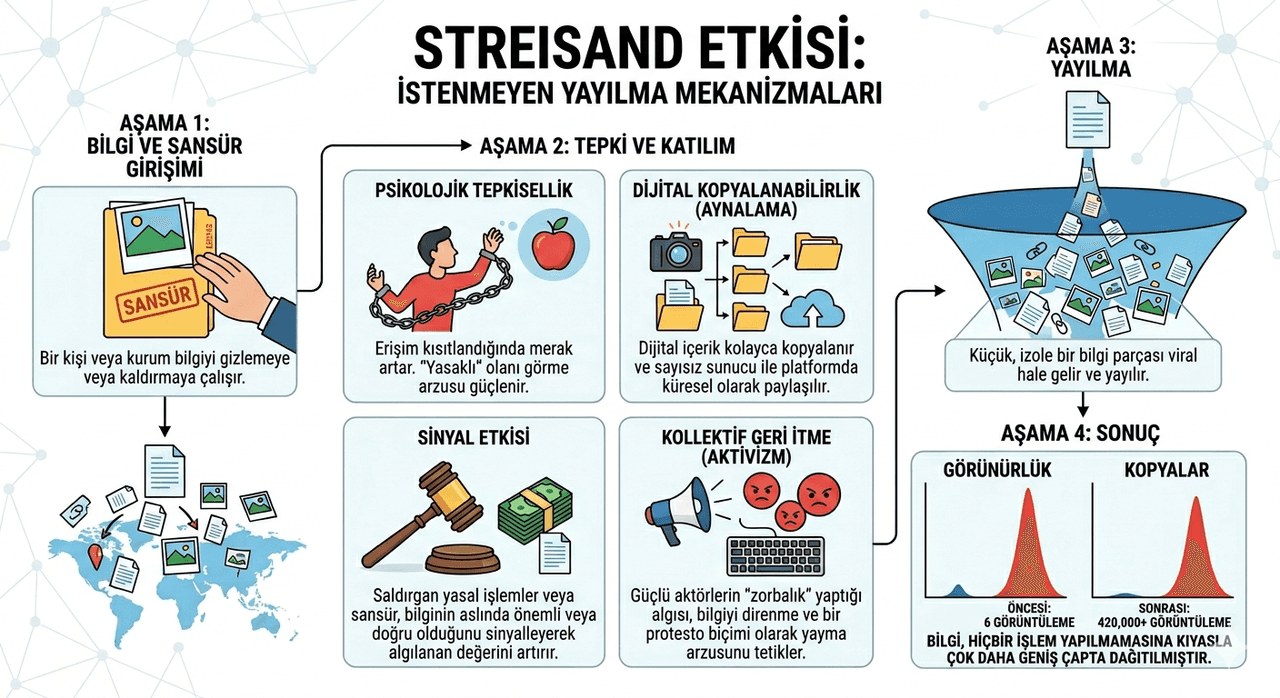
Streisand Effect (Generated by Artificial Intelligence.)
Streisand Effect is an online phenomenon in which an attempt to hide, remove, or censor information results in the information being disseminated to a much wider audience and attracting more attention than it otherwise would have. The concept derives its name from American artist Barbra Streisand, who in 2003 launched a legal battle to have photographs of her Malibu mansion removed from the internet. Before Streisand filed her $50 million lawsuit, the photograph in question had been downloaded only six times; however, due to the public interest generated by the lawsuit, the website was visited by more than 420,000 people within a month.【1】
The incident originated with photographer Kenneth Adelman’s California Coastal Records Project, which involved taking over 12,000 aerial photographs to document the state’s coastline against erosion. One of these photographs, “Image 3850,” inadvertently captured Streisand’s Malibu mansion entirely by chance.
Streisand filed a $50 million lawsuit against Adelman and the website hosting the photographs, citing violations of her privacy and potential security risks. However, until the lawsuit was filed, the photograph had attracted virtually no attention on the website; records showed that prior to the lawsuit, the image had been viewed only six times in total (two of those views were traced to Streisand’s own lawyers).

Image 3850, Taken by Kenneth Adelman (Generated by Artificial Intelligence).
When the lawsuit became public, curiosity about the “banned” or “concealed” item spurred internet users into action. The legal effort did not make the photograph invisible—it transformed it into a global focal point of attention. Within a month, the website hosting the photograph received over 420,000 visits, and the image was copied countless times and spread across multiple platforms. Streisand lost the lawsuit; the court ruled it an “unconstitutional attempt at suppression” and ordered her to pay the defendant’s legal fees.
Two years after the incident, in 2005, technology news platform Techdirt’s founder Mike Masnick coined the term “Streisand Effect” to describe this phenomenon.【2】 Masnick argued that attempts to remove something from the internet act as a catalyst that ensures its widespread dissemination.
At the core of this phenomenon lies the natural human curiosity triggered by the perception that something is being concealed, combined with general dissatisfaction toward censorship. Psychologically, increased interest in forbidden material parallels the “forbidden fruit” principle. Furthermore, the Streisand Effect emerges as a consequence of the failure of strategies used by censors to reduce backlash—such as hiding the existence of censorship, devaluing the target, using legal channels, or instilling fear. In game theory terms, this occurs because the direct mechanical effect of censorship (making access difficult) is overshadowed by its indirect signaling effect. The celebrity or institution’s failure to fully anticipate the signaling impact of censorship causes information that was initially considered insignificant to go viral.
The Streisand Effect is not limited to celebrities; it also affects public institutions and large corporations:
Cacciottolo, Mario. "The Streisand Effect: When censorship backfires" BBC. Accessed March 24, 2026. https://www.bbc.com/news/uk-18458567
Center for Land Use Interpretation. "The California Coastal Records Project." The Lay of the Land Newsletter. Accessed March 24, 2026. https://clui.org/newsletter/spring-2003/california-coastal-records-project
Hagenbach, Jeanne, Frédéric Koessler. "The Streisand effect: Signaling and partial sophistication." Journal of Economic Behavior & Organization, Volume 143, pp. 1-8. Accessed March 24, 2026. https://www.sciencedirect.com/science/article/abs/pii/S0167268117302421
Jansen, Sue Curry, Brian Martin. “The Streisand Effect and Censorship Backfire.” International Journal of Communication 9 (2015): 656-671. Accessed March 24, 2026. https://ijoc.org/index.php/ijoc/article/view/2498/1321
Saka, Erkan. "Türkiye’de İnternet." Türkiye’de Kitle İletişimi Dün-Bugün-Yarın (2017): 957–981. Accessed March 24, 2026. https://www.academia.edu/35397750/Türkiye_de_İnternet
[1]
Sue Curry, Jansen ve Brian, Martin, “The Streisand Effect and Censorship Backfire,” International Journal of Communication 9 (2015): 16, syf 1, erişim 22 Eylül 2025, https://ijoc.org/index.php/ijoc/article/view/2498/1321
[2]
Sue Curry, Jansen ve Brian, Martin, “The Streisand Effect and Censorship Backfire,” International Journal of Communication 9 (2015), syf 657, erişim 24 Mart 2026, https://ijoc.org/index.php/ijoc/article/view/2498/1321

Streisand Effect (Generated by Artificial Intelligence.)
Historical Background and Conceptual Development
Components and Mechanisms
Psychological and Strategic Dynamics
Notable Cases and Applications