


This article was automatically translated from the original Turkish version.
Sudoku is a logic-based number-placement puzzle. The traditional 9×9 Sudoku puzzle consists of a square grid divided into nine 3×3 subgrids. The objective is to fill the grid so that each row, each column, and each subgrid contains all digits from 1 to 9, with each digit appearing exactly once.
The origins of Sudoku trace back to the 18th century and the concept of Latin squares developed by Swiss mathematician Leonhard Euler. However, the modern form of Sudoku evolved from a puzzle format created in 1979 by American Howard Garns and published under the name Number Place.
In the mid-1980s, it gained widespread popularity in Japan under the name Sudoku, led by Maki Kaji, and became a globally popular puzzle type during the 2000s.
Sudoku is an abbreviation of the Japanese phrase Sūji wa dokushin ni kagiru (数字は独身に限る), which means “the digits must be single.”
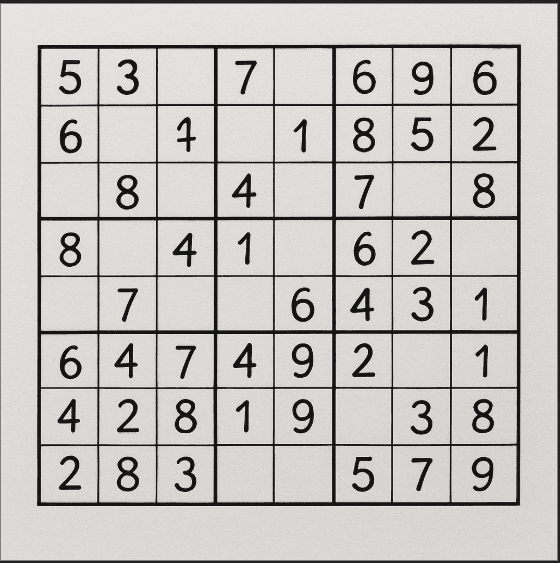
Sudoku image generated by artificial intelligence
A Sudoku puzzle is presented with some cells pre-filled. These initial clues are carefully selected to ensure that the puzzle has at least one valid solution and that this solution is unique.
Sudoku puzzles can be analyzed mathematically through combinatorial and algebraic methods. The total number of valid 9×9 Sudoku solutions has been calculated as approximately 6.67 × 10²¹. However, a valid Sudoku puzzle is expected to have only one unique solution.
Sudoku is classified as an NP-complete problem in computer science. This means that while verifying the correctness of a solution is straightforward, finding a solution in general is computationally complex. Although 9×9 Sudoku is of fixed size and therefore practically solvable, the difficulty level increases rapidly for puzzles of size 16×16 and larger.
Sudoku can be naturally modeled within the framework of constraint programming. Each cell is treated as a variable, and the possible values for each variable are the digits 1 through 9. The following fundamental constraints are defined:
Solution methods:
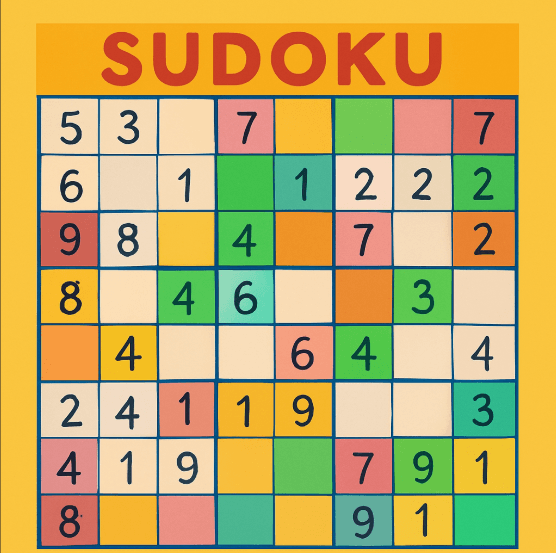
Sudoku image generated by artificial intelligence
To ensure a unique solution, a Sudoku puzzle must provide a sufficient number of initial clues. Research has shown that in classical 9×9 Sudoku puzzles, a unique solution cannot be guaranteed with fewer than 17 clues. While many valid puzzles with exactly 17 clues exist, no puzzle with fewer than 17 clues has been found that yields a unique solution.
Over time, numerous variants of Sudoku have been developed:
Computers use various algorithms to solve Sudoku puzzles:
Some AI-powered systems not only provide solutions but also explain the step-by-step reasoning process.
Regularly solving Sudoku puzzles:
Some studies suggest that Sudoku may help slow cognitive decline in older adults. However, it should be noted that overly difficult puzzles may cause stress when a solution cannot be found.
In the field of artificial intelligence, Sudoku can be solved using both classical algorithms and learning-based models. Methods employed include:
These approaches have made Sudoku an effective testbed for algorithm design and AI training.
Simonis, Helmut. "Sudoku as a Constraint Problem." *Lecture Notes in Computer Science*, vol. 3709, 2005, pp. 13–27. Springer. https://ai.dmi.unibas.ch/_files/teaching/fs21/ai/material/ai26-simonis-cp2005ws.pdf.
Simonis, Helmut. "Sudoku: A Hands-On Tutorial." *Proc. CP Workshop on Modeling and Reformulating Constraint Satisfaction Problems*, Sitges, Spain, 2005. https://citeseerx.ist.psu.edu/document?repid=rep1&type=pdf&doi=d2b0eb07e7fa8bc5e7bb2cc24877e26db19fb2c2.
Taalman, Laura. "The Mathematics of Sudoku I." *Mathematics Magazine* 81, no. 1 (February 2008): 21–29. https://citeseerx.ist.psu.edu/document?repid=rep1&type=pdf&doi=dc5d77902cebeb9f2e223c3faa7e7577e2051066.

History
Structure and Rules
Basic Rules:
Mathematical and Computational Properties
NP-Completeness
Constraint Programming Approach
Symmetries and Number of Clues
Sudoku Variants
Computer-Based Sudoku Solving
Sudoku and Human Psychology
Sudoku and Artificial Intelligence