

This article was automatically translated from the original Turkish version.
Turkmens, Anatolia before arriving, they had also traveled to Syria and Iraq and settled there. Historical accounts also relate that the tribe to which the Ottoman dynasty belonged migrated to Türkiye via Syria. Aşıkpaşazâde, Neşri and Fasting Bey like recount that the ancestor of the Ottoman dynasty, Süleyman Shah, drowned while crossing the Euphrates River near Ca‘ber Castle and that his body was retrieved from the river and buried at the foot of castle. Süleyman Şah must have died by drowning in the Euphrates near Ca‘ber Castle in the early 13th century. These same sources also state that Süleyman Şah’s grave was known as the “Turkish Grave”.
Region was a place where the Turkmens lived in large numbers. For the Turkmens and local inhabitants, the Tomb of Süleyman Şah was a place of pilgrimage. Süleyman Şah’s grave in Ca‘ber had been known since the early days of the Ottoman Beylik as “Grave-ı Türk” or “Mezar-ı Türkî” and gradually became an important pilgrimage site. By the 15th century, various beliefs concerning Süleyman Şah’s grave had already taken shape. According to historical texts, “those suffering from fevers would go to this tomb, recite the Fatiha, and be cured of their affliction with the permission of Allah”. The grave was also visited by sick horses.
Evliya Çelebi visited Ca‘ber Castle and the Tomb of Süleyman Şah during his 17th-century journey to Syria. He describes the tomb under the title “Ziyaretgâh-ı Süleyman Şah”: “The great ancestor of the House of Osman, Ertuğrul Bey’s father Süleyman Şah, departed from Mâhân and came to the House of Seljuk. While resting with all his men at the foot of Ca‘ber Castle, Süleyman Şah needed to perform ritual ablution and went to the Euphrates River to do so. By the will of God, he drowned, and his noble body was buried on a hill at the base of the castle.”

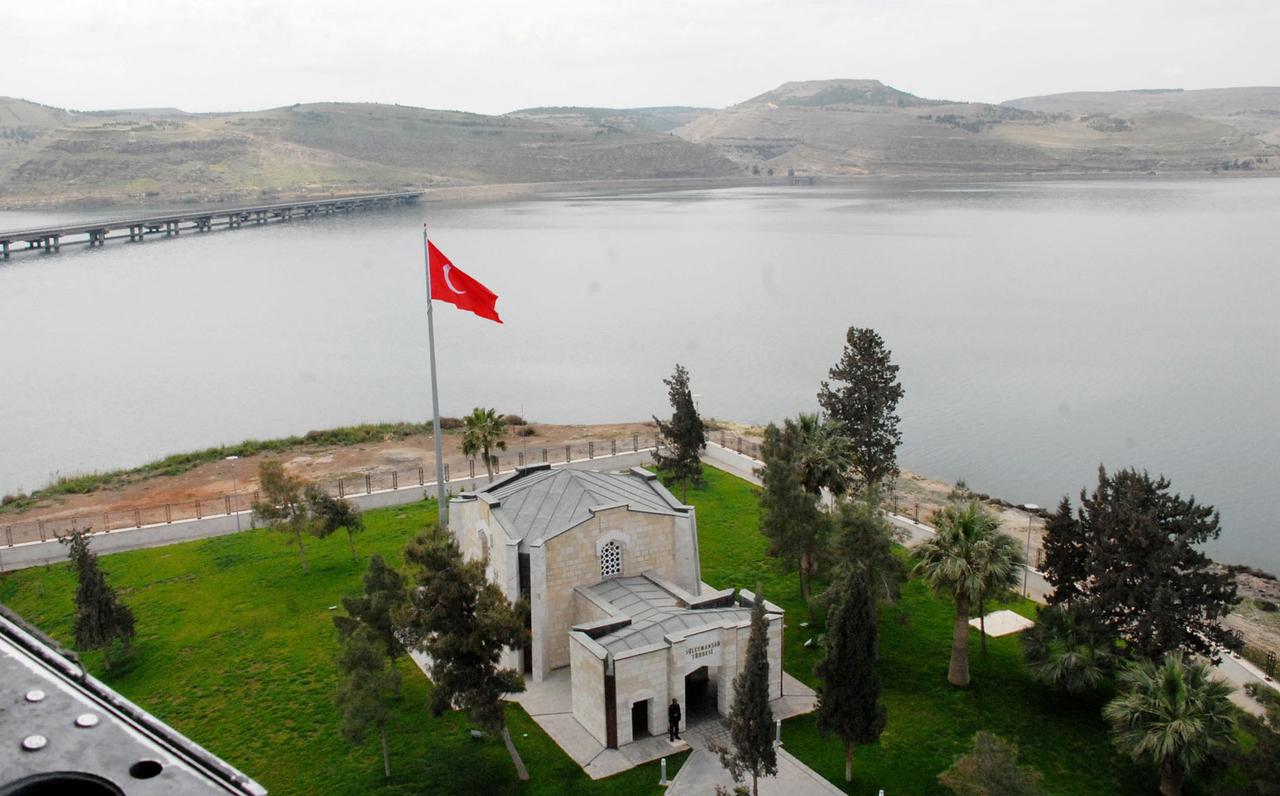
Süleyman Şah Tomb – Karakozak Village on the Aleppo–Hasseki road, 2012(Anadolu Agency)
During the reign of Abdulhamid II, tombs were constructed for important figures throughout the empire. One of these was the tomb of the sultan’s great ancestor, Süleyman Şah. The Aleppo Provincial Council requested in 1882 that a tomb be built over Süleyman Şah’s grave. In 1884, the first survey report regarding the construction of the tomb reached Istanbul. The survey estimated that 49,145 kuruş would be required for construction. According to the prepared plan, the tomb, shaped like square, was accompanied by a well, storehouses, rooms, and a barracks for soldiers assigned to guard the tomb. In 1884, permission to construct the tomb was granted by Abdulhamid II. Construction, funded from the imperial treasury, was completed in 1887. A sergeant and a tomb keeper with a monthly salary of 100 kuruş were appointed to guard the tomb. In 1910, the Aleppo Provincial Council appealed to Istanbul for repairs to the tomb. During an inspection carried out under Mehmed Reşad, it was determined that the tomb did not conform to the dignity and honor befitting Süleyman Şah’s grave, and repairs were decided upon.
National was ongoing when France and the TBMM government sat at the negotiating table. Türkiye insisted that its historical rights be considered when drawing the border with Syria. They demanded that the border pass through Ca‘ber Castle, known as the “Turkish grave” and believed to be the resting place of the father of Gazi. However, France rejected this proposal, and the border was drawn farther north of Ca‘ber Castle, although the area containing the Turkish grave was recognized as Turkish territory. According to Article 9 of the Ankara Protocol signed between the TBMM government and the French government on 20 October 1921, the region containing the tomb known as the “Turkish grave” near Ca‘ber Castle and its northwestern slopes (8797 m²) was left to Türkiye because it held spiritual significance for the Anatolian Turks. On 24 July 1923, the Treaty of Lausanne confirmed that the tomb was on Turkish territory.
On 30 November 1925, pursuant to the provisions of the Tekke Law on the Closure of Dervish Lodges and Zawiyas and the Abolition of Certain Titles of Tomb Keepers, the tomb was placed under the authority of the Ministry of Education. Following the 1925 law concerning tekkes and zawiyas, the salary of the tomb keeper of Süleyman Şah Tomb was discontinued, and the tomb came to the attention of the Republic of Türkiye authorities due to the tomb keeper’s petition. The imam’s salary for Süleyman Şah Tomb, which had been discontinued under the Law on Tekkes, Zawiyas and Tombs, began to be paid from the budget of the General Directorate of Waqfs starting in 1931.
In 1936, correspondence began regarding the construction of a police station to honor the Gendarmerie guarding the tomb. On 23 June 1937, a decision was adopted allocating funds for the construction of a police station to serve as a guard post for the tomb. In June 1938, the Süleyman Şah Tomb police station was officially opened.
After 1938, a police station was also built at the site of Süleyman Şah’s grave. The Turkish flag flew over the gendarmerie station located in this area, recognized as Turkish territory. In 1949, one non-commissioned officer, one sergeant, and eight soldiers guarded the tomb at the Ca‘berkale Gendarmerie Station. There was also an imam stationed at the tomb. On 8 September 1949, the salaries of the soldiers guarding the tomb were increased.
In 1951, Member of Parliament Saffet Gürol, who inspected the condition of Ca‘ber Castle, Süleyman Şah’s grave, and the shrines in Aleppo and Damascus, reported the irregularities he observed to the relevant authorities. Following the MP’s raising of the issue, the Süleyman Şah Tomb was examined. The poor conditions of the tomb and the soldiers stationed there were identified. On 5 August 1956, at a high-level meeting in Aleppo, a new arrangement concerning the soldiers guarding the tomb was adopted.
In 1963, unrest broke out in Syria and our soldiers stationed at the Süleyman Şah Tomb were temporarily trapped. In 1966, when Syria began construction of the Tabqa Dam, it became clear that the grave would be submerged under water, and Syria requested its relocation. In accordance with the agreement with Syria, on 24 December 1973, under the supervision of Deputy Minister of Foreign Affairs Tayyar Altıkulaç, the graves of Süleyman Şah and those buried with him in the tomb were relocated northward to Karakozak. However, a new tomb had not yet been constructed. In 1975, a new tomb was built over Süleyman Şah’s grave. Ca‘ber Castle is 92 km from Türkiye as the crow flies, while Karakozak is 28 km away.

Süleyman Şah Tomb – Syria Eşmesi, 2015(Anadolu Agency)
In 1990, when Syria began construction of the Tishrin Dam on the Euphrates River, the possibility of relocating the Süleyman Şah Tomb again came to the fore. In 2001, the Süleyman Şah Tomb was brought before the TBMM. On 22 January 2003, delegations from Syria and Türkiye signed a technical protocol in Ankara concerning the Süleyman Şah Tomb. In the same year, the protocol was approved by the Council of Ministers and enacted into law. On 13 May 2004, the Süleyman Şah Tomb Arbitration Project was signed between Syrian and Turkish officials. In 2005, prior to Prime Minister Recep Tayyip Erdoğan’s visit to Syria, the tomb once again became a topic of public discussion. In August 2006, the Council of Ministers approved a new 22-article protocol regarding the tomb. In 2007, the Ministry of Culture and Tourism allocated 4.5 million TL to protect the tomb from the waters. In 2011, civil unrest erupted in Syria and the Süleyman Şah Tomb once again became a matter of national concern. On 2 October 2014, during debates in the TBMM on the Syria and Iraq resolutions, the Süleyman Şah Tomb was raised multiple times.
After the outbreak of civil war in Syria, a decision was made to relocate the tomb. During the night of 21–22 February 2015, the graves at the Süleyman Şah Tomb were opened and the remains were temporarily moved to Syria Eşmesi by a Turkish military operation, and the original site of the tomb was completely destroyed.
Afyoncu, Erhan. Süleyman Şah Türbesi. İstanbul: Yeditepe Yayınevi, 2024.
Anadolu Ajansı. “Süleyman Şah Türbesi Türkiye'nin korumasında.” Accessed September 22, 2025. https://www.aa.com.tr/tr/yasam/suleyman-sah-turbesi-turkiyenin-korumasinda/340820
Anadolu Ajansı. “Süleyman Şah Türbesi'nin yapımı sürüyor.” Accessed September 22, 2025. https://www.aa.com.tr/tr/turkiye/suleyman-sah-turbesinin-yapimi-suruyor/67287
Hadîdî. Tevârih-i Âl-i Osman (1299-1523). Haz. Necdet Öztürk. İstanbul: Edebiyat Fakültesi Basımevi, 1991.
Karay, Refik Halit. Bir İçim Su. İstanbul: Semih Lütfi Kitapevi, 1939.
Osmanlı Tarihleri I. Haz. Çiftçioğlu N. Atsız. İstanbul: Türkiye Yayınevi, 1947.
Taneri, Aydın. “Ca‘ber Kalesi.” *TDV İslâm Ansiklopedisi.*
Yavuz, Bige. Kurtuluş Savaşı Döneminde Türk-Fransız İlişkileri (1919-1922). Ankara: Türk Tarih Kurumu, 1994.
Yund, Kerim. "Caber Kalesi." Hayat Tarih Mecmuası, sayı 2 (Mart 1970): 22–26.
Çelebi, Evliyâ. Evliyâ Çelebi Seyahatnâmesi. Cilt III. Haz. Seyit Ali Kahraman ve Yücel Dağlı. İstanbul: Yapı Kredi Yayınları, 1999.
Çimen, Cihan. "Anonim Tevârih-i Âl-i Osman (Kuruluştan 897/1487’ye Kadar)." Yüksek lisans tezi, Marmara Üniversitesi Türkiyat Araştırmaları Enstitüsü, İstanbul, 2006.
Özkan, Asaf. “Ca’ber Kalesi ve Türk Mezarı.” *Atatürk Dergisi* 5, no. 3 (March 2010): 197–209. https://dergipark.org.tr/tr/pub/atauniad/issue/2367/30339

No Discussion Added Yet
Start discussion for "Süleyman Şah Türbesi" article
Early Significance of the Tomb and Popular Beliefs
Construction of the Tomb During the Reign of Abdulhamid II
Ankara Protocol and the Status of the Tomb
Republican Era and Administrative Arrangements
Mid-20th Century Developments
Developments in the 21st Century