


This article was automatically translated from the original Turkish version.
+2 More
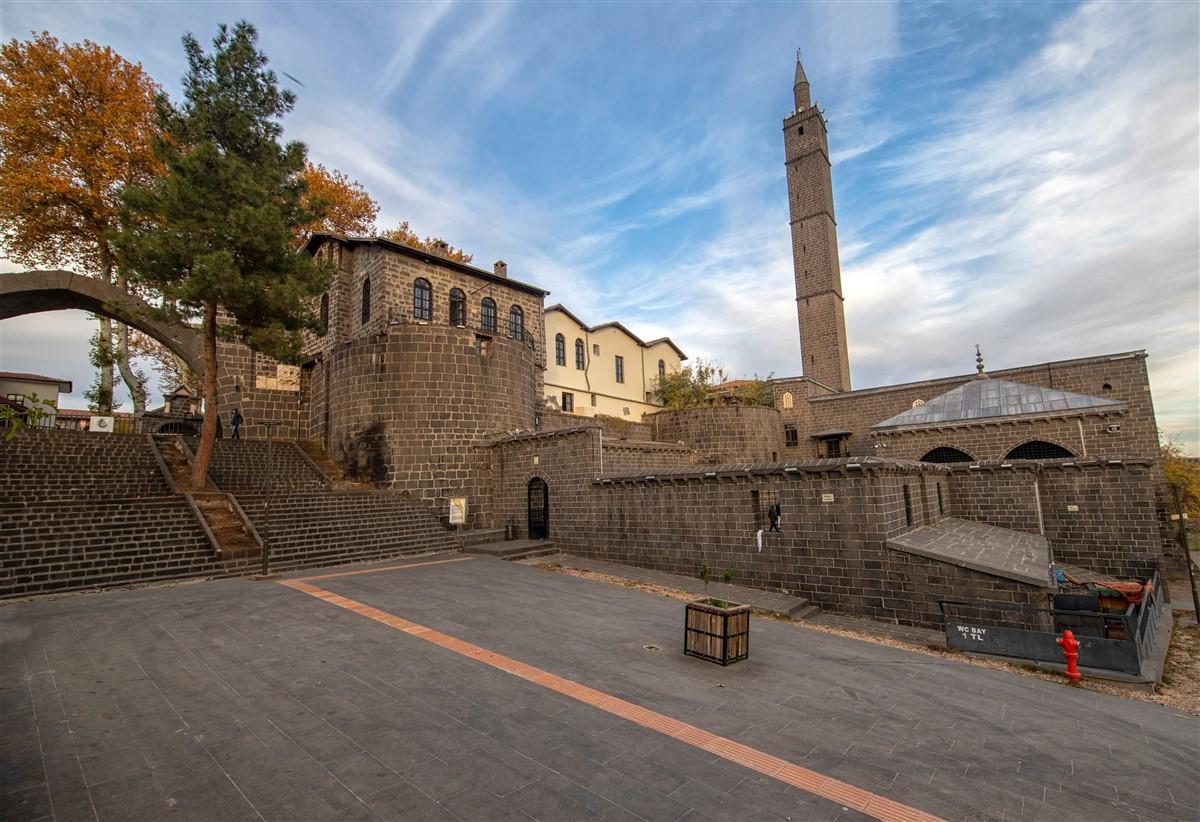
Süleymaniye Camii
Name | Hz. Süleyman Camii | ||||||||
|---|---|---|---|---|---|---|---|---|---|
Other Names | Nasiriyye Camii, Meşhed Camii, Murtaza Paşa Camii, Kale Camii | ||||||||
Location | Diyarbakır İç Kalesi The corner of the tower south of Oğrun Kapı | ||||||||
Construction Date(s) | 1155–1160 (according to inscriptions on the minaret) | ||||||||
Patron | Nisanoğlu Kemaleddin Abu'l-Qasim Ali (with the title Cemalüddevle) | ||||||||
Architect | Hibetullah al-Gurgani (estimated) | ||||||||
Material | Black basalt stone | ||||||||
Historical Significance | The starting point of the conquest of Diyarbakır during the time of Hz. Umar The Meşhed and pilgrimage site containing the graves of Sulayman, son of Khalid ibn al-Walid, and other companions | ||||||||
Structural Features | Square-bodied minaret (northeast) – inscriptions in sulus script – Rumi and palmette motifs Mihrab niche and calligraphic decorations on the ceiling The last congregational space is to the north; transition to the harem is from here Rectangular plan oriented north-south | ||||||||
Restorations and Additions | Tomb and fountain to the north 1631–1633: Repair by Silahdar Murtaza Pasha; addition of fountain and toilet 1656–1658: Additional repairs by Silahdar Murtaza Pasha 1875: Decoration renewed and tomb repaired by Ahmed Tevfik Pasha To the west: Tomb of the Companions, prayer area, and fountain | ||||||||
Current Condition | Continues to hold importance as a place of worship and pilgrimage | ||||||||
Hz. Süleyman Camii; Nasiriyye Camii, Meşhed Camii, Murtaza Paşa Camii and Kale Camii gibi are known by various names and are among Diyarbakır’s most significant historical and religious structures. According to inscriptions on its minaret, the mosque was built between 1155 and 1160 during the Nisanoğulları period by Nisanoğlu Kemaleddin Ebu’l Kasım Ali, who held the title Cemalüddevle. Based on its architectural features, the architect is believed to have been Hibetullah el-Gürgani. Although the exact date of the mosque’s initial construction is not definitively known, the minaret’s inscriptions point to these years.

Hz. Süleyman Camii (Diyarbakır Valiliği)
The mosque is located within Diyarbakır Inner Castle, on the edge of a tower south of Oğrun Gate, built on a sloping terrain. Its most important feature is that the conquest of Diyarbakır during the time of Ömer began at this very site. Adjacent to the mosque lies the Meşhed, which was renovated during the Ottoman period and contains the graves of Süleyman, son of Khalid ibn al-Walid, and other companions who were martyred during the conquest of Diyarbakır. This circumstance has transformed the mosque into a place of pilgrimage, a status it retains to this day.

Hz. Süleyman Camii (Diyarbakır Valiliği)
The mosque occupies a rectangular area oriented north-south, with access to the harem area provided from the northernmost prayer space. Interior decoration is limited to the mihrab niche and ceiling motifs executed in kalem style. Exterior ornamentation is concentrated on the inscriptions of the minaret. The square-bodied minaret on the northeast is divided into five sections by smooth yazı bands. Inscriptions carved in sülüs script on limestone are animated by curved branches featuring Rumi and palmet motifs and are rotated on three sides using half-groove and flat-smooth finishes. The eastern inscription is better preserved than the southern one.

Hz. Süleyman Camii (Diyarbakır Valiliği)
The structure has undergone various restorations and additions throughout its history. Between 1631 and 1633, Vali Silahtar Murtaza Paşa carried out a major restoration of the mosque and the meşhed; during his governorship in 1631–1632 and 1656–1658, Murtaza Paşa added a çeşme and toilets to the complex. In 1875, Diyarbakır Vali Ahmet Tevfik Paşa renewed the mosque’s decoration and restored its türbe. Built of black basalt, the mosque has evolved into a complex incorporating structures from different periods. To the west are the Sahabeler Türbesi, a namazgâh, and a çeşme; to the north, another türbe and a çeşme are located.

Hz. Süleyman Camii (Diyarbakır Valiliği)
As one of Diyarbakır’s most important centers of faith, Hz. Süleyman Camii has been enriched through successive additions and restorations and continues to serve as both a place of worship and pilgrimage today.

Hz. Süleyman Camii (Diyarbakır Valiliği)
Diyarbakır Valiliği. "Hz. Süleyman Camii ve Sahabe Kabirleri." Accessed April 6, 2025.http://www.diyarbakir.gov.tr/hz-suleyman-camii-ve-sahabe-kabirleri
Kültür Portalı. "Hazret Süleyman Camii | Kültür Portalı." Accessed April 6, 2025.https://www.kulturportali.gov.tr/turkiye/diyarbakir/gezilecekyer/hazret-suleyman-cam

Süleymaniye Camii
Name | Hz. Süleyman Camii | ||||||||
|---|---|---|---|---|---|---|---|---|---|
Other Names | Nasiriyye Camii, Meşhed Camii, Murtaza Paşa Camii, Kale Camii | ||||||||
Location | Diyarbakır İç Kalesi The corner of the tower south of Oğrun Kapı | ||||||||
Construction Date(s) | 1155–1160 (according to inscriptions on the minaret) | ||||||||
Patron | Nisanoğlu Kemaleddin Abu'l-Qasim Ali (with the title Cemalüddevle) | ||||||||
Architect | Hibetullah al-Gurgani (estimated) | ||||||||
Material | Black basalt stone | ||||||||
Historical Significance | The starting point of the conquest of Diyarbakır during the time of Hz. Umar The Meşhed and pilgrimage site containing the graves of Sulayman, son of Khalid ibn al-Walid, and other companions | ||||||||
Structural Features | Square-bodied minaret (northeast) – inscriptions in sulus script – Rumi and palmette motifs Mihrab niche and calligraphic decorations on the ceiling The last congregational space is to the north; transition to the harem is from here Rectangular plan oriented north-south | ||||||||
Restorations and Additions | Tomb and fountain to the north 1631–1633: Repair by Silahdar Murtaza Pasha; addition of fountain and toilet 1656–1658: Additional repairs by Silahdar Murtaza Pasha 1875: Decoration renewed and tomb repaired by Ahmed Tevfik Pasha To the west: Tomb of the Companions, prayer area, and fountain | ||||||||
Current Condition | Continues to hold importance as a place of worship and pilgrimage | ||||||||
Location and Historical Significance
Architectural Features
Restorations and Additions
Current Condition