


This article was automatically translated from the original Turkish version.

Symbolic Violence
Date(s) | 1970s | ||||||||
|---|---|---|---|---|---|---|---|---|---|
Developer(s) | Pierre Bourdieu | ||||||||
Contributors to Its Development | Max Weber, Émile Durkheim | ||||||||
Basic Assumption | Symbolic violence is a subtle and invisible form of violence that individuals internalize to conform to social norms, value judgments, and cultural codes. It enables individuals to oppress themselves, allowing societal dominant power structures to shape them. | ||||||||
Symbolic violence is a concept developed by French sociologist Pierre Bourdieu and refers to the indirect and invisible pressures individuals experience within social building. Unlike traditional physical violence, symbolic violence compels individuals to submit to social norms and power structures, either consciously or unconsciously. This process is legitimized through social institutions such as education, media, family and religion like, and becomes perceived as a “natural” reality by individuals.
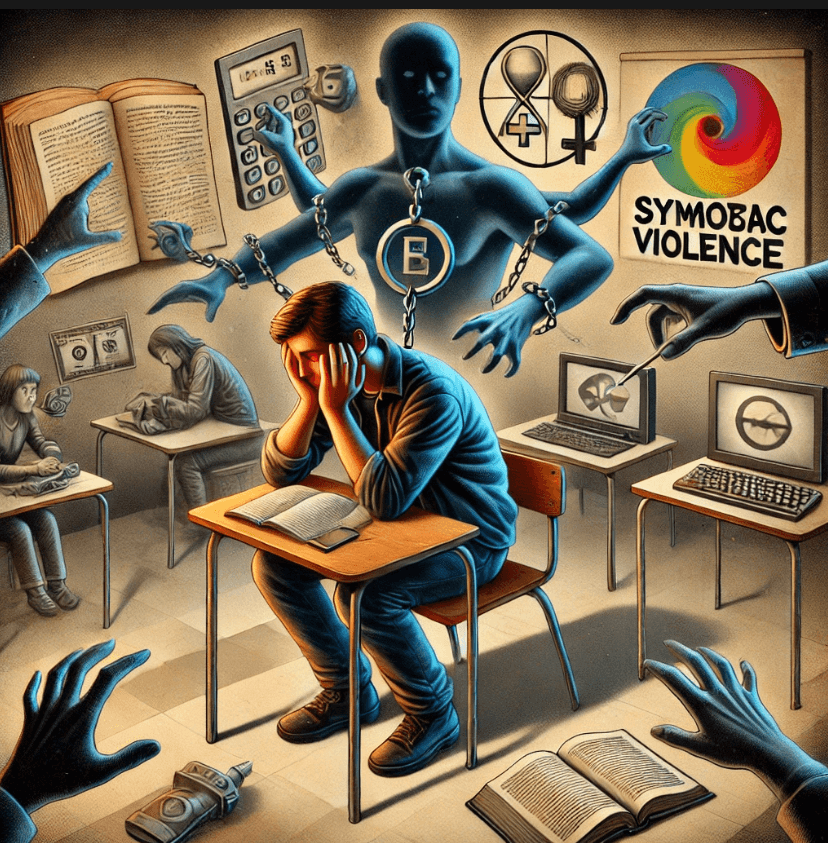
Symbolic violence depiction generated by artificial intelligence.
In Bourdieu’s social theory, symbolic violence is intertwined with the concepts of habitus, field, and capital. Habitus refers to the internalized social patterns of individuals, while field denotes the social environments in which these patterns are shaped. Capital exists in various forms—economic, cultural and social—and constitutes the accumulations that determine individuals’ social positions. Symbolic violence manifests particularly through cultural and social capital, compelling individuals to remain within a specific social order without being aware of it.
Bourdieu argues that one of the most effective instruments of symbolic violence is the media. Television, newspapers and digital media reproduce social norms and dominant ideologies by imposing specific thinking templates on individuals. News programs, series and entertainment content are often presented within frameworks that support a particular discourse of power. In this process, individuals are subtly directed toward adopting a specific world perspective without realizing it.
Symbolic violence also plays a role within gender relations. Paternalistic societies reinforce male dominance through mechanisms of symbolic violence that define women’s social roles and confine them within specific boundaries. The economic, social and political inequalities women face are frequently presented as natural and legitimate situation. This leads to the internalization and reproduction of gender-based inequality.
Bourdieu emphasizes that the education system is one of the most powerful instruments of symbolic violence. Schools provide advantages to individuals possessing a certain type of cultural capital while making it difficult for disadvantaged groups to advance within the system. Academic success is often attributed to individual talent, but in reality the education system reproduces structural inequalities that sustain the privileges of particular social classes.
Symbolic violence enables social structures to function as invisible mechanisms of coercion. When individuals accept the social order presented to them without questioning it, the existence of institutions that sustain dominant classes and power structures becomes legitimized. This process ensures the persistence of social inequalities and confines individuals within the boundaries they have internalized.

Bourdieu’s concept of symbolic violence plays a critical role in understanding how individuals perceive social reality and how power relations are maintained. Symbolic violence, evident in many areas—from education and media to gender relations and the workplace—functions as a mechanism of control that operates with the consent of individuals. According to Bourdieu, symbolic violence strengthens social structures by generating cultural and social meanings according to people’s social positions. For those seeking to analyze social structures and question inequalities, Bourdieu’s concept offers an important theoretical frame.
Accessed November 26, 2025.
Bourdieu, Pierre. *Distinction: A Social Critique of the Judgement of Taste*. Cambridge, MA: Harvard University Press, 1984. Accessed linki
Dursun, Onur. “Toplumu Pierre Bourdieu ile Düşünmek.” *Global Media Journal TR Edition* 8, no. 15 (2018): 54–72. Accessed linki.
Dursun, Onur. “Toplumu Pierre Bourdieu ile Düşünmek.” *Global Media Journal TR* 8, no. 15 (2018): 47-69. Accessed linki
Swartz, David. *Culture and Power: The Sociology of Pierre Bourdieu*. Chicago: University of Chicago Press, 1997. Accessed linki
Türk, H. B. “Eril Tahakkümü Yeniden Düşünmek: Erkeklik Çalışmaları İçin Bir İmkân Olarak Pierre Bourdieu.” *Toplum ve Bilim* 112 (2008): 119–147. Accessed linki
Yüksel, M. “Pierre Bourdieu’nün Toplumsal Kuramında Sembolik Şiddet.” *Ankara Üniversitesi SBF Dergisi* 58, no. 1 (2003): 213-238. Accessed linki.

Symbolic Violence
Date(s) | 1970s | ||||||||
|---|---|---|---|---|---|---|---|---|---|
Developer(s) | Pierre Bourdieu | ||||||||
Contributors to Its Development | Max Weber, Émile Durkheim | ||||||||
Basic Assumption | Symbolic violence is a subtle and invisible form of violence that individuals internalize to conform to social norms, value judgments, and cultural codes. It enables individuals to oppress themselves, allowing societal dominant power structures to shape them. | ||||||||
Its Place in Bourdieu’s Social Theory
Symbolic Violence in the Media
Gender and Symbolic Violence
Symbolic Violence in Education
Consequences of Symbolic Violence