

This article was automatically translated from the original Turkish version.
Syrian Currency Reform (2026) is a monetary adjustment that involves replacing the banknotes in circulation in Syria with a new series and accompanying redenomination (nominal simplification). The adjustment is based on the removal of two zeros; under this framework, the conversion rate adopted is 100 old Syrian pounds = 1 new Syrian pound.【1】 The legal basis for the reform is enacted as Decree No. 293 dated 2025; the Central Bank of Syria is designated as the primary institutional executor of the process in terms of authority and coordination.【2】

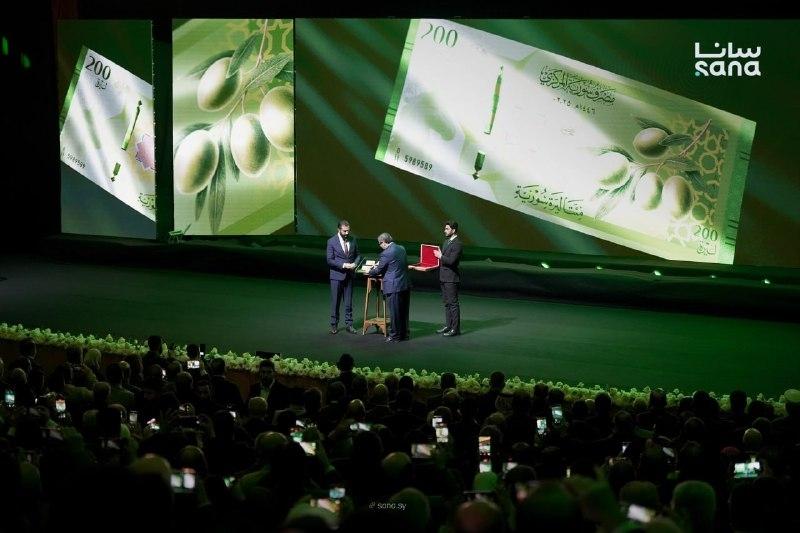
One Frame from the Introduction of New Syrian Pounds (Central Bank of Syria)
The effective date of the reform has been set as 1 January 2026.【3】 The implementation is not limited to merely introducing new banknotes; it also encompasses a multi-layered transition regime including the simultaneous circulation of old and new currencies for a specified period, the institutions responsible for conversion, the conversion of bank accounts to the new unit, and rules governing the use of the new unit in market transactions. The Central Bank of Syria has indicated that the transition period is anticipated to last 90 days and may be extended through a defined decision-making mechanism.【4】
Discussions on currency reform in Syria have taken shape within the context of prolonged conflict, sanctions, and financial isolation, which have led to the depreciation of the national currency and its impact on daily economic transactions. The Syrian pound has significantly weakened since 2011, particularly as exchange rates rose sharply throughout the 2020s, increasing the practical burden of cash usage. This situation has generated a cash economy requiring the physical transport of large quantities of banknotes even for basic expenditures; the need for “normalization” in monetary stability and payment habits has been presented as one of the fundamental elements underlying the reform.【5】

Introduction of Six New Banknotes (Anadolu Agency)
The second key rationale for the reform concerns the relationship between monetary measures and public confidence. Sources indicate that the new banknote series and nominal simplification aim to reinforce trust in the currency. In this context, redenomination is framed not as a measure that directly increases purchasing power, but as a tool that makes currency usage more manageable through improved transaction convenience and simplified calculations. Additionally, challenges related to the functioning of the banking system and liquidity management—including issues such as cash circulation, cash access, and informal circulation—are indirectly referenced among the reform’s justifications; it is discussed that the new banknotes would enable closer monitoring of cash in circulation.
The third area of justification is the symbolic and representational dimension of the reform. Texts explicitly emphasize a shift away from individual portraiture and the removal of political symbols associated with the previous era. This approach constructs a framework that positions the currency reform not merely as a technical redenomination, but as an initiative linked to narratives of “national identity” and “financial sovereignty” attributed to the new political era. At the same time, it is specifically noted that the reform alone does not signify economic recovery; economic revitalization depends on broader policy domains such as increased production, combating unemployment, and strengthening the banking sector.
The legal foundation for Syria’s 2026 currency reform is established by Decree No. 293 dated 2025. This regulation aims to introduce the “new Syrian currency” and define operational parameters for replacing old banknotes with new ones. Under the decree, the Central Bank of Syria is empowered to determine the timeline, implementation locations, and execution principles of the transition, with the obligation to issue necessary directives throughout the process.【6】
Institutionally, the Central Bank has been assigned a central role in managing the transition operation and standardizing market practices. Within this framework, implementation directives have been announced progressively; conversion rate, duration, phases, authorized exchange points, pricing, and contract adaptations have been concretized through administrative texts. To ensure nationwide implementation, it has been specified that exchange operations will be conducted within Syria’s borders, with official exchange centers structured to include 59 financial institutions and over 1,500 branches.【7】

Ahmed Al-Shara Introducing the New Banknotes (Anadolu Agency)
The commencement of the transition process has been accepted as 1 January 2026, with a duration of 90 days and a defined decision-making mechanism for potential extension. During the transition period, the simultaneous circulation of old and new banknotes has been adopted, with both currencies confirmed to retain legal tender status throughout this time. In terms of phasing, priority has been given initially to the exchange of old banknotes of denominations 1,000, 2,000, and 5,000; the timelines for other denominations are to be determined subsequently.【8】
Another pillar of the regulation is the goal of establishing uniform application across the market. Accordingly, both public and private sectors are required to apply the conversion rate to prices, wages, contracts, and all financial obligations. Transparency has been mandated by requiring businesses to display prices in both old and new currencies during the transition period. In the banking sector, it has been adopted that bank and electronic account balances will be expressed in the new currency as of 1 January 2026. Furthermore, the exchange process is to be conducted free of charge; any commission, fee, or tax under any name is prohibited, and implementation will be monitored by relevant institutions.
The technical core of the reform consists of removing two zeros from the currency’s nominal value. Under this adjustment, 100 old Syrian pounds are equivalent to 1 new Syrian pound, preserving monetary value while aiming to make daily calculations and cash usage more manageable. The conversion rate is expected to be uniformly applied to prices, wages, contracts, and other financial obligations, thereby reducing potential confusion arising from the simultaneous use of different scales in the market.
The new banknote series is structured around six denominations. This structure is designed to cover a range from small to large values, aiming to meet cash needs from retail transactions to higher-value payments within a single series. The variety of denominations is justified as a measure to reduce friction in operations such as cash change and currency exchange.

An Image of an Old Syrian Pound (Anadolu Agency)
A prominent design choice has been the avoidance of portraits and individual representations. This approach aims to move away from a visual language that glorifies individuals toward a more general and symbolic framework. Visual compositions emphasize symbols associated with agriculture and local production—for example, various agricultural products such as wheat and plant elements—while political figures and portraits from the previous era have been removed from the banknotes.【9】 The design is understood as an effort to represent national identity in a contemporary idiom and to break the visual continuity with the political symbols of the past.
Design principles indicate that the banknotes have been oriented toward a simpler, more legible, and easily verifiable visual structure. In this context, a “clean” and “abstract/symbolic” design language is framed as a functional choice enhancing both usability and detectability. When evaluated together, the technical adjustment and design approach reveal that the reform embodies not only a nominal simplification aimed at transactional convenience but also a reconfiguration of the representational regime through banknote iconography.
The implementation schedule for the currency reform is based on the commencement of exchange operations on 1 January 2026. The transition period is set at 90 days, with the possibility of extension through a decision announced prior to the end date. This scheduling reflects that the conversion is designed not as a short-term operation but as a limited “transition regime” managed through specific administrative thresholds and publicly announced deadlines.
One of the core elements of the exchange mechanism is the principle of simultaneous circulation of old and new currencies during the transition period. This principle means that both banknote series retain legal tender status throughout the transition. The implementation simultaneously aims to introduce new denominations and systematically withdraw old banknotes, thereby preventing abrupt disruptions in cash supply and panic behavior in the market.

Abdulkadir Husri, Governor of the Central Bank of Syria, Making a Statement on the New Banknotes (Anadolu Agency)
In terms of phasing, the transition has begun with higher denominations. Priority has been given to exchanging old banknotes of 1,000, 2,000, and 5,000 values; the approach of deferring detailed timelines for other denominations has been adopted. This method is understood as a strategy to rapidly simplify cash logistics and calculation scales by converting the most widely circulated high-denomination banknotes first.
The locations where exchange operations will take place constitute a critical administrative component of the reform’s implementation. Accordingly, exchanges are to be conducted within Syria through officially authorized centers, with the authorized network expected to include 59 financial institutions and over 1,500 branches. This creates a nationwide distribution and acceptance infrastructure aimed at reducing capacity bottlenecks that might arise from concentrating exchange operations solely in central locations.
When evaluated together, the schedule, the principle of simultaneous circulation, the phased transition starting with high denominations, and the extensive network of exchange centers reveal that the operational design of the currency reform is structured around a “short-term but widely accessible” transition period, with special emphasis placed on managing market behavior through detailed administrative and technical provisions.
The primary objective in implementing the currency reform has been to establish the conversion rate as a single, binding standard across the market. Accordingly, both public and private sectors are required to apply the conversion rate to prices, wages, salaries, contracts, and all financial obligations. To ensure transparency during the transition period, businesses are required to display prices in both old and new currencies. Similarly, the approach of officially announcing exchange rates for both currencies through official bulletins has been adopted, aiming to reduce risks of discrimination, uncertainty, and speculative pricing during implementation.
A complementary component of the transition in banking and recorded payments is the re-denomination of accounts in the new currency. As of 1 January 2026, bank and electronic account balances will be expressed in the new Syrian pound, ensuring alignment between cash exchange and accounting unit conversion. In terms of contracts and documentation, a framework has been adopted requiring the new currency to be the primary unit in financial documents from the start of the transition period, with the currency type clearly specified in all documents.

Final Transactions Conducted in Old Syrian Pounds (Anadolu Agency)
The free execution of the exchange process has been a distinguishing feature of the implementation principles. Any commission, fee, tax, or deduction under any name is prohibited; this prohibition is considered critical to preserving public confidence in the process and preventing cost-based inequalities. The responsibility for monitoring and oversight rests with the Central Bank and relevant public institutions, completing this framework.
In terms of communication, the goal has been to prevent panic behavior and avoid pressure on exchange rates and prices caused by sudden demand surges. In this direction, the emphasis has been placed on a phased transition, encouraging the public to avoid hasty exchange behavior. Attention has been drawn to the risks of speculative transactions and opportunism, with emphasis placed on maintaining market discipline and managing liquidity progressively during the transition period.
The main focus of discussions surrounding the reform has been the potential indirect effects of redenomination on inflation and purchasing power.
It has been stated that the conversion is technically a nominal simplification that does not alter intrinsic value; however, risks have emerged during implementation due to price re-labeling, perceptual pricing, and transition-period behaviors. On the international level, efforts to reconnect Syria’s banking system with external financial networks—through engagement with platforms such as SWIFT and Sibos—and supply chains for banknote printing have gained visibility as complementary contextual elements. When considered together, these components reveal that the currency reform functions both as a transition program governed by technical and administrative rules and as a process tested by market confidence and governance capacity.
Al Jazeera. “سوريا تطلق عملتها الجديدة مطلع 2026.. فماذا عن شكلها؟" Accessed December 31, 2025. https://www.aljazeera.net/ebusiness/2025/12/25/syria-launch-currency-2026.
Anadolu Agency. “Syria Launches New Banknotes after Redenomination, Drops Portraits.” December 30, 2025. Accessed December 31, 2025. https://www.aa.com.tr/en/middle-east/syria-launches-new-banknotes-after-redenomination-drops-portraits/3784270.
Anadolu Ajansı. “Suriye yönetimi ulusal parayı modernize edecek.” Accessed December 31, 2025. https://www.aa.com.tr/tr/ekonomi/suriye-yonetimi-ulusal-parayi-modernize-edecek/3712370.
Anadolu Ajansı. “Suriye'de iki sıfır atılan banknotlar tedavüle giriyor.” December 29, 2025. Accessed December 31, 2025. https://www.aa.com.tr/tr/dunya/suriyede-iki-sifir-atilan-banknotlar-tedavule-giriyor/3783276.
Anadolu Ajansı. “Suriye'nin başkenti Şam'da yeni banknotların tanıtımı yapıldı.” December 30, 2025. Accessed December 31, 2025. https://www.aa.com.tr/tr/dunya/suriyenin-baskenti-sam-da-yeni-banknotlarin-tanitimi-yapildi/3784266.
Central Bank of Syria. “Photo Album.” Accessed December 31, 2025. https://www.cb.gov.sy/index.php?page=show&ex=2&dir=items&lang=2&ser=3&cat_id=2101#prettyPhoto.
Euronews. "Syria unveils new banknotes removing al-Assad images from currency." December 30, 2025. Accessed December 31, 2025. https://www.euronews.com/2025/12/30/syria-assad-currency.
Reuters. "Exclusive: Syria Plans to Print New Currency in UAE and Germany Instead of Russia." Accessed December 31, 2025. https://www.reuters.com/ar/world/6DYLQFNHA5LCJAEL7LRONYY3JU-2025-05-16/.
Reuters. "حاكم مصرف سوريا المركزي لرويترز: دمشق طلبت عروضا من موردين لطباعة أوراق نقدية جديدة." Accessed December 31, 2025. https://www.reuters.com/ar/business/M4BDLRE7H5KPRN6U665XZ6YQJM-2025-09-17/.
Reuters. “Syria to Revalue Currency by Dropping Two Zeros in Bid for Stability.” August 22, 2025. Accessed December 31, 2025. https://www.reuters.com/business/finance/syria-revalue-currency-dropping-two-zeros-bid-stability-2025-08-22/.
Reuters. “Syria to Start Currency Swap January 1, Central Bank Governor Says.” December 25, 2025. Accessed December 31, 2025. https://www.reuters.com/world/middle-east/syria-start-currency-swap-january-1-central-bank-governor-says-2025-12-25/.
Syrian Arab News Agency (SANA). “Syria to launch new currency January,1, 2026, CBS Governor announces.” Accessed December 31, 2025. https://sana.sy/en/economic/2285744/.
Syrian Arab News Agency (SANA). “المركزي يصدر بعض تفاصيل التعليمات التنفيذية لمرسوم العملة السورية الجديدة.” Accessed December 31, 2025. https://sana.sy/economy/2363574/.
[1]
Euronews. “Syria unveils new banknotes removing al-Assad images from currency.” 30 Aralık 2025. Erişim tarihi: 31 Aralık 2025. https://www.euronews.com/2025/12/30/syria-assad-currency.
[2]
Al Jazeera. “سوريا تطلق عملتها الجديدة مطلع 2026.. فماذا عن شكلها؟.” Erişim tarihi: 31 Aralık 2025. https://www.aljazeera.net/ebusiness/2025/12/25/syria-launch-currency-2026.
[3]
Reuters. “Syria to Start Currency Swap January 1, Central Bank Governor Says.” 25 Aralık 2025. Erişim tarihi: 31 Aralık 2025. https://www.reuters.com/world/middle-east/syria-start-currency-swap-january-1-central-bank-governor-says-2025-12-25/.
[4]
Euronews. “Syria unveils new banknotes removing al-Assad images from currency.” 30 Aralık 2025. Erişim tarihi: 31 Aralık 2025. https://www.euronews.com/2025/12/30/syria-assad-currency.
[5]
Reuters. “Syria to Revalue Currency by Dropping Two Zeros in Bid for Stability.” 22 Ağustos 2025. Erişim tarihi: 31 Aralık 2025. https://www.reuters.com/business/finance/syria-revalue-currency-dropping-two-zeros-bid-stability-2025-08-22/.
[6]
Syrian Arab News Agency (SANA). “المركزي يصدر بعض تفاصيل التعليمات التنفيذية لمرسوم العملة السورية الجديدة.” Erişim tarihi: 31 Aralık 2025. https://sana.sy/economy/2363574/.
[7]
Syrian Arab News Agency (SANA). “المركزي يصدر بعض تفاصيل التعليمات التنفيذية لمرسوم العملة السورية الجديدة.” Erişim tarihi: 31 Aralık 2025. https://sana.sy/economy/2363574/.
[8]
Syrian Arab News Agency (SANA). “المركزي يصدر بعض تفاصيل التعليمات التنفيذية لمرسوم العملة السورية الجديدة.” Erişim tarihi: 31 Aralık 2025. https://sana.sy/economy/2363574/.
[9]
Anadolu Agency. “Syria Launches New Banknotes after Redenomination, Drops Portraits.” 30 Aralık 2025. Erişim tarihi: 31 Aralık 2025. https://www.aa.com.tr/en/middle-east/syria-launches-new-banknotes-after-redenomination-drops-portraits/3784270.

No Discussion Added Yet
Start discussion for "Syrian Currency Reform (2026)" article
Background and Rationale
Legal–Institutional Framework
Technical Structure and Banknote Design
Implementation Schedule and Exchange Mechanism
Implementation Principles, Communication, and Discussions