
badge icon

This article was automatically translated from the original Turkish version.

Article

Taşçı Hamamı

Location
Erzincan/MerkezBeydağı Neighborhood
Period
Ottoman Period (19th century)
Plan Type
Four-iwan and four-cornered halvet
Dimensions
15.70 x 38.20 metres
Construction Material
Rubble StoneCut Stone and Brick
Registration Date
29 April 1991
Restoration
2008 - 2010
Current Function
Restaurant

Taşçı Hamamı is a structure from the Ottoman period located within the boundaries of the Central District, Beydağı Neighborhood in Erzincan. It is accessible by urban transportation. Although no inscription or archival record exists regarding its construction, based on its plan and architectural features, it is dated to the 19th century.【1】

History and Conservation Status

Like other historical structures in Erzincan, the hamam suffered significant damage in the 1939 earthquake and remained out of use for a long period thereafter. It was officially registered as a Protected Immovable Cultural Asset on 29 April 1991.


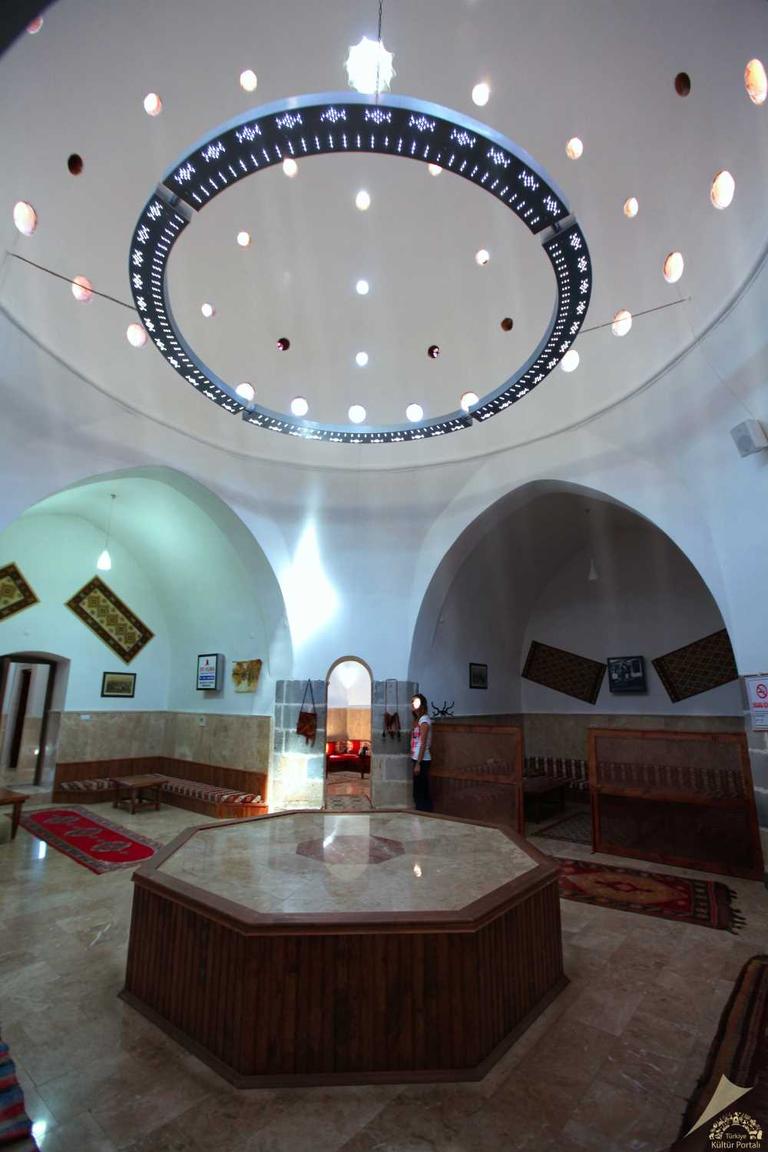
The structure was restored and reactivated in 2010 through restoration works carried out by the provincial governorship and has since been operating as a restaurant. During the restoration, interventions such as covering the interior spaces with cement plaster and cladding walls and floors with materials such as granite or marble that do not match the original texture have been criticized from an architectural standpoint.

Architectural Features

  • Plan and Typology: The building, oriented north-south, has a rectangular mass measuring 15.70 x 38.20 metres and belongs to the typological category of a single hamam.【2】
  • Spatial Arrangement: Following classical Ottoman bath architecture, the changing room (soğukluk), transitional room (ılıklık), hot room (sıcaklık), water reservoir, and furnace (külhan) are aligned along the same axis.
  • Changing Room (Soğukluk): This space, forming the entrance and measuring 12.50 x 13.70 metres, has a nearly square plan and is covered by a flat wooden ceiling.【3】
  • Transitional Room (Ilıklık): The transverse rectangular passage measuring 3.50 x 13.70 metres is covered by three domes accessed through trompes. Star-shaped light openings provide illumination in the domes.【4】
  • Hot Room (Sıcaklık): The main bathing area, measuring 12.70 x 13.70 metres, follows the four-ayvan and four-corner-cell (Type A) plan common in Turkish bath tradition. The central area and halvet cells are covered by domes, while the ayvans are covered by barrel vaults. An octagonal central stone (göbek taşı) is located at the center of the space.【5】
  • Water Reservoir and Furnace: A barrel-vaulted water reservoir is located at the southern end of the building. The furnace, which served as the heating center, is now buried beneath the ground.

Construction Technique and Materials

The main walls of the hamam are constructed using rubble stone, while regular ashlar masonry is employed at the building’s corners and arches. The almaşık wall technique, in which three rows of brick are laid between rubble stones, is recorded as an original feature reminiscent of 14th and 15th century Ottoman architecture. Brick was the preferred material for the roof system and domes.【6】

Citations

  • [1]

    Funda Naldan, "Erzincan’da Osmanlı Dönemi Hamamları," Belleten 83, no. 297 (2019): syf 594, https://belleten.gov.tr/tam-metin-pdf/375/tur

  • [2]

    A.e., syf 594

  • [3]

    A.e., syf 594

  • [4]

    A.e., syf 594

  • [5]

    A.e., syf 594-595

  • [6]

    A.e., syf 600

Author Information

Avatar
Authorİkranur GülaçtıMarch 3, 2026 at 8:53 AM

Tags

Discussions

No Discussion Added Yet

Start discussion for "Taşçı Hamamı" article

View Discussions

Contents

  • History and Conservation Status

  • Architectural Features

  • Construction Technique and Materials

Ask to Küre