

This article was automatically translated from the original Turkish version.
Name(s) | Taşpınar Rugs | ||||||||
|---|---|---|---|---|---|---|---|---|---|
Category | Traditional Handicrafts – Rug Weaving | ||||||||
Geographical Location(s) | Taşpınar Town Türkiye Aksaray | ||||||||
Type(s) | Taban (Kelle) Rug Somya Cover Sack Pillow Cushion Prayer Mat Double Rug | ||||||||
Taşpınar Rugs are a traditional hand-woven rug type produced in the town of Taşpınar, within Aksaray Province in Türkiye’s Central Anatolia Region. Aksaray has been known for carpet weaving since the Seljuk period, and this tradition continued through the Ottoman era. Taşpınar carpet weaving is regarded today as the most renowned and representative branch of Aksaray carpet production. Written sources indicate that the name Taşpınar first appears in the 1869–70 Second Konya Salname. These region-specific textiles have served local needs for centuries while also achieving commercial value in external markets.
Taşpınar carpet weaving is closely linked to Aksaray’s location along historic trade routes and its past status as a center of science, art, and commerce. Thanks to merchants, artisans, and scholars settled in Aksaray by Seljuk Sultan II. Kılıç Arslan, the city became a significant production and export hub. Historical records state that Aksaray carpets were exported during the Seljuk period as far as Damascus, Egypt, Iraq, India, and China.
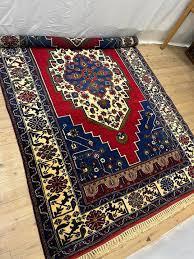
Taşpınar rugs are woven using the traditional Turkish knot technique, with pure wool as the primary material. The wool is obtained from sheep raised in the plains and mountain villages of Aksaray. In the past, yarns were washed, dried, combed, spun, and dyed with natural pigments by the weavers themselves. Today, these processes are carried out only by a limited number of master artisans. The yarns used in weaving are colored with natural dyes such as root dyes, walnut husks, and grape leaves, along with mordants like alum, rock salt, and pickling brine. Common color tones include red, navy blue, gray-blue (pisi tüyü), cream (plum fiber), and yellow-green.
The terms used in weaving are referred to by local names. For example, the warp threads are called “arış,” while the weft threads are known as “argaç” or “ara geçgi.” Rug patterns are typically copied from small sample rugs known as “örneklik.” These sample rugs also serve as catalogs of the region’s traditional motifs and color schemes.
The compositions of Taşpınar rugs are predominantly based on geometric arrangements of plant-based motifs. The designs exhibit clear symmetry and repetition. The most common motifs include:
In local interpretations, the tetir border is likened to an ant or a sheep and is regarded as a symbol of prosperity. According to traditional beliefs, these figures imbue the rug with positive meanings and are thought to bring good fortune to its owner.

Taşpınar Carpet Weaving (Aksaray Governorship)
Taşpınar rugs are named according to their intended use and dimensions:
Each rug type is woven with specific motifs and color schemes suited to its function. Prayer rugs feature motifs of lamps, mihrabs, and minarets, while salon rugs emphasize civil göbek, kelle, and sandık elements.
Due to technological advances, changing consumer habits, and the decline of handcrafted production, Taşpınar carpet weaving is now maintained only on a limited scale. There has been a significant reduction in the number of weavers. However, in centers such as Sultanhanı, rug restoration has become an important activity. Antique rugs are carefully repaired by skilled artisans to restore them to their original condition.
Sample rugs (örneklik) hold cultural significance as carriers of motif and color traditions and thus serve as documentary evidence in the preservation of cultural heritage.
Kılıç Karatay, Semra. “Taşpınar Halılarında Kullanılan Motifler ve Anlamları.” İdil Sanat ve Dil Dergisi 8, no. 53 (2019): 75–80. https://doi.org/10.7816/idil-08-53-08.
T.C. Aksaray Valiliği. “Taşpınar Halısı.” T.C. Aksaray Valiliği Resmî Web Sitesi. Accessed May 23, 2025. http://www.aksaray.gov.tr/taspinar-halisi.
T.C.Aksaray Üniversitesi. "Aksaray Taşpınar Halıları." e-Şehir Aksaray Projesi. Accessed May 23, 2025. http://e-sehir.aksaray.edu.tr/2021/03/29/aksaray-taspinar-halilari/.
Yenigün Gazetesi. “Aksaray Belediye Başkanlarından Taşpınar Halısına Destek: Geleneksel El Sanatı Öne Çıkıyor.” Accessed May 23, 2025. https://yenigungazete.com/ekonomi/aksaray-belediye-baskanlarindan-taspinar-halisina-destek-geleneksel-el-sanati-one-cikiyor/.

Name(s) | Taşpınar Rugs | ||||||||
|---|---|---|---|---|---|---|---|---|---|
Category | Traditional Handicrafts – Rug Weaving | ||||||||
Geographical Location(s) | Taşpınar Town Türkiye Aksaray | ||||||||
Type(s) | Taban (Kelle) Rug Somya Cover Sack Pillow Cushion Prayer Mat Double Rug | ||||||||
Cultural and Historical Background
Technical Characteristics
Motifs and Composition Features
Types of Rugs and Their Uses
Current Status and Preservation Efforts