


This article was automatically translated from the original Turkish version.
TCP Freeze is an enhancement method for transmission control protocols developed to improve connection continuity in wireless networks. TCP Freeze is a flow control technique implemented on the receiver side that allows the source to temporarily halt data transmission. This method prevents unnecessary termination of TCP connections during temporary link disruptions, thereby preserving data transmission performance in mobile environments.
TCP (Transmission Control Protocol) was originally designed for wired networks and therefore interprets most data losses as congestion. However, in mobile environments, the primary causes of data loss are link disconnections and high bit error rates. Traditional TCP implementations misinterpret these temporary link losses as congestion, leading to reduced transmission rates and diminished connection efficiency.
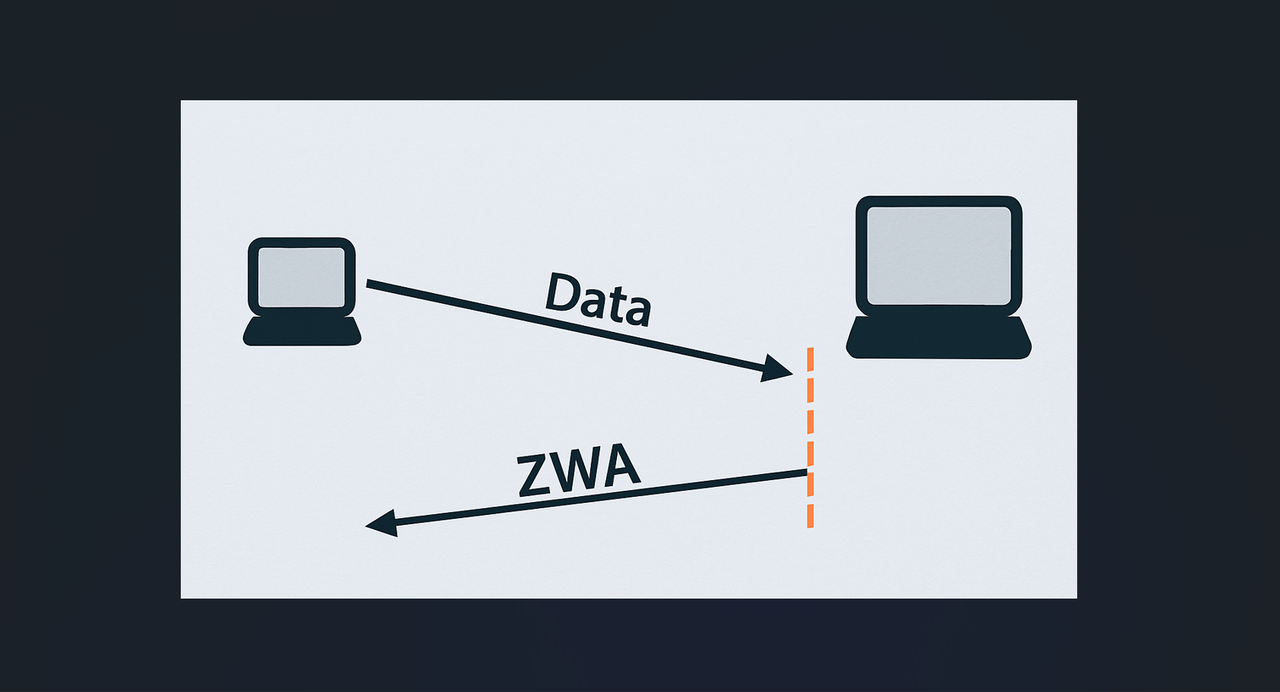
TCP Freeze is a mechanism developed to address this issue. It operates in an end-to-end manner and requires protocol-level modifications only on the receiver side. In this approach, the receiving device anticipates a link disconnection and sends an ACK (acknowledgment) to the source with a zero window size (Zero Window Advertisement – ZWA). This signal causes the transmitting side to stop sending data and suspend its retransmission timers. As a result, the source avoids unnecessary timeout events and window size reductions during link disruptions.
The Freeze-TCP mechanism can be implemented solely by integrating it into the receiver’s TCP stack. No modifications are required on the source side or intermediate nodes, ensuring full compatibility with existing network infrastructure and enabling its use even with encrypted traffic. Encryption technologies such as IPSEC prevent intermediate nodes from inspecting TCP header information, rendering node-based solutions ineffective in such environments. In contrast, Freeze-TCP’s end-to-end architecture overcomes this limitation.

Illustrates the operation of TCP Freeze. A ZWA is sent before the link disconnects, prompting the source to halt data transmission. (Drawn by YZ)
The timing of Zero Window Advertisement (ZWA) transmission directly affects the performance of this method. If the ZWA is sent too early, the source will pause prematurely; if sent too late, the link may disconnect before the signal reaches the source. Therefore, it is recommended that the ZWA be transmitted approximately one Round Trip Time (RTT) before the expected link disconnection.

Illustrates the operation of TCP Freeze. A ZWA is sent before the link disconnects, prompting the source to halt data transmission. (Drawn by YZ)
TCP Freeze distinguishes itself from other techniques such as SNOOP, I-TCP, and M-TCP by not requiring modifications to intermediate nodes, by functioning with encrypted data, and by preserving end-to-end connection logic. Unlike these methods, Freeze-TCP relies on the mobile client proactively responding to link disconnections and offers a more sustainable performance solution.

TCP Issues in Mobile Environments
TCP Freeze Approach
Implementation Principle
Timing and Effectiveness