


This article was automatically translated from the original Turkish version.
TCP-Peach
Developer(s) | Ian F. Akyildiz and colleagues | ||||||||
|---|---|---|---|---|---|---|---|---|---|
First Publication | 2001 | ||||||||
Application Area(s) | Satellite IP networks | ||||||||
Structures Replaced | Fast Recovery TCP Slow Start | ||||||||
Variant | TCP-Peach+ | ||||||||
The poor performance of traditional TCP protocols in satellite networks, due to long latency and high bit error rates, has necessitated the development of new congestion control algorithms. In this context, TCP-Peach is a congestion control protocol proposed to enhance end-to-end connection efficiency in satellite IP networks. TCP-Peach incorporates two novel algorithms—Sudden Start and Rapid Recovery—alongside traditional TCP mechanisms: Congestion Avoidance and Fast Retransmit. The core innovation of its design lies in the use of low-priority TCP segments known as “dummy segments,” which carry no new information.
Satellite communication systems negatively impact the performance of traditional TCP algorithms due to high latency and error rates. In particular, the Slow Start algorithm hinders efficient utilization of network resources at the beginning of a connection. Because Round-Trip Time (RTT) values are high in satellite networks, it takes a long time for TCP to reach its target bit rate at startup. Additionally, since the TCP protocol initially associates all segment losses with congestion, it reduces the transmission rate even when losses are caused by link errors, resulting in unnecessary performance degradation.
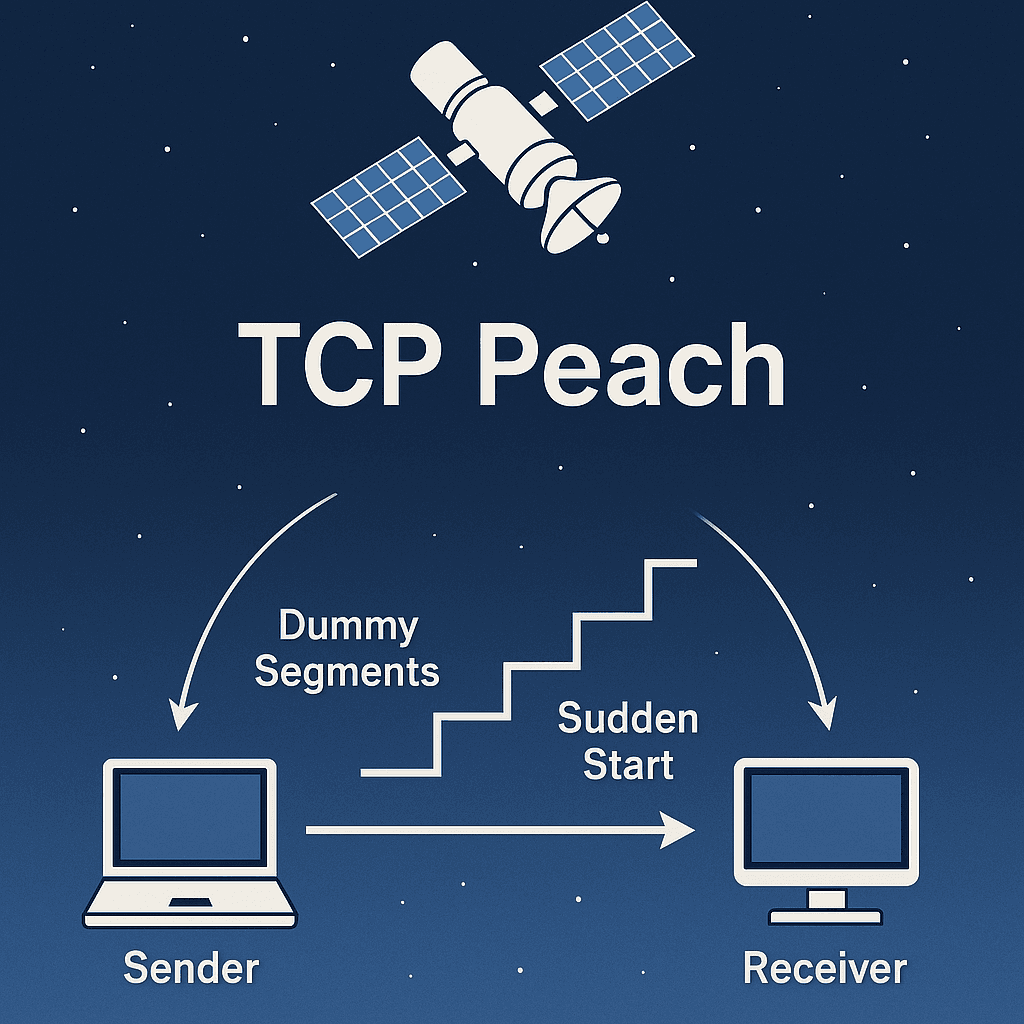
TCP-Peach consists of four core algorithms: Sudden Start, Rapid Recovery, Congestion Avoidance, and Fast Retransmit. The Sudden Start and Rapid Recovery algorithms are unique to TCP-Peach. Their innovation lies in their use of special TCP segments called dummy segments. These dummy segments are transmitted to test available network resources; they carry no actual data and inform the sender whether additional bandwidth is still available in the network.

TCP-Peach architecture. (Drawn by YZ)
Dummy segments are copies of the last transmitted data segment and do not convey new information to the receiver. They are generated by the sender and transmitted using low-priority IP packets. These segments have low priority in the network; thus, when a router experiences congestion, dummy segments are discarded first. This mechanism ensures that the transmission of dummy segments does not interfere with the transmission of actual data segments. If acknowledgments (ACKs) for dummy segments are received, this indicates the presence of available network resources, allowing the sender to increase its transmission rate.
The Sudden Start algorithm is designed to replace the classical Slow Start algorithm in TCP. At the beginning of a new connection, the sender transmits one data segment, followed by dummy segments at regular intervals. This enables a rapid increase in transmission rate over a single RTT, as numerous dummy segments return with acknowledgments from the receiver. The receipt of ACKs for dummy segments allows the sender to increase its transmission rate. If the receiver does not recognize or properly respond to dummy segments, TCP-Peach reverts to behaving like TCP-Reno.
The Rapid Recovery algorithm was developed to replace the traditional TCP Fast Recovery algorithm. When a segment loss is detected, the sender first retransmits the lost segment and then sends dummy segments. The ACKs for these dummy segments arrive during the Congestion Avoidance phase. Initially, ACKs for the first dummy segments are interpreted as evidence that congestion still exists, and the transmission rate is not increased. However, as subsequent dummy segment ACKs are received, the sender gradually increases its transmission rate, rapidly returning to the pre-loss state.

Transmission rate increase with TCP-Peach Sudden Start algorithm. (Drawn by YZ)
The TCP-Peach protocol has been further enhanced with an advanced variant called TCP-Peach+. This variant introduces two new algorithms: Jump Start and Quick Recovery. Jump Start replaces Sudden Start and uses NIL (Non-Intrusive Low-priority) segments instead of dummy segments. Unlike dummy segments, NIL segments may carry new information and can also be used for error correction. The Quick Recovery algorithm provides more stable and faster recovery in scenarios involving multiple segment losses.
TCP-Peach outperforms classical and modern TCP variants such as TCP Tahoe, Reno, New Reno, and Westwood in high-latency, high-error environments like satellite networks. Specifically, through the use of dummy segments, it effectively evaluates network conditions and adjusts transmission rates accordingly during connection startup and error recovery phases.
Ian F. Akyildiz, Giacomo Morabito, Sergio Palazzo. "TCP-Peach: A New Congestion Control Scheme for Satellite IP Networks." IEEE/ACM Transactions on Networking, 2001.
Ian F. Akyildiz, Xin Zhang, Jian Fang. "TCP-Peach+: Enhancement of TCP-Peach for Satellite IP Networks." IEEE Communications Letters, 2002.
İlkin Ulaş Balkanay. "Telsiz Ortamlardan Geçen TCP Bağlantıları İçin Yeni Bir Başarım Artırma Tekniği", Master's thesis, İstanbul Teknik Üniversitesi, 2005.

TCP-Peach
Developer(s) | Ian F. Akyildiz and colleagues | ||||||||
|---|---|---|---|---|---|---|---|---|---|
First Publication | 2001 | ||||||||
Application Area(s) | Satellite IP networks | ||||||||
Structures Replaced | Fast Recovery TCP Slow Start | ||||||||
Variant | TCP-Peach+ | ||||||||
Problems of TCP in Satellite Networks
TCP-Peach Architecture
Dummy Segments
Sudden Start Algorithm
Rapid Recovery Algorithm
TCP-Peach+ Variant
Comparison with Other TCP Variants