


This article was automatically translated from the original Turkish version.
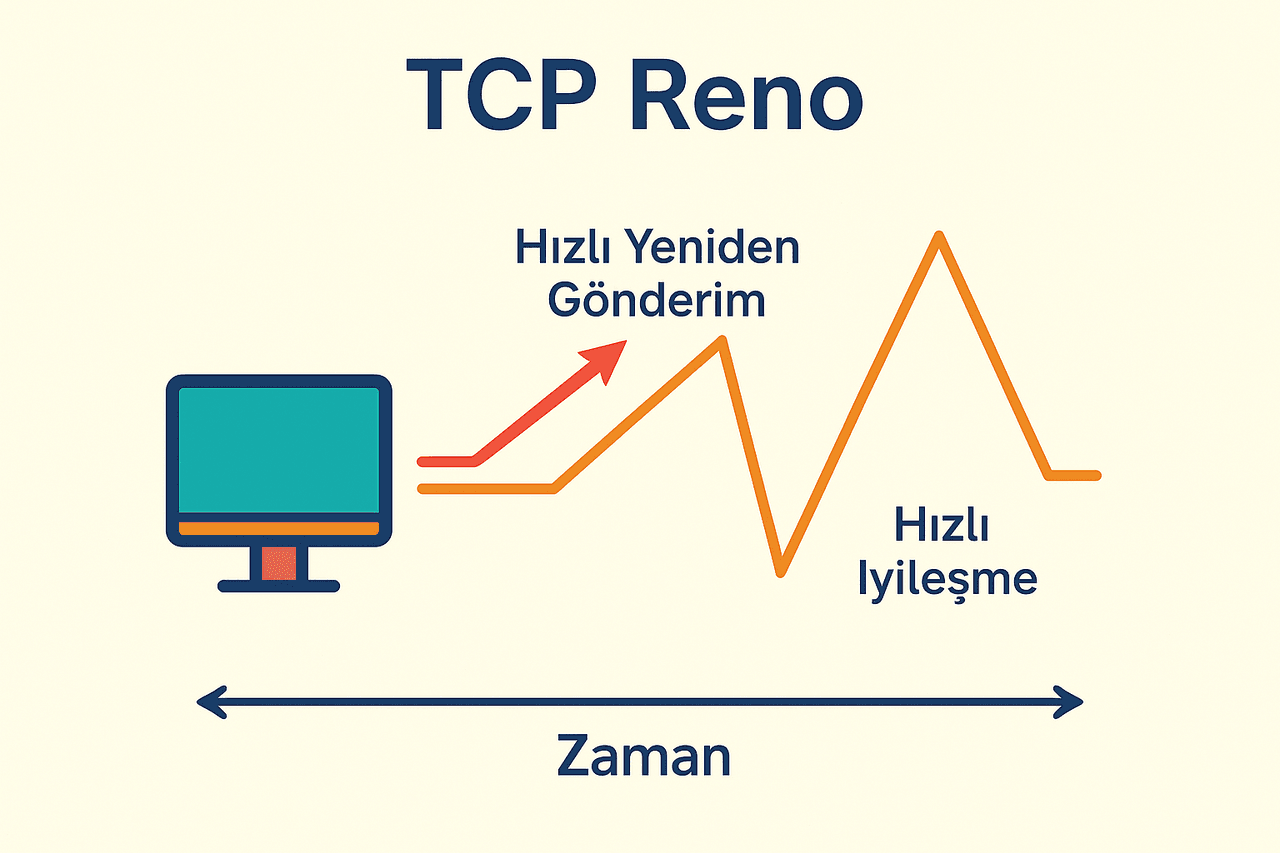
TCP Reno
Developer(s) | Van Jacobson | ||||||||
|---|---|---|---|---|---|---|---|---|---|
Initial Release | early 1990s | ||||||||
Application Area(s) | Data Centers Cabled Networks | ||||||||
Key Features | Fast Recovery Fast Retransmit | ||||||||
TCP Reno is a TCP variant developed for congestion control and holds a significant place in modern computer networks. It emerged as a continuation of TCP Tahoe, which was created in the late 1980s to address congestion collapse in computer networks. TCP Reno employs the "Fast Retransmit" and "Fast Recovery" mechanisms to detect congestion during data transmission more quickly and improve transmission efficiency. This version was widely implemented in traditional wired networks and marked a major advancement in the evolution of TCP’s congestion control mechanisms.
The core operation of TCP Reno is based on interpreting packet loss as an indicator of network congestion. Reno continuously increases the transmission window (congestion window – cwnd); however, when a packet loss is detected, it reduces the window size. Two fundamental principles govern this process: additive increase and multiplicative decrease.
TCP Reno initiates a rapid retransmission process upon receiving three duplicate acknowledgments (DUPACKs) for the same segment. This mechanism allows the lost segment to be retransmitted without waiting for a timeout, significantly reducing the time required to detect and respond to congestion.
Unlike TCP Tahoe, TCP Reno does not revert directly to the Slow Start phase after Fast Retransmit. Instead, it activates the Fast Recovery algorithm, which follows these steps:

TCP Reno’s Congestion Window Behavior. (Drawn by YZ)
Through this approach, TCP Reno reduces transmission speed in a controlled manner without fully dropping it, enabling faster recovery.
Traditional TCP versions, including TCP Reno, encounter various performance issues in wireless networks. TCP Reno misinterprets packet loss occurring due to physical layer errors as congestion, leading to unnecessary interventions. In such cases, it unnecessarily reduces the window size, resulting in inefficient utilization of available bandwidth.
Balkanay, İ. U. (2005). "Telsiz Ortamlardan Geçen TCP Bağlantıları İçin Yeni Bir Başarım Artırma Tekniği." Master's thesis, İstanbul Teknik Üniversitesi
Mo, J., La, R. J., Anantharam, V., and Walrand, J. (1998). "Analysis and Comparison of TCP Reno and Vegas." University of California at Berkeley
Şimşek, M., and Akcayol, M. A. (2008). "Bilgisayar Ağlarında Tıkanıklık Denetimi ve Çözüm Yöntemleri." Bilişim Teknolojileri Dergisi

TCP Reno
Developer(s) | Van Jacobson | ||||||||
|---|---|---|---|---|---|---|---|---|---|
Initial Release | early 1990s | ||||||||
Application Area(s) | Data Centers Cabled Networks | ||||||||
Key Features | Fast Recovery Fast Retransmit | ||||||||
Operation Mechanism of TCP Reno
Fast Retransmit
Fast Recovery
Strengths and Weaknesses of TCP Reno
Strengths
Weaknesses
TCP Reno in Wireless Networks