

This article was automatically translated from the original Turkish version.
+2 More
Construction Date(s) | 1553 | ||||||||
|---|---|---|---|---|---|---|---|---|---|
Patron | Kilis Sanjak Bey Canbolad Bey | ||||||||
Other Name(s) | Canbolad Mosque Canboladoğlu Mosque Canboladiyye Mosque | ||||||||
Architectural Period | Ottoman Period (16th century) | ||||||||
Material(s) | Cut stone tile decoration elements marble | ||||||||
Tekke Camii is a place of worship from the Ottoman period located in the center of Kilis Province, within the boundaries of Tekke Mahallesi in Southeastern Anatolia. Situated near Cumhuriyet Meydanı, the mosque holds a significant place within the city’s historical fabric. The structure was commissioned in 1553 by Canbolad Bey, the Sanjak Bey of Kilis, and is recorded as one of the most notable religious monuments in the region due to its architectural and historical value.
Tekke Camii was constructed in the mid-16th century during the period of Ottoman rule. Its foundation deed states that the building was erected in 1553 by Canbolad Bey, Sanjak Bey of Kilis. The mosque is also referred to in some documents as “Canbolad Camii,” “Canboladiyye Camii,” or “Canboladoğlu Camii.” Its current name, Tekke Camii or Tekye Camii, derives from the nearby tekke structure.

Tekke Camii (Kilis Governorate)
Tekke Camii features a square prayer hall covered by a single large dome. The dome has a diameter of 14.40 meters, making it the largest dome among all mosques in Kilis Province. The final congregational space is supported by five arches and integrates seamlessly with the polygonal drum of the main dome.
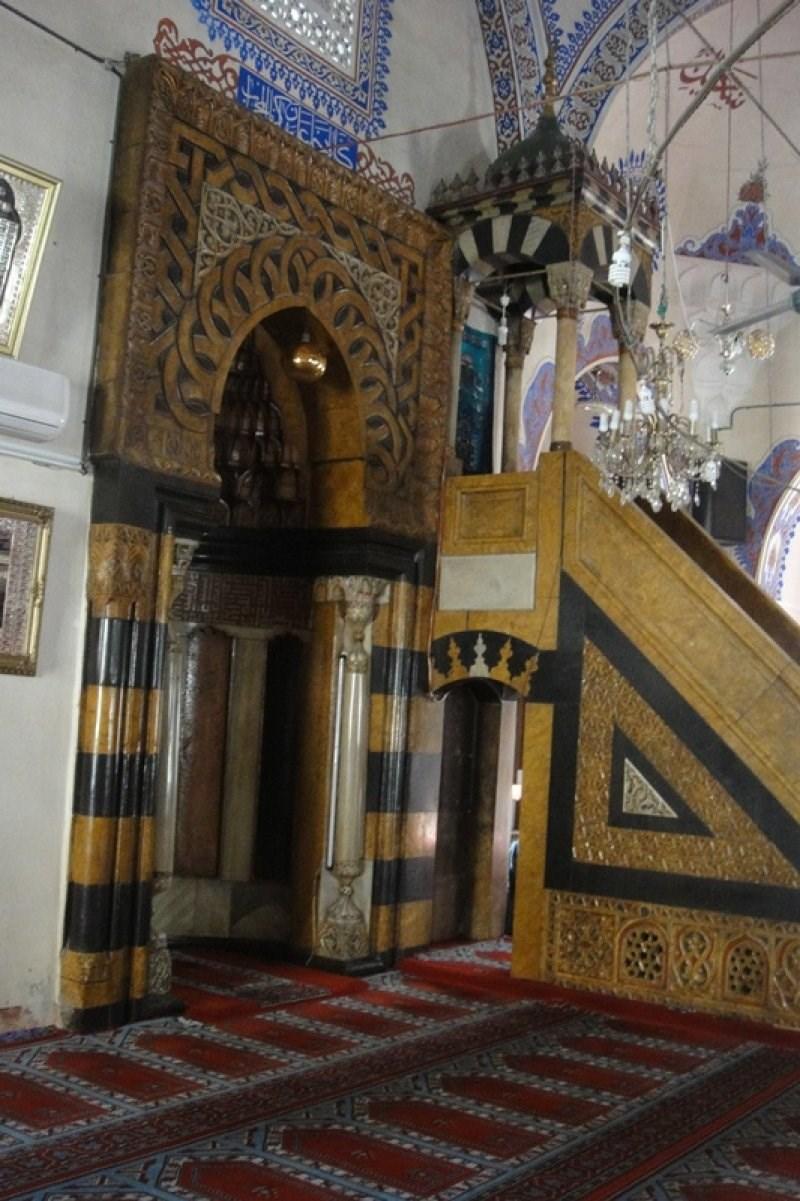
The north façade contains the main entrance, while windows are located on the east and west façades. The window lintels feature ceramic decorations, stone rosettes, and carved details reflecting Ottoman decorative aesthetics. On all three façades, the upper row of windows is fitted with stained glass. The window frames are made of black and yellow marble.
The courtyard floor is paved with white stone. Within the courtyard stands a stone ablution facility and a well with double handles. The minaret is situated in the northwest corner of the mosque and is constructed from alternating black and white cut stone. Its shaft is adorned with three bands, while the balcony is decorated with muqarnas.
Tekke Camii embodies the fundamental elements of classical Ottoman mosque architecture. With its expansive dome system, stonework, ceramic ornamentation, minaret design, and interior spatial organization, it represents a key example of Ottoman architectural tradition in Kilis. As a structure carrying both religious and cultural heritage, it occupies an important position within the region’s historical mosque ensemble.
Tekke Camii is referred to by this name in its foundation deed and forms an integral unit with the adjacent tekke. The building served as a significant center in the religious and cultural life of its time. Due to Canbolad Bey’s reverence for Mevlâna Celâleddîn-i Rûmî, the mosque was positioned in front of a tekke established in his honor.

Tekke Camii (Kilis Municipality)
Tekke Camii has been placed under protection as a regional example of classical Ottoman architecture. The mosque is registered in the inventory of cultural heritage maintained by the Ministry of Culture and Tourism. Restoration and reinforcement works have been carried out in various periods, with careful attention paid to preserving the building’s original architectural characteristics.
Kilis Belediyesi. “29-Tekye Cami.” *Kilis Belediyesi Resmî İnternet Sitesi*, September 11, 2024. Accessed October 22, 2025. https://www.kilis.bel.tr/index.php/2024/09/11/29-tekye-cami/
Ministry of Culture and Tourism of the Republic of Türkiye. "Tekke Camisi (Tekye Camisi) – Kilis." Türkiye Kültür Portalı. Accessed October 22, 2025. https://www.kulturportali.gov.tr/turkiye/kilis/gezilecekyer/tekke-camisi--tekye-camisi
T.C. Kilis Governorship. "Tarihi Camiler." *Kilis Valiliği Resmî İnternet Sitesi*. Accessed October 22, 2025. http://kilis.gov.tr/tarihi-camiler1
T.C. Kilis Valiliği. “Tekke Camii (1553).” Kilis Valiliği Resmî İnternet Sitesi. Accessed October 22, 2025. http://www.kilis.gov.tr/ftekke-camii-1553

Construction Date(s) | 1553 | ||||||||
|---|---|---|---|---|---|---|---|---|---|
Patron | Kilis Sanjak Bey Canbolad Bey | ||||||||
Other Name(s) | Canbolad Mosque Canboladoğlu Mosque Canboladiyye Mosque | ||||||||
Architectural Period | Ottoman Period (16th century) | ||||||||
Material(s) | Cut stone tile decoration elements marble | ||||||||
No Discussion Added Yet
Start discussion for "Tekke Mosque (Kilis) " article
History
Architectural Features
Function and Foundation Deed Information
Conservation Status