


This article was automatically translated from the original Turkish version.
TEKNOFEST Unmanned Underwater Systems Competition
First Regulation Year | 2018 | ||||||||
|---|---|---|---|---|---|---|---|---|---|
Team Rules | Team members between 3 and 15 people + 1 advisor | ||||||||
Vehicle Types | Autonomous (AUV) systems Remotely operated (ROV) | ||||||||
Organization | TEKNOFEST Türkiye Technology Team Foundation | ||||||||
TEKNOFEST Unmanned Underwater Systems Competition is an engineering competition held within the framework of TEKNOFEST, Türkiye’s largest technology festival, aiming to equip young people with expertise in marine technologies. First held in 2018, the competition is being organized for the eighth time as of 2025 and will for the first time take place in an open sea environment this year. The competition challenges participants to develop remotely operated or autonomous underwater vehicles capable of completing specific tasks.

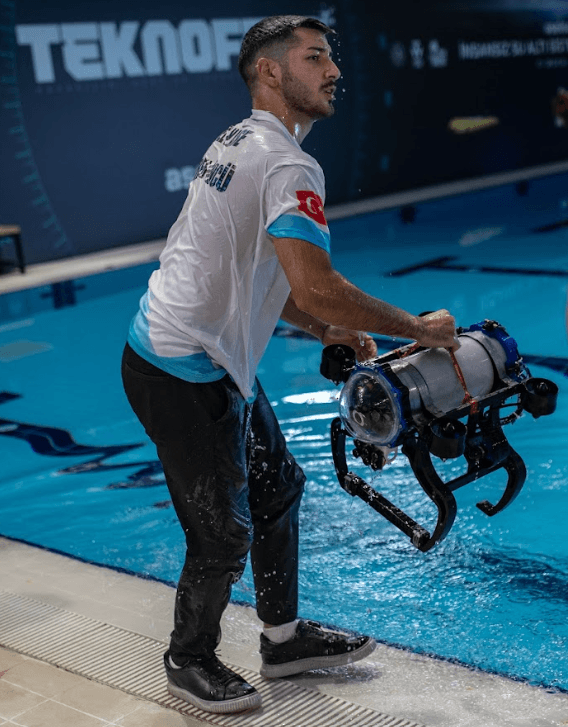
TEKNOFEST Unmanned Underwater Systems Competition (Photo: T3 Foundation)
The primary objective of the competition is to encourage the development of unmanned systems in underwater research, which holds a significant place in both civilian and military domains, and to promote the spread of knowledge and skills in this field among young people. In recent years, interest in unmanned systems has grown substantially due to their ability to conduct underwater operations without risking human life and reduce operational costs. In this context, the competition leads the design of original, innovative and practical unmanned underwater vehicles.
The TEKNOFEST Unmanned Underwater Systems Competition features a task-based format that enables participants to demonstrate their technological competencies. Competitors may participate using remotely operated vehicles (ROVs) or autonomous underwater vehicles (AUVs). The 2025 edition’s transition to an open sea environment represents a significant advancement, allowing participants to develop engineering solutions under real-world conditions.
The competition is open to students at middle school, high school, pre-bachelor’s, bachelor’s and postgraduate levels. Teams may consist of between three and fifteen members and may be supported by only one advisor.

TEKNOFEST Unmanned Underwater Systems Competition (Photo: T3 Foundation)
Participants go through a multi-stage evaluation process in which their projects are assessed at different phases:
Templates for all reports to be submitted by participants are published on the official TEKNOFEST website in accordance with the competition schedule.
This competition provides participants with hands-on experience in multidisciplinary fields such as robotics, sensor systems, artificial intelligence, mechanical design, underwater communication and autonomous software development. Teams gain the opportunity to learn real-world engineering practices by solving engineering challenges encountered during their projects. The competition also contributes to nurturing skilled individuals capable of advancing Türkiye’s indigenous and national technologies in line with the National Technology Initiative vision.

TEKNOFEST Unmanned Underwater Systems Competition (Photo: T3 Foundation)
The TEKNOFEST Unmanned Underwater Systems Competition is a pioneering initiative that motivates young engineering candidates to actively participate in the entire process of research, design, production and testing of underwater technologies. This technological journey into the mysterious depths of the ocean embodies not only engineering but also the spirit of exploration. The competition offers a strategic platform for Türkiye to become a key player in future underwater technologies.
TEKNOFEST. "İnsansız Su Altı Sistemleri Yarışması." TEKNOFEST Resmi Web Sitesi. Accessed April 9, 2025.https://www.teknofest.org/tr/yarismalar/insansiz-su-alti-sistemleri-yarismasi/

TEKNOFEST Unmanned Underwater Systems Competition
First Regulation Year | 2018 | ||||||||
|---|---|---|---|---|---|---|---|---|---|
Team Rules | Team members between 3 and 15 people + 1 advisor | ||||||||
Vehicle Types | Autonomous (AUV) systems Remotely operated (ROV) | ||||||||
Organization | TEKNOFEST Türkiye Technology Team Foundation | ||||||||
No Discussion Added Yet
Start discussion for "TEKNOFEST Unmanned Underwater Systems Competition" article
Objective and Vision
Competition Format
Evaluation Process
Technological and Educational Contributions
Significance of the Competition