
This article was automatically translated from the original Turkish version.
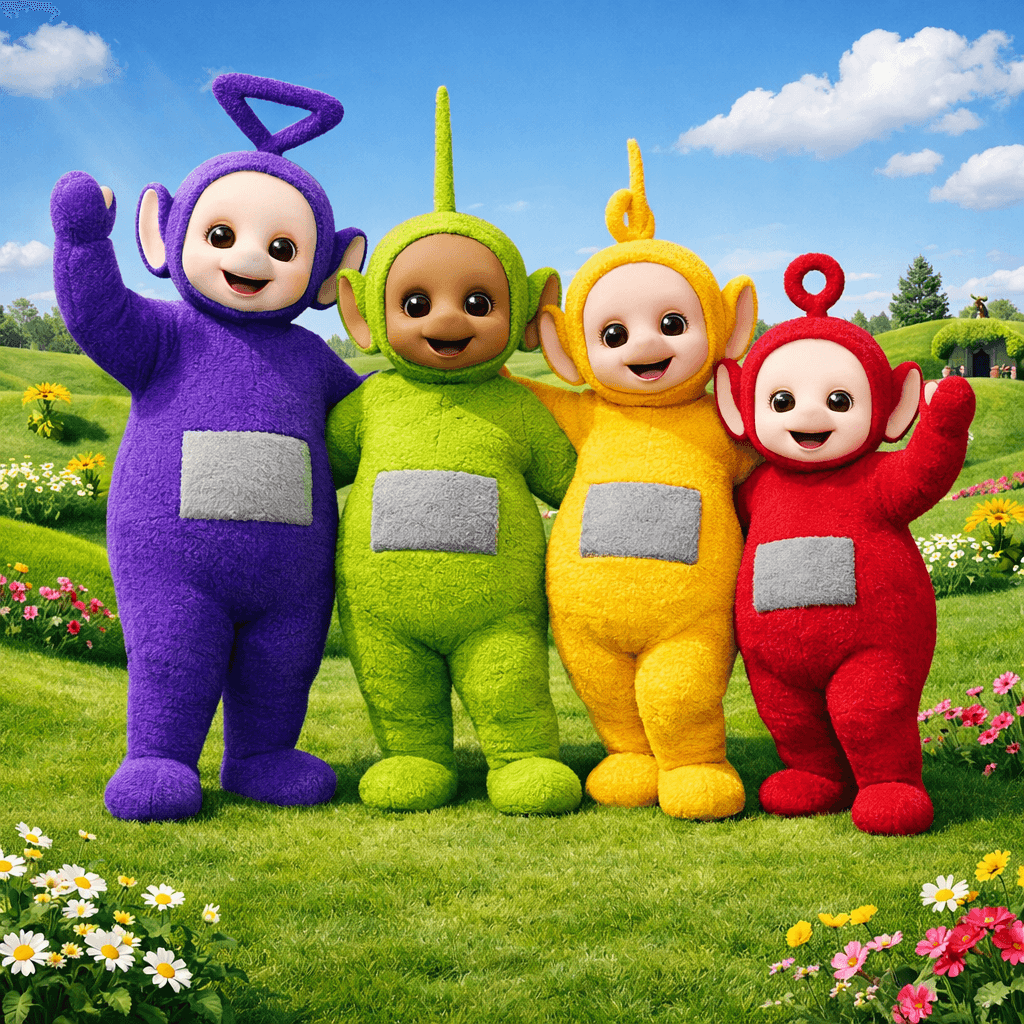
(Görsel, Yapay Zekâ İle Oluşturulmuştur.)
Teletubbies (Original title: Teletubbies), a It is a British television series. specifically designed to support the mental, physical and social development of preschool-aged children and reaching a vast global audience. The production focuses on the daily lives, play and interactions of four humanoid characters known as Teletabi Country, each distinguished by a unique color, antenna shape and personality trait.
The program’s core structure is built on a simple, repetitive and visually rich language tailored to how infants and young children perceive the world. Short video clips reflecting children’s real-life experiences are presented through television screens located on the characters’ abdomens.
Teletubbies – Intro (Teletubbies - WildBrain)
Karakter Analysis and Physical Features
In the world of Teletubbies, each character symbolizes different emotional states and interests of young children. Their physical forms are generally designed with infantile proportions and soft contours, enabling children to form empathy with them.

Teletubbies – Tinky Winky (Generated by Artificial Intelligence)
The largest and tallest member of the group, Tinky Winky wears a bright purple costume and has an antenna shaped like an inverted triangle on his head. Described as a gentle and thoughtful leader, his most cherished possession is a red handbag he never leaves behind.

Teletubbies – Dipsy (Generated by Artificial Intelligence)
Dipsy, who wears a green costume, derives his name from the straight rod-like antenna on his head resembling a “dipstick.” Known as the most stubborn member of the group, Dipsy sometimes refuses to join group activities. His favorite accessory is a long hat with a Dalmatian pattern featuring black and white spots.

Teletubbies – Laa-Laa (Generated by Artificial Intelligence)
Recognizable by her yellow costume and curly, trumpet-shaped antenna, Laa-Laa is one of the most energetic and cheerful characters. Laa-Laa loves singing, dancing and playing with an orange ball about her own height. She displays a protective and nurturing attitude toward the other Teletubbies.

Teletubbies – Po (Generated by Artificial Intelligence)
Po, the smallest and youngest member of the group, wears a red costume and has a ring-shaped antenna on his head resembling a bubble-blowing wand. Quiet, shy and sometimes mischievous, Po loves riding a scooter and occasionally uses Cantonese words to represent cultural diversity.
Since the roles of the Teletubbies require not only voice acting but also in-costume physical performance, the artists portraying them have demonstrated both physical and vocal talents.
The character of Tinky Winky, the largest member of the group, was originally portrayed by Dave Thompson at the start of the series, later taken over by Simon Shelton. John Simmit brought the green character Dipsy to life, while the lively and energetic Laa-Laa was portrayed by Nikky Smedley. The smallest member, Po, was voiced and performed by Pui Fan Lee. The Sun Baby character was portrayed by Jessica Elizabeth Smith.
Simple greetings such as “Eh-oh!” and repetitive speech patterns used by the characters were specially delivered by these performers with a distinct rhythm to serve developing children's vocabulary.
Various auxiliary figures accompany the main characters in their daily routines in Teletabi Country, adding dynamism to the world. These figures are designed to teach children concepts of routine, responsibility and play.

Teletubbies – Noo-Noo (Teletubbies Fandom)
Noo-Noo, the Teletubbies’ house companion and helper, is a blue vacuum cleaner robot. Unable to speak, Noo-Noo communicates through suction sounds and playfully cleans up crumbs and sometimes the Teletubbies’ belongings, symbolically teaching children the habits of cleanliness and order. Often chasing the mischievous Teletubbies, Noo-Noo is one of the most beloved technological figures in the series.

Teletubbies – Baby Sun(Teletubbies Fandom)
The smiling baby face at the center of a golden sun, visible at the beginning and end of every episode, is one of the most iconic symbols of Teletubby Land. Baby Sun helps children develop a sense of time by signaling the start and end of the day, while its cheerful giggles reinforce the production’s positive atmosphere.【2】
Jessica Elizabeth Smith (stage name: Jess), born on 13 November 1995 in England, is a British child actress known for portraying the character “Baby Sun” in the Teletubbies series. Smith was only nine months old during filming. For this role, she was paid 250 pounds and given a box of toys to take home. As an infant, she appeared in the series’ filming, and her face was used in the program’s narrative structure to symbolize the beginning and end of the day. This role fulfilled a symbolic function within the show’s visual language, which operates independently of verbal narration.
Smith no longer continues in the entertainment industry and has since pursued a different career. In recent years, she gave birth to a daughter. Her daughter’s name is Poppy Rae Latham'.
Periscope-like audio pipes that suddenly rise from various locations in Teletubby Land issue instructions to the characters, guiding them to play or participate in activities. These pipes represent authority within the series while also emphasizing the characters’ interaction with the external world and their listening skills.
Teletubbies constructs its pedagogical approach for early childhood on a visual-auditory framework aligned with developmental psychology and preschool education principles. The production employs simple narration, repetitive scenes and slow pacing, specifically tailored to the cognitive, motor and social development characteristics of children aged 0 to 4. This structure supports children’s engagement in the learning process without overburdening their attention spans, while providing a predictable viewing experience that reinforces a sense of security.【4】
Physical movement plays a central role in the program’s pedagogical content. Through dance, rhythm and simple bodily motions, children’s gross motor skills are encouraged, alongside the development of bodily awareness and coordination. Repeated movements and songs reinforce learning and enable children to actively participate in imitation-based learning processes. In this way, Teletubbies offers a participatory model of learning rather than passive viewing.【5】
The educational elements extend beyond physical development to encompass social and emotional learning. Fundamental social skills such as sharing, greeting and empathy are conveyed indirectly through character interactions and daily routines. Noo-Noo’s cleaning actions and the structured daily rhythm established by the audio pipes subtly introduce children to concepts of responsibility and routine. The consistent structure of Teletubby Land contributes to the formation of an early sense of a safe learning environment.【6】
Bulut, Büşra. “Küçük Kalplerin Büyük Tutkusu: Teletabiler.” Wannart. Accessed January 26, 2026. https://wannart.com/icerik/8710-kucuk-kalplerin-buyuk-tutkusu-teletabiler
Hürriyet. "Teletabiler İsimleri ve Renkleri Nelerdir? Teletabilerin Sarı, Mor, Yeşil ve Kırmızı Olanı Hangisi ve Özellikleri Nedir." Accessed January 26, 2026. https://www.hurriyet.com.tr/aile/teletabiler-isimleri-ve-renkleri-nelerdir-teletabilerin-sari-mor-yesil-ve-kirmizi-olani-hangisi-ve-ozellikleri-nedir-41927762
IMDb. "Jessica Smith – Biography." IMDb. Accessed January 26, 2026. https://www.imdb.com/name/nm0808709/bio/?ref_=nm_ov_bio_sm
IMDb. "Teletubbies - Awards." IMDb. Accessed January 26, 2026. https://www.imdb.com/title/tt0142055/awards/?ref_=tt_ov_at_op_awd
IMDb. *Teletubbies (TV Series)* - Full Cast & Crew. IMDb. Accessed January 26, 2026. https://www.imdb.com/title/tt0142055/fullcredits/?ref_=tt_ov_at_pop_cst
Teletubbies Wiki. "Noo-Noo." Teletubbies Wiki. Accessed January 26, 2026. https://teletubbies.fandom.com/wiki/Noo-Noo
Teletubbies Wiki. "Sun Baby Intro." Visual file. Teletubbies Wiki. Accessed January 26, 2026. https://teletubbies.fandom.com/wiki/Baby_Sun?file=Sun_Baby_Intro.PNG
Teletubbies. "A Joyful Learning Journey." Teletubbies Official Website. Accessed January 26, 2026. https://www.teletubbies.com/about/joyful-learning-journey
Teletubbies. "Classic Teletubbies: The Origin Story! | Teletubbies 20th Anniversary." YouTube, 4:21. March 30, 2017. Accessed January 26, 2026. https://youtu.be/5ZCgbGgA-_8?si=lH9Z36wdQiqjL7JM
[1]
IMDb. Teletubbies (TV Series) - Full Cast & Crew. Erişim tarihi: 26 Ocak 2026. https://www.imdb.com/title/tt0142055/fullcredits/?ref_=tt_ov_at_pop_cst
[2]
Bulut, Büşra. "Küçük Kalplerin Büyük Tutkusu: Teletabiler." Wannart. Erişim tarihi: 26 Ocak 2026. https://wannart.com/icerik/8710-kucuk-kalplerin-buyuk-tutkusu-teletabiler.
[3]
IMDb. “Jessica Smith - Biography.” IMDb. Erişim tarihi: 26 Ocak 2026. https://www.imdb.com/name/nm0808709/bio/?ref_=nm_ov_bio_sm
[4]
Teletubbies, “A Joyful Learning Journey,” Erişim tarihi: 26 Ocak 2026. https://www.teletubbies.com/about/joyful-learning-journey.
[5]
Bulut, Büşra. "Küçük Kalplerin Büyük Tutkusu: Teletabiler." Wannart. Erişim tarihi: 26 Ocak 2026. https://wannart.com/icerik/8710-kucuk-kalplerin-buyuk-tutkusu-teletabiler.
[6]
Teletubbies Wiki. “Noo-Noo.” Erişim tarihi: 26 Ocak 2026. https://teletubbies.fandom.com/wiki/Noo-Noo
[7]
IMDb, “Teletubbies - Awards,” IMDb. Erişim tarihi: 26 Ocak 2026. https://www.imdb.com/title/tt0142055/awards/?ref_=tt_ov_at_op_awd

(Görsel, Yapay Zekâ İle Oluşturulmuştur.)
No Discussion Added Yet
Start discussion for "Teletablers (Television Series)" article
Tinky Winky
Dipsy
Laa-Laa
Po
Voice Acting History and Performance Artists【1】
Supporting Characters and Their Functions
Noo-Noo
Baby Sun
Jessica Elizabeth Smith (Baby Sun)【3】
Pipes and Speakers
Pedagogical Approach and Educational Elements
Awards and Nominations【7】
Awards
Nominations