


This article was automatically translated from the original Turkish version.
+2 More
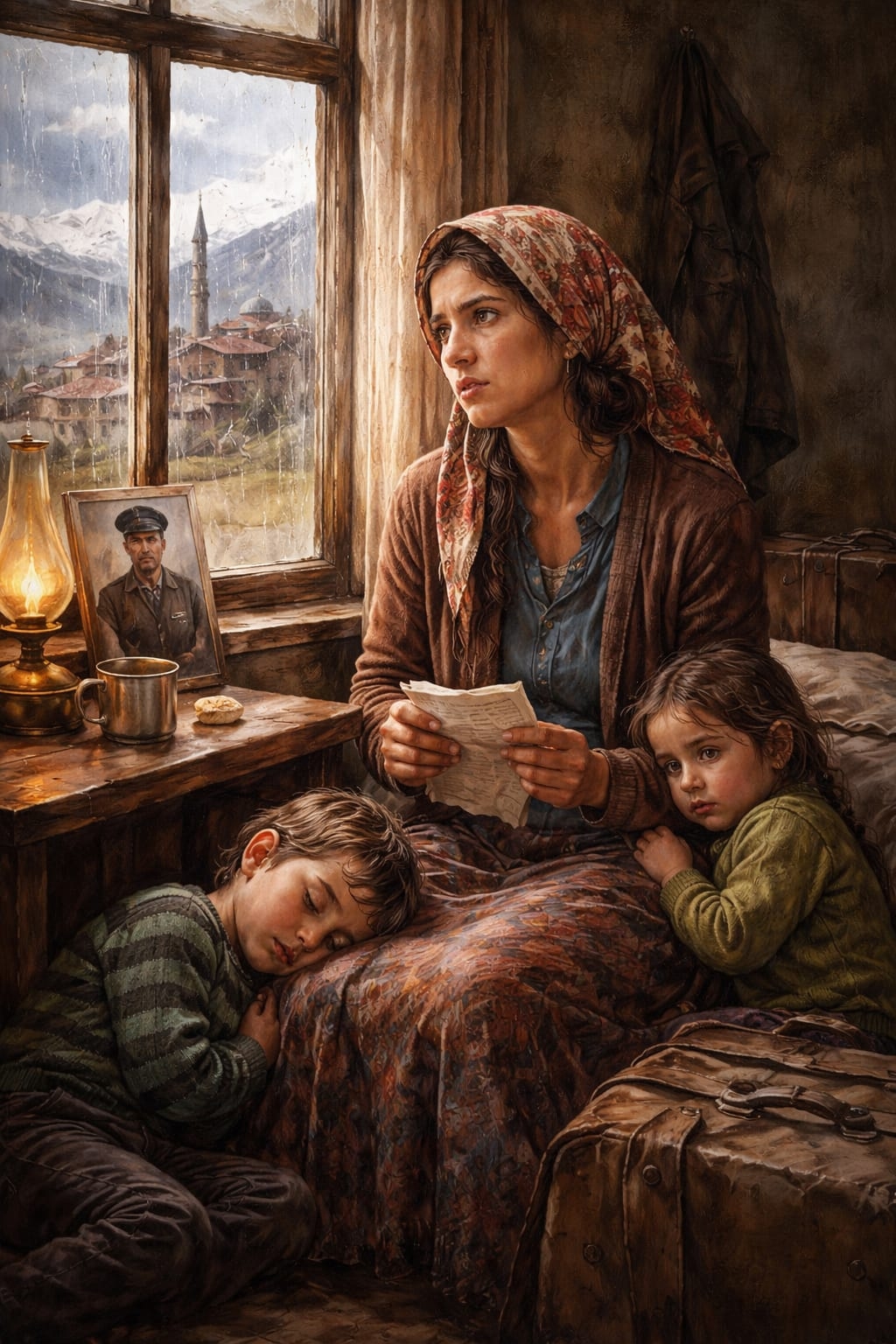
O Gelin Şiirini Temsil Eden Bir Görsel (Yapay Zeka ile Oluşturulmuştur)
Âşık Yaşar Reyhanî’s poem “O Gelin” is a lyrical work that exhibits variation within the oral tradition, incorporates narrative elements, and addresses the fragmentation of family life caused by the experience of exile. The poem reflects the dynamic characteristics of the âşıklık tradition, particularly its dependence on oral performance. It centers on the hardships endured by a woman and her children after the man of the household departs for work abroad, and it acquires a variant character through minor structural changes in different performances. The poem exemplifies how texts in oral culture evolve and are re-created over time.
The central subject of the poem is the material and emotional suffering experienced by a woman left behind when her husband fails to return for a long time after going to work in Germany. Her struggle to survive in poverty with her children, her longing for her absent spouse, and her sense of social isolation form the core of the poem. Although framed as an individual event, the poem represents a widespread social condition tied to the phenomenon of labor migration in its era. In this sense, it carries both a personal drama and a social reality. The woman’s waiting is made concrete through letters, the presence of her children, signs of poverty, and small details of daily life. The language of the poem reinforces her helplessness and emotional intensity through recurring images and verbs.

A Visual Representing the Poem “O Gelin” (Generated by Artificial Intelligence)
“O Gelin” is a typical example of how oral cultural products change according to their performance context. Variations have been observed in audio and video recordings made at different times, including differences in the number of quatrains, the order of certain lines, and word choices. However, the preservation of the first and last quatrains indicates that the poem’s core structure remains stable. This allows the poem to be regarded within the oral tradition as an “equivalent text” or a “variant”. The narrative framework is strengthened by the âşık’s association of the poem with a specific event. The integration of storytelling with poetic performance creates a structure that approaches the nature of a “narrative folk song” or a “song-tale”. The poetic section is primary, while the prose narrative serves an explanatory function.【1】
In different performances and written transmissions of the poem, the following variations occur:
Number and Order of Quatrains: In some versions, the number of quatrains increases or decreases, and their sequence may be altered. Nevertheless, the central theme and narrative direction are preserved.
Word and Expression Differences: Minor lexical changes and synonymous expressions may appear in the same lines. These variations are considered natural outcomes of oral transmission.
Context-Dependent Additions: New quatrains may be added depending on the audience and performance setting. The poem’s “broad-foot” structure is noted as a feature that facilitates such additions.【2】
The poem is included among Âşık Yaşar Reyhanî’s socially themed works. Reyhanî addressed issues such as labor migration, exile, and the breakdown of family unity in his poetry. “O Gelin” is interpreted within this thematic framework. The poet’s extensive performances in various countries and his sensitivity to social problems provided the context for the emergence of such poems.
Her hands in her lap, by the fountain’s side,
She gazes toward Germany, that bride.
Seven children she has, four at her heel,
She rises, looks down the road, that bride.
I asked what sorrow weighs on her soul,
Her tongue stays silent, her back bent and old.
The dirty handkerchief you gave her as a keepsake,
She washes with tears, that bride.
Months pass, she knows not the year,
She speaks words without knowing their meaning here.
A thread has slipped from her needle’s eye,
She unravels where she should sew, that bride.
Her wounds have grown faint, they say,
She writes her letter with tears, they say.
Her little son resembles his father, they say,
She never stops staring at his face, that bride.
Reyhanî says, “Son, come, let me anoint your hands,”
For ten years his hands have never touched the henna bands.
The dish he loved comes to her mind at table,
She spills the soup, she cannot eat, that bride.【3】
[1]
M. Mete Taşlıova, "Sözlü Gelenekte Şiirin Varyantlaşması: “O Gelin” Şiiri," Akdeniz İnsani Bilimler Dergisi 8 (2), (2018): 508, Access Date: 6 March 2026, https://dergipark.org.tr/tr/download/article-file/3676587
[2]
A.e, 508, Access Date: 6 March 2026,
[3]
A.e, 514, Access Date: 6 March 2026,

O Gelin Şiirini Temsil Eden Bir Görsel (Yapay Zeka ile Oluşturulmuştur)
Subject and Theme of the Poem
Place within the Oral Tradition
Characteristics of Variation
Relation to Âşık Yaşar Reyhanî
Text of the Poem