

This article was automatically translated from the original Turkish version.
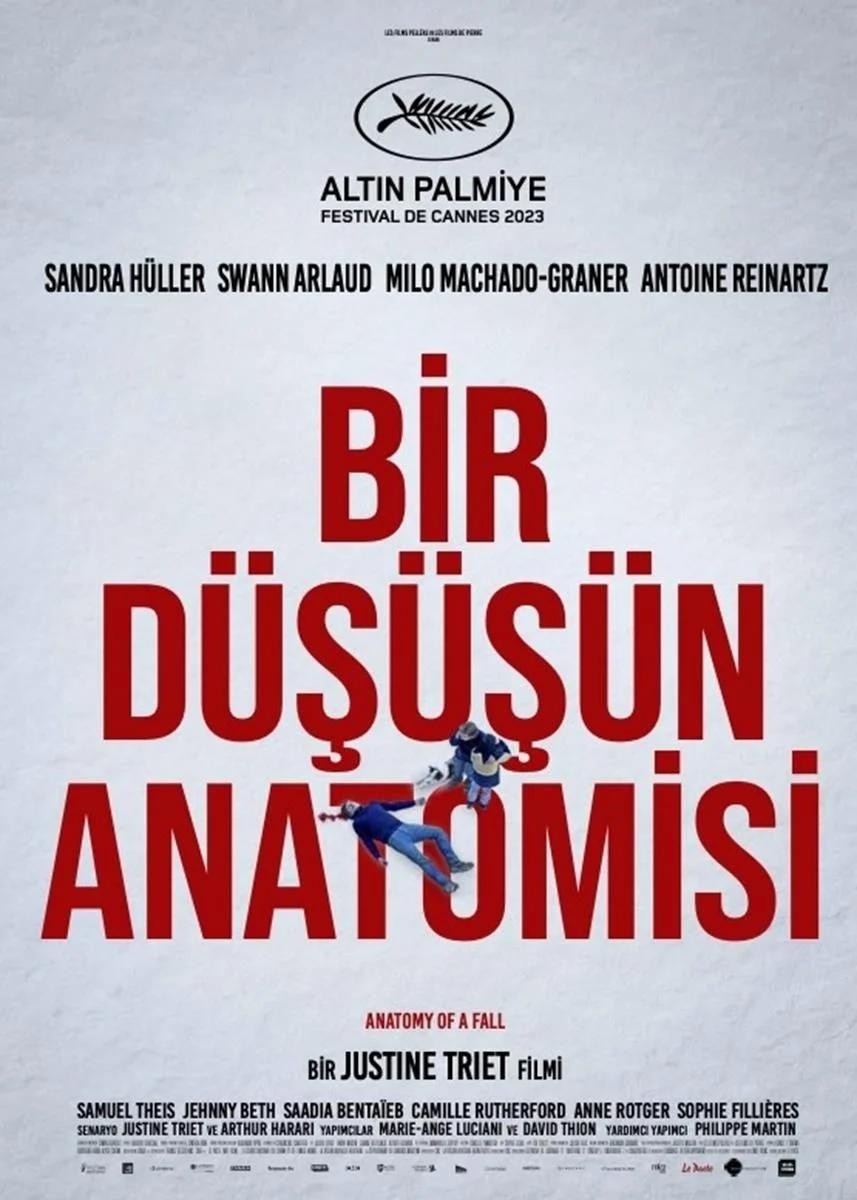
Original Title | Anatomy of a Fall | ||||||||
|---|---|---|---|---|---|---|---|---|---|
Production Year / Country | 2023 / France-based co-production | ||||||||
Genre | Courtroom drama crime/psychological drama | ||||||||
Director(s) | Justine Triet | ||||||||
Screenplay(s) | Justine Triet Arthur Harari | ||||||||
Main Actors | Sandra Hüller, Swann Arlaud, Milo Machado-Graner, Antoine Reinartz | ||||||||
Duration | 2.5 hours | ||||||||
Notable Achievements | Cannes 2023 Golden Palm; Oscar 2024 Best Original Screenplay (+ nominations for Film, Director, Actress, Editing); BAFTA 2024 Best Original Screenplay (+ numerous nominations); Golden Globe 2024 Best Foreign Language Film and Screenplay; European Film Awards 2023 for Film–Director–Screenplay–Actress–Editing | ||||||||
Anatomy of a Fall (Anatomie d’une chute) is a feature-length film designed as a contemporary courtroom drama and character study. At its center lies a narrative in which the circumstances of a death are left ambiguous between the possibilities of accident, suicide, or murder. The story concretizes the investigation and trial processes through a tension line intersecting with familial dynamics. The film aims to establish a controlled transition between the cold order of legal procedure and the fragility of domestic everyday life. This formal precision is supported by the realism of set design and the economy of dialogue. The overarching framework is built on the logic of reconstructing a single event through multiple perspectives, thereby establishing a cinematic language that avoids definitive judgments while opening space for interpretation.
The production synchronously employs the courtroom space, the isolated setting of the home, and the rhythm of the investigation to heighten emotional tension. The lead actor’s performance relies on a measured progression of silences, subtle gestures, and glances. The defense, prosecution, and witness testimonies reveal a different facet of the event in each scene. Occasional flashbacks, audio recordings, and written documents expand the narrative’s evidentiary base. The rhythm varies according to the stages of the investigation; intense debates are followed by deliberate silences and calm observations. The film makes visible the intersection of social perception, media influence, and familial fractures with the legal system. The conclusion offers a systematic reading of how a single incident is interpreted on both private and public levels.
Anatomy of a Fall Film Trailer (Other Cinema)
The story opens with a domestic death occurring in a mountainous, rural region. Following the incident, the investigation places one of the spouses at the center of suspicion, and the process gradually evolves into a case that captures public attention. The narrative unfolds through the courtroom’s reflection of investigative findings and the gradual revelation of details from the domestic past. Flashbacks and audio recordings provide fragmented glimpses into the events preceding the death, multiplying possible motivations. Trial scenes intensify with witness and expert testimony; the interpretive nature of the evidence sustains dramatic tension. Information about the characters’ private lives is translated into the cold logic of legal discourse, transforming personal conflicts into components of the public judgment arena.
The narrative does not seek to arrive at a single “truth” but systematically places different interpretations side by side. The lawyers’ strategies, cross-examinations, and minor contradictions recorded in transcripts generate new possibilities in each scene. Traces found in the home offer varied explanations for the central fall, yet the film focuses not on reaching a definitive verdict but on the interpretive nature of the evidence. This approach invites the viewer to become an active participant in the process of judgment. The timeline progresses systematically according to the stages of investigation and trial. The final section loosens dramatic tensions while avoiding a clear resolution. Overall, the structure rests on a narrative skeleton that opens a discussion on the relationship between discourse and evidence.
The production was realized within a French-based co-production framework. Shooting took place primarily on location, with the lighting and acoustic conditions of the rural landscape playing a decisive role in set design. The camera alternates between handheld and static shots to balance spatial realism with dramatic intensity. The visual palette emphasizes neutral and cold tones, ensuring consistency between the legal nature of the event and its visual atmosphere. Editing creates fluid transitions between trial segments and scenes delving into the domestic past. Sound design carefully preserves ambient textures; the echoes of the courtroom and the silence within the home generate dramatic contrasts. The technical whole operates with a minimalism that underscores the relationship between evidence and interpretation.
Choices regarding format, color, aspect ratio, and filming equipment aim for a controlled naturalism rather than a documentary realism. Music is used sparingly, completing the atmosphere without amplifying dramatic direction. In post-production, rhythm and sound levels are scaled according to the intensity of witness testimony and cross-examination. Set decoration, costumes, and prop selection make visible class and professional backgrounds while avoiding excess. Art direction establishes a functional arrangement to clarify the placement of evidence and sightlines within the space. Collectively, these choices reinforce the narrative’s “ambiguous yet traceable” line. The result is a technical framework that is unadorned yet intensely gripping.
The lead actor carries the character’s shifting position between defense and accusation with a balanced style. The performance advances through measured reactions and silences rather than emotional outbursts. The defense attorney, the prosecutor, and the judge form a dramatic triangle that determines the rhythm of the narrative. Witnesses, neighbors, and experts assume functional roles in brief scenes, each offering a new clue to the case. Small domestic cues, particularly the presence of the child character, introduce an additional emotional layer. Supporting roles accelerate transitions between evidence and interpretation. Thus, the performances maintain a consistent tone between the demands of the courtroom drama and domestic realism.
Characterizations avoid one-dimensional good-versus-evil distinctions and foreground the contested nature of motivation. The protagonist’s professional and personal identity is strategically questioned throughout the trial. The prosecution’s language reframes ethical and psychological interpretations within a legal framework. The defense follows a tactical path that explores how ambiguity is evaluated under the law. The child character’s observational power proves decisive in dramatic openings; in some scenes, silence carries more meaning than spoken words. This approach generates a constantly shifting empathy between the viewer and the characters. Overall, the cast works in harmony with a restrained realism.
Critical readings note that the film constructs a structure that positions the viewer as a “judge” through the tension between evidence and narrative. Particularly in the trial scenes, the language, rhythm, and gaze arrangement enhance the sense of realism. Camera scales, close-ups, and static frames amplify ethical and psychological questions. The cold palette and sparse settings carry the emotional weight of factual disputes. The measured performances allow characters to remain in gray areas. This approach produces a dramatic maturity that avoids emotional manipulation. The film is regarded as a contemporary reference point within the courtroom drama genre.
Further evaluations highlight the fractures in translating domestic relationships into legal language and the limits of testimony. The child character’s perception and role in the narrative contribute to the proliferation of possible truths. The calibration between sound and silence heightens tension in certain scenes while avoiding directional musical cues. The editing continuity renders the collision between witness testimony and visual evidence transparently. The restrained conclusion of the final section leaves not a definitive verdict but an ethical space for reflection. The general consensus affirms the film’s consistency across artistic and technical parameters. This coherence has been supported by numerous awards and nominations throughout the season.
The film gained international recognition by winning the Palme d’Or at its premiere festival, emerging as one of the strongest productions of the season. It won the Academy Award for Best Original Screenplay and received nominations in multiple categories including Best Picture, Best Director, Best Actress, and Best Editing. At the BAFTAs, it won Best Original Screenplay and received nominations for Best Film, Best Director, Best Non-English Language Film, Best Actress, Best Editing, and Best Casting. At the Golden Globes, it won Best Foreign Language Film and Best Screenplay, and was nominated for Best Drama and Best Actress in a Drama. At the European Film Awards, it won Best European Film, Best Director, Best Screenplay, Best Actress, and Best Editing. It won Best International Film at the Independent Spirit Awards. At the Gotham Awards, it won Best International Film and Best Screenplay.
A comprehensive range of awards and nominations was also received from critics’ associations and national/local institutions. It received international film honors from the New York Film Critics Circle and the National Board of Review; it won Best Editing and Best Non-English Language Film from the Los Angeles Film Critics Association. It won Best Actress from the National Society of Film Critics and ranked among the top in the foreign language category. It received the London Critics’ Circle Award for Screenwriter of the Year and the Seattle Film Critics Award for Best Young Performer. It won Best European Film at the Goya Awards, Best International Film at the David di Donatello Awards, Best European Film at the Gaudí Awards, and Best European Film at the Polish Film Awards. It won Best Film and Best Actress from the Vancouver Film Critics Circle; it was nominated for Best Foreign Language Film at the Bodil Awards and received awards and nominations in women-centered categories from the Women Film Critics Circle. The film was officially selected or featured in special sections at numerous festivals including Toronto, San Sebastián, Telluride, New York, Locarno, Karlovy Vary, Busan, Sydney, Melbourne, Jerusalem, Tallinn, São Paulo, Gijón, Hamburg, Belfast, Sevilla, Mill Valley, Haifa, and many others.
Başka Sinema. “Bir Düşüşün Anatomisi / Anatomy Of A Fall | Fragman | 3 Kasım'dan İtibaren #Başkasinema'da!” YouTube. https://www.youtube.com/watch?v=BjrfoafH7P0
Büte, Ekrem Buğra. “Bir Düşüşün Anatomisi.” *Altyazı Dergisi*. Accessed October 8, 2025. https://altyazi.net/yazilar/elestiriler/bir-dususun-anatomisi/
Gerdan, Ünal Sinem. “A Feminist Discourse Analysis of the Film Anatomy of a Fall (2023).” *Medeniyet Sanat Dergisi* 11, no. 1 (2025): 43–57. Accessed October 8, 2025. https://dergipark.org.tr/tr/download/article-file/4702887
IMDb. "Anatomy of a Fall – Awards." Accessed October 8, 2025. https://www.imdb.com/title/tt17009710/awards/?ref_=tt_ov_at_op_awd
IMDb. "Anatomy of a Fall – Full Cast & Crew." Accessed October 8, 2025. https://www.imdb.com/title/tt17009710/fullcredits/?ref_=tt_ov_at_pop_cst
IMDb. "Anatomy of a Fall – Plot Summary." Accessed October 8, 2025. https://www.imdb.com/title/tt17009710/plotsummary/?ref_=tt_ov_at_pl_pl
IMDb. "Anatomy of a Fall." Accessed October 8, 2025. https://www.imdb.com/title/tt17009710/
IMDb. “Anatomy of a Fall – Filming Locations.” Accessed October 8, 2025. https://www.imdb.com/title/tt17009710/locations/?ref_=tt_ov_at_dt_flmg
IMDb. “Anatomy of a Fall – Release Info.” Accessed October 8, 2025. https://www.imdb.com/title/tt17009710/releaseinfo/?ref_=tt_ov_at_dt_rdat
IMDb. “Anatomy of a Fall – Technical Specs.” Accessed October 8, 2025. https://www.imdb.com/title/tt17009710/technical/?ref_=tt_ov_at_dt_spec
MUBI. "Anatomy of a Fall – Awards." Accessed October 8, 2025. https://mubi.com/tr/films/anatomy-of-a-fall/awards
MUBI. “Anatomy of a Fall.” Accessed October 8, 2025. https://mubi.com/tr/tr/films/anatomy-of-a-fall
Türkel, Tamer. “Muğlak Bir Ölümün İzleyiciye Sunumu: Bir Düşüşün Anatomisi Filminin Mizansen Eleştirisi.” *Kastamonu İletişim Araştırmaları Dergisi* 14 (Spring 2025). Kastamonu Üniversitesi İletişim Fakültesi. Accessed October 8, 2025. https://dergipark.org.tr/tr/download/article-file/4206673

Original Title | Anatomy of a Fall | ||||||||
|---|---|---|---|---|---|---|---|---|---|
Production Year / Country | 2023 / France-based co-production | ||||||||
Genre | Courtroom drama crime/psychological drama | ||||||||
Director(s) | Justine Triet | ||||||||
Screenplay(s) | Justine Triet Arthur Harari | ||||||||
Main Actors | Sandra Hüller, Swann Arlaud, Milo Machado-Graner, Antoine Reinartz | ||||||||
Duration | 2.5 hours | ||||||||
Notable Achievements | Cannes 2023 Golden Palm; Oscar 2024 Best Original Screenplay (+ nominations for Film, Director, Actress, Editing); BAFTA 2024 Best Original Screenplay (+ numerous nominations); Golden Globe 2024 Best Foreign Language Film and Screenplay; European Film Awards 2023 for Film–Director–Screenplay–Actress–Editing | ||||||||
No Discussion Added Yet
Start discussion for "The Anatomy of a Fall (Film)" article
Subject and Narrative Structure
Production and Technical Features
Actors and Characters
Critical Evaluation
Awards